

Storytelling in leadership communication is not about dramatic speeches or personal anecdotes. It is a practical structure for simplifying complexity, creating context, and helping audiences understand why information matters.
In our workshops, we frequently see highly capable professionals lose audience attention because their communication is too technical, data-heavy, or difficult to process. Strong expertise has limited impact when ideas lack structure and relevance.
After more than 25 years of delivering communication and presentation training, we have consistently seen storytelling help leaders make complex information clearer, more memorable, and easier to act upon. It transforms information into communication that feels organized, conversational, and audience-focused.
Storytelling is therefore more than a presentation technique. It is an essential leadership communication skill.
Key Takeaways
- Storytelling helps leaders simplify complexity and create clarity.
- Strong stories make information easier to understand and remember.
- Context helps audiences recognize why information matters.
- Audience-focused communication strengthens stakeholder engagement.
- Leadership storytelling should support practical organizational outcomes.
Why Storytelling Improves Leadership Communication
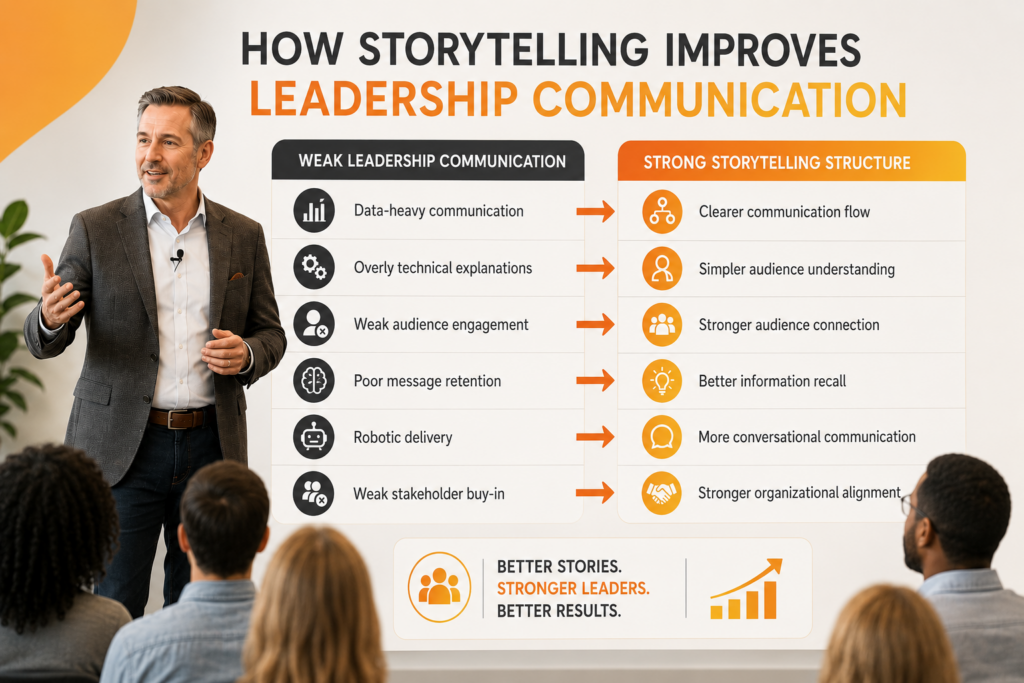
In modern organizations, leaders are expected to communicate constantly. They explain strategic direction, lead meetings, align teams, present recommendations, manage change, communicate priorities, and respond to difficult questions under pressure. One challenge we frequently observe is that many leaders rely too heavily on data, technical detail, or information density while underestimating the importance of communication structure and audience understanding. As a result, presentations and discussions often become difficult to follow, overloaded with information, disconnected from audience priorities, and weaker in long-term message retention.

For additional insights into neuroscience and narrative communication, see this research on neuroscience and storytelling communication from Harvard Business Review, which explores how storytelling and narrative structure help audiences process information, retain ideas, and engage more deeply with communication. One challenge we frequently observe is that leaders often focus heavily on what they want to say while spending far less attention on how audiences are actually processing information.
One pattern we frequently observe is that professionals often assume audiences process information the same way they do internally. This is especially common among subject matter experts and technical leaders. Because they understand information deeply and contextually, they often communicate too broadly or include more information than audiences can realistically absorb in real time. Strong storytelling helps solve this problem by making communication more structured and audience-focused. Instead of simply presenting information, leaders begin organizing communication around context, relevance, organizational impact, and audience understanding, which significantly improves communication effectiveness.
Another important shift involves message retention. Facts and data alone are often difficult for audiences to remember, particularly during fast-moving business discussions where people are processing large amounts of information simultaneously. Storytelling provides a communication structure that helps audiences mentally organize information and retain it more effectively. Rather than receiving disconnected facts, audiences receive a logical narrative that helps them understand how ideas connect and why they matter.
For additional insights into neuroscience and narrative communication, see research from the Harvard Business Review on storytelling and narrative communication, which explores how narrative structures help audiences process information, retain ideas, and engage more deeply with communication.
One challenge we frequently observe is that leaders often focus heavily on what they want to say while spending far less attention on how audiences are actually processing information. Strong storytelling changes that dynamic by encouraging leaders to think from the audience’s perspective. It helps communication become more conversational, more relatable, and significantly easier to follow. This becomes especially valuable during executive briefings, stakeholder discussions, change communication, strategic presentations, leadership meetings, cross-functional collaboration, and virtual or hybrid communication environments where audience attention and alignment are critical.
Storytelling therefore becomes much more than a presentation technique. It becomes a mechanism for improving leadership communication clarity, strengthening audience engagement, and helping organizations communicate complex ideas in ways that are easier to understand, remember, and act upon.
Why Many Leaders Struggle With Storytelling
Many professionals struggle with storytelling because they misunderstand what professional storytelling actually requires. One challenge we frequently observe is that leaders often assume storytelling means adding personal stories or emotional anecdotes to presentations. In reality, effective business storytelling is usually much more practical and communication-focused. At its core, leadership storytelling helps audiences understand why information matters, how ideas connect, what priorities are important, what decisions are required, and what organizational impact exists. Without that structure, communication often becomes overly informational rather than strategically communicative.
This is one reason many presentations feel technically accurate but difficult to follow. Another challenge we frequently observe is robotic or scripted communication. Many professionals become so focused on accuracy, precision, and information management that their communication begins to sound formal, rigid, or disconnected from the audience. While the information may be correct, the delivery often lacks the flow and context needed to keep people engaged.
For additional insights into audience engagement and communication psychology, see research from the Greater Good Science Center on storytelling and audience engagement, which explores how narrative structure helps audiences process information, retain ideas more effectively, and build stronger connections with communication.
Strong storytelling helps professionals communicate more conversationally because it organizes information into a structure that feels natural and easier to process. Instead of overwhelming audiences with disconnected facts or excessive detail, leaders begin guiding audiences through information more intentionally. This creates stronger communication flow, improves audience engagement, and makes key messages easier to understand and remember.
One pattern we frequently observe after workshops is that leaders often become significantly more concise once they improve storytelling structure. Rather than trying to communicate everything they know, they begin focusing on what audiences actually need to understand, what information matters most, what organizational context is required, and what action or decision should follow. This shift dramatically improves communication clarity and often produces some of the biggest improvements among technical professionals and subject matter experts.
Another major challenge involves explaining why information matters. One issue we frequently see is that leaders communicate facts, updates, or recommendations without sufficiently connecting them to organizational meaning, strategic impact, or audience priorities. As a result, communication can feel informative but not influential. Strong storytelling helps bridge that gap by providing context and relevance. It helps leaders explain not only what is happening, but also why it matters, why audiences should care, what implications exist, and what actions or decisions are needed. This significantly strengthens leadership communication effectiveness and makes it easier to build alignment, engagement, and stakeholder support.
For additional insights into audience engagement and communication psychology, see this research on storytelling and audience engagement from Greater Good Science Center, which explores how storytelling, emotion, and narrative structure help audiences process information, retain ideas more effectively, and build stronger emotional connection with communication.
How Storytelling Improves Organizational Communication
As organizations become more communication-driven, storytelling increasingly affects leadership effectiveness, stakeholder alignment, and organizational performance. This is especially true in virtual and hybrid work environments where maintaining audience attention, engagement, and message retention has become significantly more challenging. One challenge we frequently observe is that leaders often overestimate how effectively communication translates through screens and virtual meetings. Without strong communication structure, presentations can become overly informational, mentally exhausting, difficult to follow, and weak in audience retention. Strong storytelling helps create a clearer communication flow that keeps audiences engaged and makes important messages easier to understand and remember.

One of the biggest shifts we frequently observe during workshops is that leaders stop viewing storytelling as a performance skill and begin viewing it as a communication organization skill. That shift changes communication behavior significantly. Instead of focusing primarily on delivering information, professionals begin focusing on audience understanding, communication clarity, message retention, stakeholder alignment, and strategic communication flow. As a result, communication becomes calmer, more intentional, and more audience-focused, which often strengthens executive presence and overall leadership effectiveness.
Another important shift involves conversational delivery. Many leaders initially communicate in ways that feel overloaded with information or excessively formal because they are trying to ensure every detail is covered. As storytelling structure improves, communication often becomes more natural because leaders no longer feel responsible for verbally managing every possible detail at once. Clients frequently report improvements in audience engagement, meeting effectiveness, communication clarity, leadership consistency, stakeholder buy-in, and cross-functional communication. Leaders often become more concise, more relatable, and significantly easier to follow, while technical professionals become more audience-aware and more effective at explaining complex ideas to broader organizational audiences.
For organizations looking to improve leadership communication, communication clarity, audience engagement, and organizational alignment, our Presentation Training for Teams programs focus heavily on practical workplace communication, structured messaging, real-world leadership communication situations, and coach-led feedback designed to improve communication effectiveness across the organization.
Frequently Asked Questions
Why do leaders need storytelling skills?
Storytelling helps leaders communicate information more clearly, improve audience engagement, strengthen message retention, and create stronger organizational alignment.
Is storytelling important in business communication?
Yes. Storytelling helps professionals simplify complexity, create communication structure, and explain why information matters in workplace communication situations.
Why do technical professionals struggle with storytelling?
Many technical professionals communicate information exactly as they understand it internally, which can make communication overly detailed or difficult for broader audiences to follow.
How does storytelling improve leadership communication?
Strong storytelling improves communication clarity, audience understanding, conversational delivery, and stakeholder engagement by organizing information more effectively.
Why is storytelling important in virtual and hybrid communication?
Virtual communication environments often reduce audience attention and retention. Storytelling helps leaders create stronger communication flow and maintain engagement more effectively.
Conclusion
Storytelling is no longer simply a presentation technique. In modern organizations, it has become an important leadership communication capability that helps leaders make complex information easier to understand and act upon. Strong storytelling helps simplify complexity, improve audience understanding, strengthen message retention, and communicate ideas in ways that are more organized, conversational, and strategically effective. Rather than overwhelming audiences with information, storytelling provides structure and context that help people understand why information matters and how it connects to larger organizational goals.
As organizations become increasingly communication-driven, leaders who communicate with clarity, structure, and audience awareness often create stronger alignment, higher engagement, and more effective communication across teams and departments. In many cases, storytelling is the structure that makes that communication possible. It helps leaders move beyond simply sharing information and instead create understanding, build alignment, and guide audiences toward meaningful decisions and action.
For professionals, managers, and leaders looking to elevate storytelling skills, we offer Presentation Skills Training, Public Speaking Workshops for Individuals, and Corporate Team & Group Training programs across Canada and the United States.