

Presentation skills influence stakeholder alignment, communication clarity, executive presence, and execution. As organizations become more matrixed and hybrid, managers, technical leaders, project leads, and emerging leaders must simplify complexity, guide discussions, and communicate confidently under pressure.
Yet many organizations still treat presentation skills as a standalone workshop. Stronger organizations embed communication development into leadership meetings, briefings, stakeholder discussions, and decision-making.
After more than 25 years of coaching, we have seen this approach improve clarity, alignment, meeting efficiency, and leadership presence. When leaders communicate well, decisions happen faster and work moves forward with less friction.
Key Takeaways
- Presentation skills are increasingly viewed as a core leadership capability rather than a standalone communication skill
- Organizations often improve communication consistency, stakeholder alignment, and leadership effectiveness when presentation skills are integrated into leadership development
- The strongest leadership communication programs focus on real workplace application, reinforcement, coaching, and progressive development over time
Why Presentation Skills Have Become a Leadership Development Priority
Leadership communication has changed significantly over the past decade.
In many organizations, leaders now spend a substantial portion of their time communicating in environments that require rapid clarity, audience awareness, strategic thinking, and concise decision-oriented communication. Leaders are expected to explain priorities, simplify complexity, align teams, communicate recommendations, and manage conversations under pressure constantly.
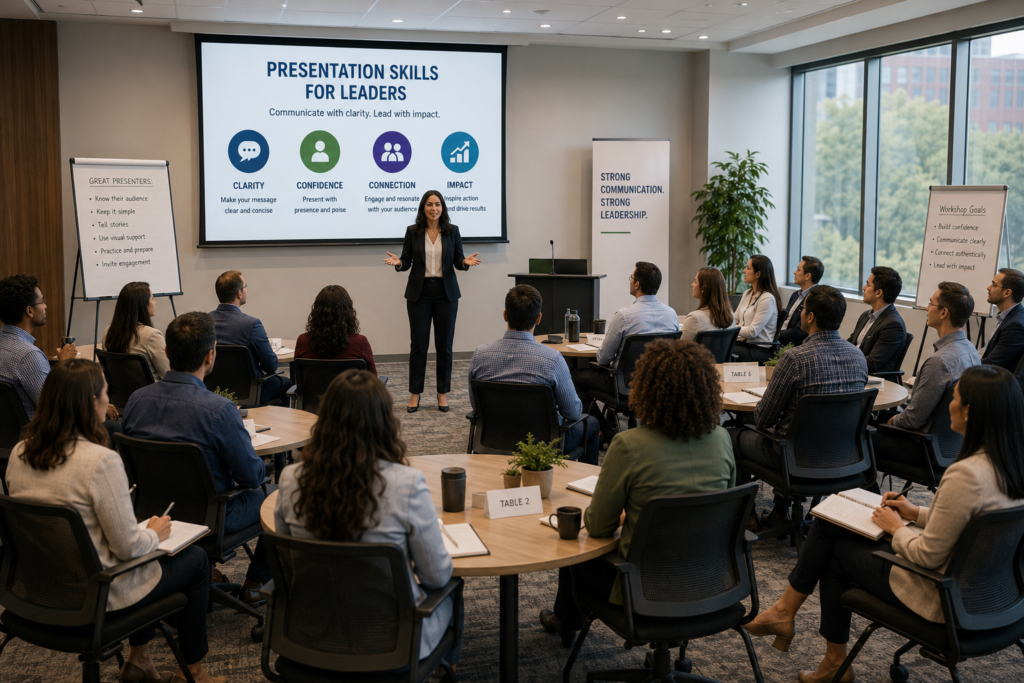
This is particularly true in hybrid and cross-functional environments where communication quality directly affects execution speed and collaboration effectiveness.
One challenge we frequently observe in workshops is that many highly capable professionals struggle not because they lack expertise, but because they communicate with too much complexity. Subject matter experts often feel pressure to explain every detail, provide exhaustive context, or demonstrate expertise through information density.
As a result, communication becomes harder for audiences to process.
Leaders may unintentionally overwhelm audiences with detail, lose stakeholder attention, create confusion around priorities, reduce message retention, and slow down decision-making.
For additional insights into working memory and information processing, see this research on working memory and cognitive processing from Simply Psychology, which explains how working memory limitations affect attention, information organization, comprehension, and communication processing.
This becomes especially important at leadership levels where communication influences organizational alignment. Senior leaders often need communication that is concise, structured, and decision-focused rather than highly detailed or technically exhaustive.
One challenge many L&D teams identify is inconsistency across leadership communication styles. Different leaders may structure updates differently, communicate priorities differently, or present information with varying levels of clarity. Over time, this creates operational friction because teams spend additional time interpreting, clarifying, or revisiting discussions.
Strong presentation skills development helps reduce this significantly. Organizations often begin seeing greater consistency in how leaders structure information, guide meetings, communicate recommendations, and align stakeholders.
Another major factor involves executive presence. Presentation skills are not limited to formal presentations. They influence how leaders communicate during meetings, difficult conversations, executive briefings, stakeholder discussions, and other high-pressure interactions.
Leaders who communicate with greater structure, clarity, calmness, and audience awareness are often perceived as more credible, more strategic, and more effective. This is one reason presentation skills increasingly sit at the intersection of communication, leadership, and organizational performance.
One pattern we frequently observe is that organizations underestimate how much communication inconsistency affects operational efficiency. When leaders communicate differently across departments, stakeholders may receive conflicting priorities, varying levels of detail, or unclear expectations regarding execution.
Over time, this creates unnecessary confusion and slows organizational alignment. The strongest leadership communication cultures create greater consistency in how leaders communicate priorities, recommendations, updates, and decisions across the organization.
For additional insights into leadership perception and communication effectiveness, see this research on executive presence and leadership communication from Harvard Business Review, which explores how communication clarity, composure, audience awareness, and delivery style influence leadership perception and professional credibility.
Why Traditional Presentation Skills Training Often Falls Short
Despite the growing importance of leadership communication, many organizations have had mixed results with traditional presentation skills training programs. In many cases, the issue is not the intent behind the training. It is how the training is designed and reinforced.
One challenge we frequently see is that traditional training programs are often too generic and disconnected from real workplace communication demands. Participants may learn general speaking techniques, but the training does not always reflect how leaders actually communicate inside organizations.

This creates a significant application gap. Leaders rarely operate in formal presentation environments alone. They communicate during executive updates, stakeholder discussions, project briefings, operational reviews, difficult conversations, and impromptu discussions under pressure.
Another major challenge involves lack of practice. Presentation skills are behavioral skills that improve through repetition, feedback, coaching, and application rather than theory alone. Many professionals understand communication concepts intellectually but struggle to apply them consistently in real-world situations.
This is particularly common in technical environments. Professionals often know their material extremely well but struggle to simplify complexity for broader audiences. They may rely too heavily on slides, provide excessive background information, or communicate in ways that prioritize technical completeness over audience understanding.
Strong presentation skills development changes this significantly. Professionals begin focusing more intentionally on audience understanding, message clarity, communication structure, concise delivery, and decision-oriented communication.
Another challenge involves reinforcement. Many organizations still treat presentation skills training as a one-time event rather than an ongoing leadership capability. Without reinforcement, coaching, and continued application, old communication habits often return over time.
The most effective organizations approach development differently. They integrate presentation skills into broader leadership development pathways and reinforce the capability as leaders take on increasingly complex communication responsibilities.
One workshop observation we frequently see is that leaders are often unaware of how their communication style affects others until they receive direct coaching and structured feedback. Rambling updates, excessive technical detail, weak audience engagement, and overly formal delivery styles can become normalized because professionals rarely receive communication-specific coaching once they move into leadership roles.
This is one reason feedback and application are so important. Awareness often becomes the starting point for rapid communication improvement.
For additional insights into audience attention and message retention, see this research on storytelling and audience retention from the University of Chicago, which explores how storytelling, emotion, and attention influence audience engagement, comprehension, and long-term information retention.
How High-Performing Organizations Build Presentation Skills Into Leadership Development
The strongest Learning and Development teams increasingly integrate presentation skills directly into leadership development strategies rather than treating them separately. This creates much stronger long-term outcomes.
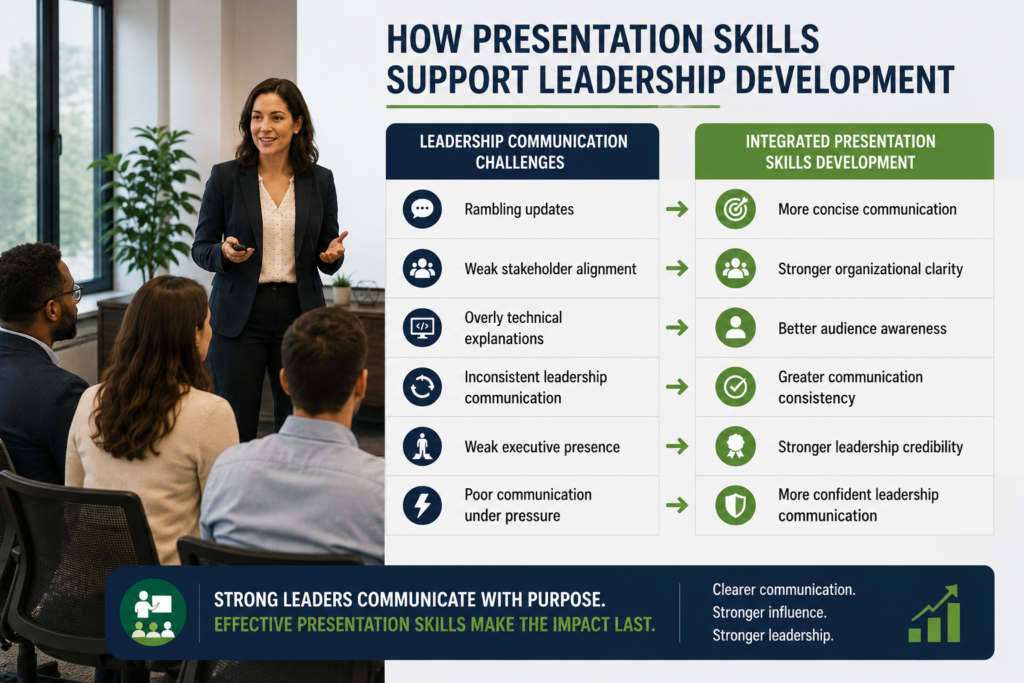
One reason this approach works so effectively is that communication demands evolve as leaders advance.
Emerging leaders often need help organizing ideas clearly, speaking up confidently in meetings, and improving audience awareness. Mid-level leaders often need to improve stakeholder alignment, executive communication, and strategic recommendation delivery.
Senior leaders often focus more heavily on executive presence, communication under pressure, organizational influence, and simplifying complexity at scale. Embedding presentation skills into these stages allows development to match the role.
One pattern we frequently observe in highly effective organizations is that presentation skills development becomes increasingly integrated into real business communication rather than isolated training exercises.
Leaders practice using actual presentations, real stakeholder updates, operational briefings, executive recommendations, and live meeting communication.
This dramatically improves transfer of learning because communication development becomes directly connected to day-to-day leadership responsibilities.
Another major improvement often involves communication consistency across leadership groups. When organizations establish common communication principles and frameworks, leaders begin communicating with greater alignment across departments and teams. Meetings become easier to follow, stakeholder discussions become clearer, and leadership messaging becomes more consistent organizationally.
Clients frequently report that after integrating presentation skills into leadership development, meetings become shorter and more focused, executive updates become more concise, technical leaders become more audience-aware, and communication under pressure improves significantly. Organizations also often experience faster stakeholder alignment and greater consistency in how leaders communicate across teams.
Another important factor involves feedback. One challenge we frequently observe is that many leaders rarely receive meaningful coaching on communication effectiveness once they move into management or senior leadership roles. Yet communication quality continues to influence leadership performance at every stage of organizational growth.
Structured feedback changes this significantly. Leaders become more aware of habits such as overexplaining, rambling updates, unclear messaging, weak audience awareness, excessive technical detail, and inconsistent meeting leadership. This awareness often creates rapid improvement because leaders begin recognizing communication patterns they previously did not notice themselves.
Another important shift we frequently observe after training involves confidence. Many leaders become more concise and more audience-focused because they feel less pressure to prove expertise through volume of information. Instead, they focus more intentionally on whether the audience understands, retains, and can act on the message effectively.
This improves both leadership presence and communication efficiency. As leaders become clearer and more audience-aware, their communication often becomes more influential, more consistent, and easier for stakeholders to follow.
For organizations looking to strengthen communication quality, leadership consistency, executive presence, and stakeholder alignment, our Presentation Training for Teams programs focus heavily on practical workplace communication, audience-focused messaging, leadership communication under pressure, and structured presentation development designed for real organizational environments.
Frequently Asked Questions
Why should presentation skills be part of leadership development?
Presentation skills directly affect leadership communication, stakeholder alignment, meeting effectiveness, executive presence, and organizational clarity.
Why do technical leaders often struggle with presentations?
Many technical professionals communicate with too much complexity or detail, which can make information harder for broader audiences to process and apply.
How do presentation skills improve organizational performance?
Strong presentation skills improve communication clarity, stakeholder alignment, meeting efficiency, audience engagement, and leadership consistency across teams.
Why do traditional presentation skills programs often fail?
Programs often fail because they are too generic, disconnected from real workplace communication, and lack reinforcement or practical application.
Can leadership communication skills improve through training?
Yes. Communication skills improve significantly through structured practice, coaching, audience-focused communication frameworks, and repeated real-world application.
Conclusion
Presentation skills are no longer separate from leadership development. They have become an important part of how organizations build leadership capability, improve communication consistency, strengthen stakeholder alignment, and support operational effectiveness across teams. As communication demands continue increasing in hybrid, fast-moving, and cross-functional environments, organizations are recognizing that communication quality directly affects organizational performance.
Leaders who communicate clearly, concisely, and strategically often create stronger alignment, more efficient decision-making, better stakeholder engagement, and greater confidence across teams. As a result, many organizations are moving away from treating presentation skills as standalone training and instead embedding communication development directly into their leadership development strategies.
For L&D and HR teams looking to raise the communication bar across their organization, we offer Presentation Skills Training, Executive Communication Coaching, Public Speaking Workshops for Individuals, and Corporate Team & Group Training programs across Canada and the United States.