

Executive presence is often mistaken for natural confidence, authority, or charisma. In reality, it is strongly shaped by communication delivery and how professionals engage with others.
Pacing, vocal variety, pauses, eye contact, movement, and audience connection all influence professional perception. In our workshops, we often see capable professionals weaken strong ideas through rushed delivery, nervous energy, poor eye contact, or an overly scripted style.
After more than 25 years of coaching, we have found that executive presence rarely comes from forceful communication or polished performance. It develops through delivery that feels calm, clear, intentional, and audience-focused. Strong delivery builds trust, improves engagement, and strengthens leadership presence.
Key Takeaways
- Delivery strongly influences how confidence, authority, and leadership presence are perceived
- Pacing, vocal variation, eye contact, and physical presence all affect audience engagement and trust
- Small improvements in delivery often create immediate improvements in executive presence perception
Why Delivery Shapes Executive Presence
Audiences form communication impressions extremely quickly. Before they fully evaluate the content of a message, they are already responding to tone, pacing, posture, eye contact, vocal control, and physical presence. One challenge we frequently see is that professionals focus almost entirely on preparing content while spending far less attention on how that content is delivered. As a result, communication can feel rushed, flat, overly scripted, low-energy, and difficult to follow.
One of the most important realities of communication is that audiences interpret delivery as information. Pacing influences how calm or nervous someone appears. Vocal variation influences whether communication feels engaging or monotonous. Eye contact influences trust and connection, while posture influences perceptions of authority and composure. Even small delivery habits can significantly affect how communication is interpreted.
How Delivery Influences Executive Presence
One challenge we frequently observe is that professionals often speak too quickly under pressure. This usually happens because they are trying to communicate large amounts of information efficiently or because nervousness unconsciously increases their pacing. Unfortunately, rushed delivery often weakens executive presence significantly.

When communication moves too quickly, audiences process less information, key ideas lose impact, and speakers often appear more anxious. Slower pacing often creates the opposite effect. Professionals immediately appear calmer, more controlled, and more authoritative because audiences have more time to process information and observe confidence cues.
One pattern we frequently observe during workshops is that participants are often surprised by how dramatically executive presence improves after relatively small delivery adjustments. The content itself may change very little, but the audience experience changes substantially.
Another major factor involves vocal delivery. Many professionals unintentionally communicate in a monotone or low-variation manner, especially during technical discussions or high-pressure situations. This often reduces engagement because audiences struggle to identify emphasis, transitions, emotional energy, and communication hierarchy. Strong vocal variation helps create a clearer communication flow and significantly improves audience attention and retention.
Why Many Professionals Struggle With Delivery Under Pressure
Most delivery problems are not caused by a lack of intelligence or preparation. More often, they are caused by pressure. One challenge we frequently see is that professionals become less natural when the stakes increase. As pressure rises, communication often becomes more rigid, more formal, more scripted, and less audience-focused.
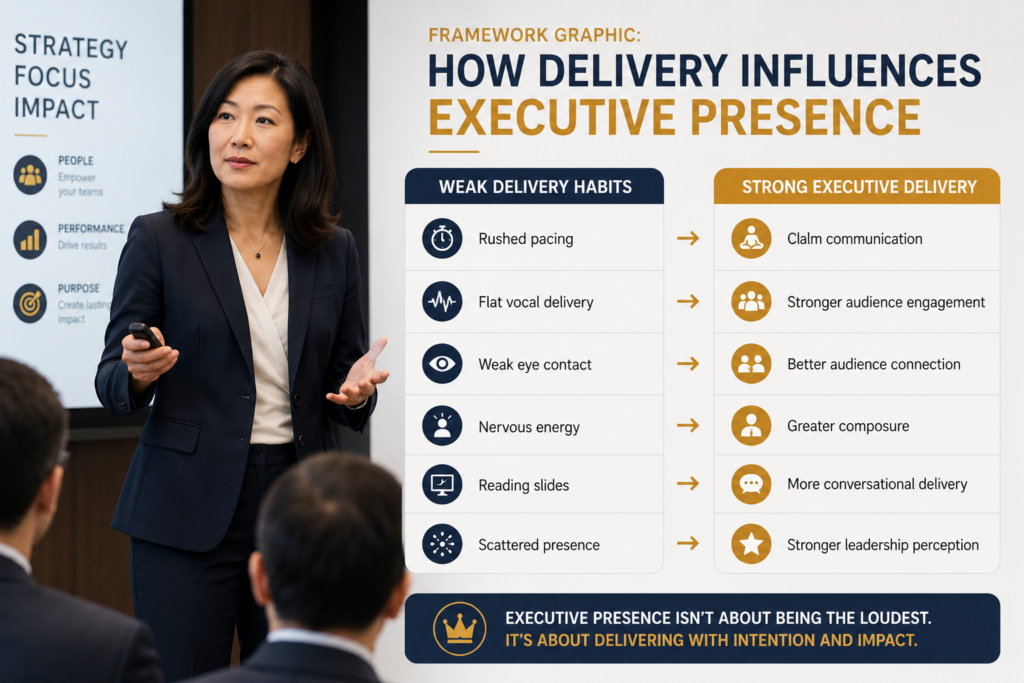
Many professionals also become heavily dependent on slides or notes during presentations. While understandable, this often weakens eye contact, audience connection, pacing control, communication flow, and overall executive presence because attention becomes divided between the audience and the material being referenced.
One challenge we frequently observe is that professionals become more focused on getting through content than on whether audiences are actually following and engaging with the message. Strong delivery helps reverse this by increasing audience awareness and encouraging speakers to pay closer attention to pacing, engagement signals, and communication clarity.
Another common challenge involves filler words and nervous energy. When professionals become mentally overloaded or uncomfortable with silence, they often begin speaking too quickly, overexplaining, or filling pauses unnecessarily. Stronger communication structure and delivery control typically reduce these habits because professionals feel calmer, more intentional, and more comfortable managing audience attention without constantly speaking.
In many cases, filler words are not caused by a lack of expertise. They are caused by discomfort with silence, uncertainty about pacing, or fear of losing momentum. One of the biggest shifts we frequently observe during workshops is that professionals often sound significantly more confident once they slow down, reduce filler words, and become more comfortable with pauses.
Another important factor involves physical presence. Many professionals are unaware of how posture, movement, facial tension, or nervous gestures affect communication perception. One pattern we frequently observe after video review exercises is that professionals become dramatically more self-aware once they see how they actually appear while speaking. This awareness often creates rapid improvement because professionals can finally connect delivery habits to audience perception.
For additional insights into stress, communication processing, and audience perception, see this research on stress and communication processing from the American Psychological Association, which explores how stress affects cognitive processing, focus, communication clarity, and interpersonal interaction.
How Strong Delivery Improves Leadership Communication
Executive presence is not performance. It is communication alignment. Strong executive presence occurs when communication delivery supports and reinforces the message itself. When pacing, tone, posture, eye contact, and communication energy align naturally with the message, audiences experience communication as more trustworthy, more intentional, and more credible.

One challenge we frequently see is that professionals try to sound “executive” by becoming more formal, overly controlled, or excessively polished. In many cases, this weakens audience connection because communication begins to feel less natural, less conversational, and less authentic. Ironically, the effort to sound more executive often produces the opposite result.
As delivery improves, communication often becomes calmer, clearer, more natural, more audience-aware, and more authoritative. Strong delivery also creates stronger audience connection because people feel included in the communication process rather than simply receiving information passively. Eye contact becomes more intentional, pauses feel more natural, and pacing becomes more controlled.
This becomes especially important in hybrid and virtual communication environments where audience attention is more fragile and communication fatigue is significantly higher. One challenge we frequently see is that professionals often overcompensate by increasing information density and reducing natural pacing. Unfortunately, this usually weakens engagement rather than improving it.
One of the biggest shifts we frequently observe during workshops is that professionals begin communicating with greater calmness and intentionality once they stop trying to perform and begin focusing more on audience connection and communication clarity. Clients frequently report noticeable improvements in audience engagement, communication confidence, eye contact, vocal variation, pacing control, and overall leadership presence. As communication becomes more structured and conversational, professionals often appear more composed, more credible, and more confident during presentations, meetings, and leadership discussions.
For additional insights into communication processing and trust formation, see this research on building trust with an audience from Harvard Business Review, which explores how trust, credibility, audience perception, and communication effectiveness influence how messages are received.
gagement, and communication confidence in high-stakes workplace situations, our Public Speaking Training for Individuals programs focus heavily on practical delivery coaching, audience connection, video review, real-time feedback, and communication techniques designed to improve how professionals are perceived during presentations, meetings, and leadership discussions.
Frequently Asked Questions
Why does delivery affect executive presence?
Delivery affects how audiences perceive confidence, authority, composure, and leadership credibility during communication.
What delivery habits weaken executive presence?
Rushed pacing, monotone delivery, poor eye contact, nervous energy, excessive filler words, and heavy slide dependency can all weaken executive presence.
How does vocal variation improve communication?
Vocal variation helps maintain audience attention, emphasize important ideas, improve engagement, and create more dynamic communication.
Why does pacing matter during presentations?
Pacing affects audience processing, retention, and perception. Slower, controlled pacing often makes speakers appear calmer and more authoritative.
Can executive presence be improved?
Yes. Executive presence improves significantly through delivery awareness, structured practice, audience-focused communication, coaching, and feedback.
Conclusion
Executive presence is heavily shaped by delivery. How professionals use pacing, vocal variation, eye contact, posture, pauses, and physical presence directly affects how audiences experience communication. Strong delivery improves communication clarity, audience engagement, leadership perception, trust, and overall effectiveness because it helps ideas feel more intentional, more credible, and easier to follow.
As workplace communication becomes increasingly fast-paced and high-pressure, professionals who communicate with calmness, clarity, and stronger delivery awareness often stand out immediately. In many cases, executive presence is not created by changing the message itself. It is created by changing how that message is delivered.
For professionals looking to elevate their executive presence, we offer a range of specialized trainings include Presentation Skills Training, Communication Skills Training, and Executive Communication Coaching across Canada and the United States.