
Communication affects every level of an organization. Meetings, project updates, leadership briefings, client conversations, and stakeholder discussions all depend on clear, concise, and persuasive communication.
In our workshops, we frequently see communication problems treated as operational or leadership issues when the underlying cause is unclear messaging. Even highly capable teams can experience slower decisions, weak alignment, inconsistent communication, and departmental silos when information is difficult to understand.
After more than 25 years delivering presentation and communication skills training, we have consistently seen stronger communication improve collaboration, alignment, efficiency, and execution.
For additional insights into workplace communication and organizational effectiveness, see this research on workplace communication and organizational effectiveness from Gallup, which explores how communication, alignment, and workplace culture directly influence organizational performance and employee engagement.
Key Takeaways
- Corporate presentation skills training improves communication clarity, leadership effectiveness, and organizational alignment
- Weak communication structure often creates inefficiency, unclear messaging, and reduced audience engagement
- Strong presentation skills improve meetings, stakeholder discussions, leadership communication, and cross-functional collaboration
Why Presentation Skills Affect Organizational Performance

In modern workplaces, communication drives nearly every aspect of organizational performance. Organizations depend on professionals to explain ideas clearly, communicate priorities effectively, align teams around decisions, simplify complexity, and move discussions toward productive outcomes.
One challenge we frequently see is that organizations often invest heavily in technical expertise while investing far less in communication capability. As a result, highly knowledgeable professionals may struggle to simplify information clearly, organize ideas effectively, communicate concisely, maintain audience engagement, or adapt communication to different stakeholder groups.
This becomes particularly noticeable in executive meetings, stakeholder presentations, project updates, cross-functional collaboration, leadership discussions, and client-facing communication situations where communication quality directly affects business outcomes.
Research on leadership communication and organizational influence consistently shows that effective leadership communication is heavily connected to listening, alignment, and audience understanding rather than simply delivering information. This research on active listening and leadership effectiveness from the Center for Creative Leadership explores how active listening helps leaders build trust, improve understanding, strengthen communication, and create stronger team alignment.
One pattern we frequently observe is that organizations often mistake excessive information for effective communication. In reality, communication effectiveness is usually determined by clarity, structure, and audience understanding rather than the volume of information being shared. More information does not automatically create better understanding. In many cases, it simply creates more work for the audience.
When communication lacks structure, meetings become longer, discussions become repetitive, and decision-making slows down because people struggle to identify what matters most, what action is required, and which priorities deserve attention. Over time, these small communication challenges create organizational friction that affects productivity, alignment, and momentum.
Strong presentation skills help reduce that friction by helping professionals communicate in ways that are easier to process, retain, and act upon. When information is structured clearly, audiences spend less time interpreting messages and more time making decisions and moving initiatives forward.
One challenge we frequently observe with technical professionals and subject matter experts is that they often communicate information exactly as they understand it internally rather than adapting it for the audience receiving it. As a result, presentations and discussions can become overly technical, too detailed, difficult to follow, and disconnected from audience priorities.
Strong presentation skills help professionals simplify complexity without sacrificing credibility or accuracy. That balance is particularly important in modern organizations where communication increasingly occurs across departments, disciplines, leadership levels, and hybrid work environments. The goal is not to communicate less information. The goal is to communicate the right information in a way that helps audiences understand it quickly.
Another major challenge involves audience awareness. Professionals often communicate from their own perspective rather than focusing on what audiences actually need to understand in order to make decisions, support recommendations, or move initiatives forward. When communication is centered on the speaker’s knowledge instead of the audience’s needs, clarity and engagement often suffer.
As presentation skills improve, professionals become much more audience-focused in how they structure information, communicate priorities, and guide conversations. This shift creates stronger communication alignment throughout the organization and helps ensure that expertise is translated into action, understanding, and results.
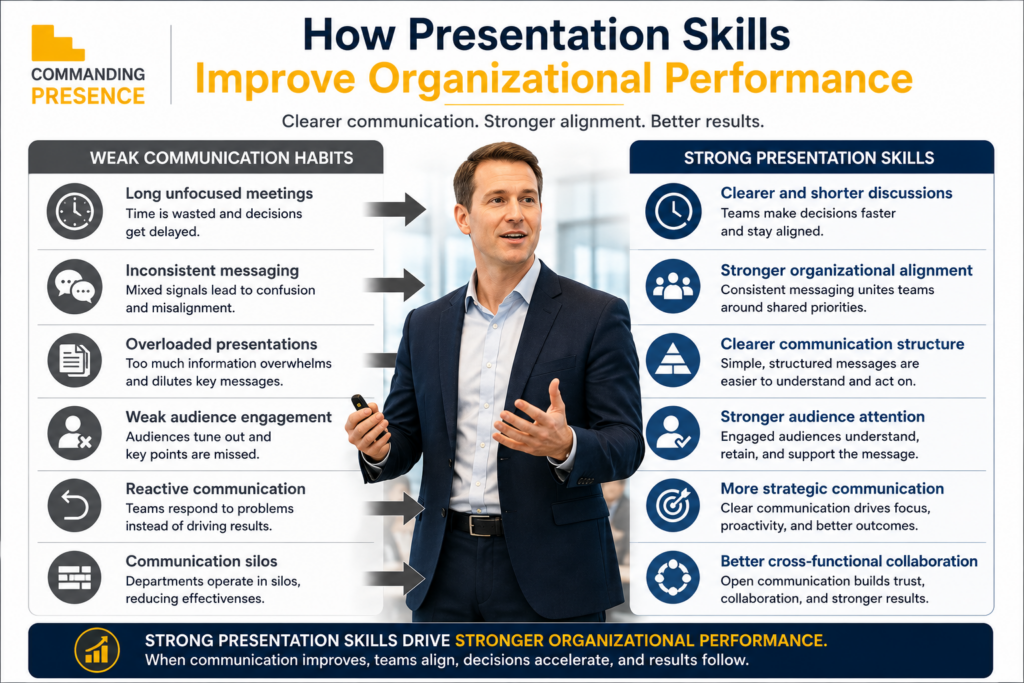
Why Weak Communication Habits Reduce Team Effectiveness
Many organizational communication problems are actually presentation structure problems.
One challenge we frequently see is that professionals often communicate reactively instead of strategically. They may know their material extremely well, but without structure, communication can quickly become overly detailed, repetitive, unfocused, and mentally exhausting for audiences.
This often affects meeting efficiency, stakeholder confidence, leadership communication, organizational consistency, and team alignment.
For additional insights into cognitive overload and information retention, see this research on cognitive overload and information retention from the American Psychological Association, which explores how people process, retain, and recall information more effectively when communication is clear and organized.
Reading slides is another common issue we frequently observe in corporate environments.
Professionals often rely heavily on slides because they feel safer having all information visible in front of them. Unfortunately, this usually weakens audience engagement and reduces conversational communication.

Audiences begin focusing more on reading information independently than listening to the speaker itself.
One challenge we frequently see is that professionals become so focused on communicating everything accurately that they lose focus on whether audiences are actually understanding the message.
That shift weakens communication effectiveness significantly.
Strong presentation skills help professionals focus communication around clarity, audience understanding, message retention, discussion management, and communication efficiency.
One of the biggest organizational shifts we frequently observe after training is improved communication consistency across teams and leadership groups.
As professionals adopt more structured communication habits, meetings often become shorter, more focused, more actionable, and easier to follow organizationally.
Clients frequently report improvements in:
- stakeholder alignment
- leadership consistency
- executive communication
- cross-functional collaboration
- communication confidence
Technical professionals often become significantly more audience-aware, while leaders frequently become more concise and intentional in how they communicate direction and priorities.
This creates noticeable organizational impact because communication becomes easier to understand, retain, and execute against.
Another important shift involves discussion management.
Many professionals struggle not during prepared presentations, but during the conversations surrounding those presentations. Questions, interruptions, stakeholder concerns, and shifting priorities can quickly derail communication when structure is weak.
One challenge we frequently observe is that professionals often lose clarity once discussions become less predictable.
Strong presentation skills help professionals maintain structure and communication control even when conversations become more dynamic and high-pressure.
This becomes especially important during:
- executive discussions
- client presentations
- difficult conversations
- leadership meetings
- strategic planning sessions
Communication structure improves not only formal delivery, but also real-time communication performance under pressure.
How Corporate Presentation Skills Training Improves Leadership Communication
As organizations become more collaborative and communication-driven, presentation skills increasingly affect leadership effectiveness.
Leadership communication now extends far beyond formal presentations.
Leaders are expected to align teams, communicate strategic direction, manage discussions, influence decisions, lead conversations under pressure, and communicate effectively across virtual and hybrid environments.
One challenge we frequently see is that many leaders unintentionally overcomplicate communication because they are trying to communicate too much information simultaneously.
This often reduces clarity instead of improving it.
For additional insights into communication under pressure and decision-making, see this research on communication under pressure and decision-making from Harvard Business Review, which explores how pressure and cognitive overload can affect clarity, communication, and professional decision-making.
Strong presentation skills help leaders simplify communication while maintaining credibility and authority.
One of the biggest shifts we frequently observe during workshops is that leaders stop viewing presentations as isolated speaking events and begin viewing communication as an ongoing leadership responsibility.
That shift changes communication behavior significantly.
Instead of focusing primarily on delivering information, leaders begin focusing more intentionally on:
- audience understanding
- message clarity
- communication structure
- discussion flow
- stakeholder alignment
This creates stronger executive presence because communication becomes calmer, more intentional, and more audience-focused.
Another major improvement often involves conversational delivery.
Many professionals initially communicate in ways that feel overly formal, overly scripted, or overloaded with information. As communication structure improves, delivery often becomes significantly more natural and engaging because professionals no longer feel responsible for mentally managing excessive amounts of information while speaking.
This becomes especially important in virtual and hybrid communication environments where maintaining engagement and clarity is often more difficult.
Strong presentation skills help professionals maintain audience attention, communicate clearly through screens, structure virtual discussions effectively, manage pacing more intentionally, and create stronger engagement remotely.
Organizations that invest in presentation skills training frequently report that communication becomes more consistent across teams and leadership groups over time.
Meetings become more efficient.
Stakeholder discussions become clearer.
Cross-functional collaboration improves.
Leaders communicate direction more consistently.
And organizational alignment becomes easier to maintain.
For organizations looking to improve workplace communication, leadership communication, executive presence, audience engagement, and communication consistency across teams, our Presentation Training for Teams programs focus heavily on practical workplace application, structured communication methods, real-world business scenarios, and coach-led feedback designed to create measurable communication improvement.
Frequently Asked Questions
Why does corporate presentation skills training matter?
Corporate presentation skills training improves communication clarity, meeting effectiveness, leadership communication, stakeholder alignment, and overall organizational performance.
How do presentation skills affect organizational performance?
Strong presentation skills help organizations communicate more efficiently, reduce confusion, improve collaboration, and support faster decision-making.
Why do technical professionals often struggle with presentations?
Many technical professionals possess strong expertise but have never received structured communication development. This can make it difficult to simplify complexity and communicate clearly to broader audiences.
Can presentation skills improve meeting effectiveness?
Yes. Organizations often report shorter meetings, more focused discussions, clearer alignment, and improved communication consistency after training.
Why are presentation skills important in virtual and hybrid workplaces?
Virtual and hybrid communication environments require professionals to communicate more intentionally because maintaining audience attention and engagement remotely is often more difficult.
Conclusion
Corporate presentation skills training is no longer simply about helping professionals deliver better presentations. In today’s workplace, it plays a much broader role in improving how organizations communicate, collaborate, align priorities, and execute effectively. As teams become more cross-functional and decisions involve larger groups of stakeholders, the ability to communicate clearly has become a critical business skill rather than just a presentation skill.
Strong presentation skills improve communication clarity, meeting effectiveness, stakeholder alignment, executive presence, and organizational consistency because they help professionals communicate information in ways that audiences can more easily understand, retain, and act upon. When communication is structured and audience-focused, conversations become more productive, recommendations become clearer, and decisions can be made with greater confidence.
In modern organizations, communication quality increasingly affects organizational performance. Teams that communicate effectively tend to make decisions faster, align more easily around priorities, and experience less friction during execution. Conversely, unclear communication can create confusion, delays, misalignment, and unnecessary rework.
This is one reason presentation skills have become such an important area of professional development. In many cases, presentation skills are the mechanism through which organizational communication is either strengthened or weakened. When professionals learn how to communicate ideas clearly, simplify complexity, and engage audiences effectively, the benefits extend far beyond presentations and positively influence performance across the organization.
For professionals, managers, and leaders looking to elevate their speaking and presentation skills, we offer Presentation Skills Training, Executive Communication Coaching, Public Speaking Workshops for Individuals, and Corporate Team & Group Training programs across Canada and the United States.