

Most corporate presentations fail because they deliver information without creating understanding. Presentations are often overloaded with data, technical detail, and background information, leaving audiences to determine what matters and what action should follow.

In our workshops, we frequently see capable professionals overwhelm audiences with detail while under-communicating meaning. This is where storytelling becomes valuable. In professional settings, storytelling is not about entertainment. It is a structure that helps audiences process complexity, retain information, and understand why it matters.
After more than 25 years of coaching, we have found that the strongest presenters are not always the most charismatic. They are the professionals who make information structured, relevant, contextual, and easy to follow. Effective storytelling transforms information into clarity.
Key Takeaways
- Business storytelling helps audiences understand information more quickly and retain it more effectively
- Strong corporate storytelling improves stakeholder alignment, recommendation clarity, and executive communication
- Effective storytelling is primarily about communication structure, not personality or performance
Why Storytelling Improves Corporate Presentations
Most audiences are not struggling because they lack intelligence. More often, they are struggling because modern workplace communication environments constantly overload attention and processing capacity.
For additional insights into cognitive overload and information processing, see this research on learning, memory, and information processing from the American Psychological Association, which explores how people process, retain, and recall information more effectively when communication is structured clearly.
Meetings move quickly. Presentations often contain too much information. Slides become increasingly dense. Audiences are frequently trying to absorb complex material while simultaneously evaluating decisions, risks, timelines, strategic implications, operational impact, and organizational priorities.
One challenge we frequently see is that professionals often present information in the order they learned it rather than in the order audiences need to understand it. This creates unnecessary mental effort for listeners.
Strong storytelling reduces that effort. It organizes communication around context, relevance, implications, and meaning so audiences can process information more naturally and efficiently.
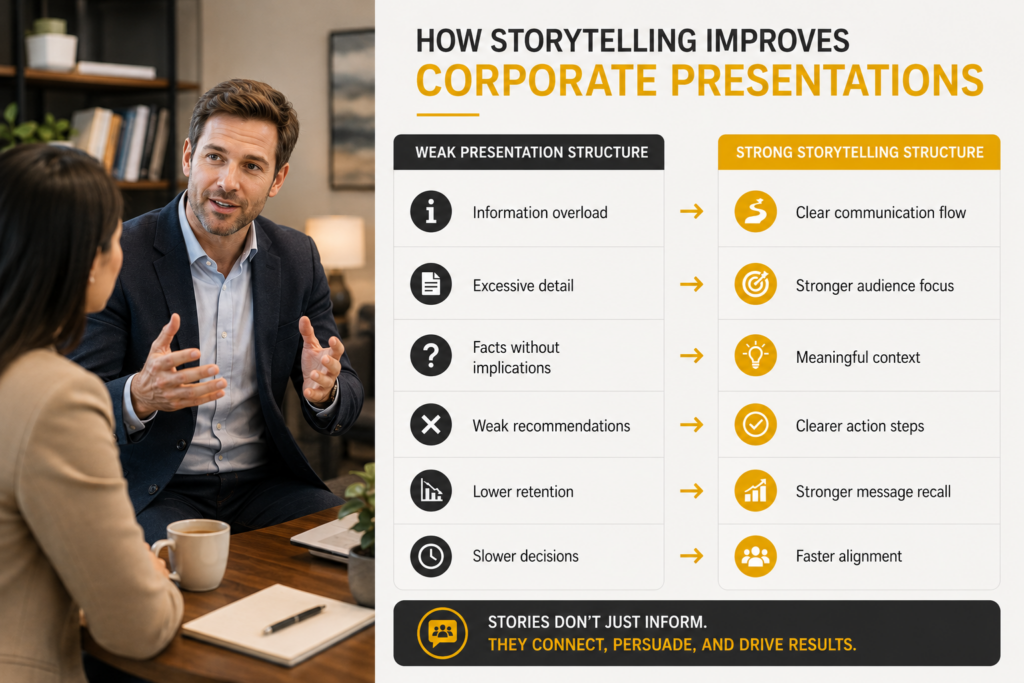
For additional insights into how narrative structure improves comprehension and retention, see this research on storytelling and audience comprehension from Harvard Business Review, which explores how narrative structure helps audiences process information, retain ideas, and engage more deeply with communication.
One of the most important benefits of storytelling is that it creates context. Data alone rarely explains significance. A presentation may show that customer satisfaction increased, operational delays declined, or project completion times improved, but audiences still need to understand what changed, why it changed, and what the information means for the organization. Without that context, even valuable information can feel disconnected from decision-making and organizational priorities.
Storytelling helps bridge that gap by connecting information to outcomes, priorities, risks, and decisions. One pattern we frequently observe after training is that professionals become significantly more concise once they focus on audience understanding rather than information transfer alone. Instead of trying to communicate everything they know, they begin concentrating on what audiences need to understand, what concerns need to be addressed, what decisions must be supported, and which organizational priorities matter most. This often improves communication clarity almost immediately.
Another important factor is memory retention. For additional insights into memory, attention, and narrative processing, see this research on emotion, attention, and narrative memory from the University of Chicago, which explores how people engage with stories and how attention influences what audiences remember. The human brain retains structured information more effectively than disconnected facts because stories create meaningful connections between ideas. This becomes especially valuable during executive briefings, stakeholder discussions, leadership updates, strategic recommendations, and client presentations where audiences are evaluating not only information, but also its meaning, implications, and strategic relevance. Strong storytelling helps support all three.
Why Many Corporate Presentations Fail to Connect
Most presentation problems are not caused by a lack of expertise. More often, they are caused by communication structure. One challenge we frequently see is that subject matter experts feel pressure to communicate every detail in order to appear thorough, credible, or fully prepared. Unfortunately, excessive detail often weakens communication effectiveness rather than strengthening it.
When audiences receive too much information, they begin working harder to identify priorities, determine relevance, and interpret implications while the presentation continues moving forward. This can lead to weaker engagement, lower retention, slower decision-making, and presentations that feel mentally exhausting rather than strategically useful.
Another major issue involves presenting facts without explaining their significance. We frequently observe presentations that explain what happened but do not clearly communicate why it matters. Leaders may present performance metrics, project updates, operational findings, or strategic results without helping audiences understand the broader organizational relevance of that information.
One pattern we frequently observe after coaching is that presentations become significantly stronger once professionals begin focusing on audience perspective. Instead of asking, “What information should I present?” they begin asking, “What does this audience need to understand, support, or act on?” That shift often changes communication behavior dramatically.
Another common challenge involves recommendation communication. Many professionals explain problems extensively but communicate recommendations weakly. Presentations become analysis-heavy but action-light. Strong storytelling helps address this by connecting challenge, context, consequence, resolution, and action into a clearer communication flow.
Technical communication can create additional challenges. Subject matter experts often possess deep contextual understanding and may unintentionally communicate information too broadly, too technically, or without enough audience framing. For additional insights into communication psychology and audience processing, see this research on narrative, comprehension, and retention from the National Library of Medicine, which explains how stories can help audiences engage with, understand, and retain information more effectively.
Executive audiences typically require less technical detail and more strategic framing. They want clearer implications, stronger context, and more direct communication around priorities and recommended action. Strong storytelling helps simplify complexity without weakening credibility, which becomes increasingly important as professionals move into leadership roles.
Another major issue we frequently observe is weak transitions between ideas. Presentations often feel fragmented because information is delivered as isolated updates rather than as part of a coherent communication flow. Strong storytelling improves continuity by connecting ideas through progression, context, and meaning, making presentations easier to follow and significantly improving audience understanding.
How Strong Storytelling Improves Strategic Communication
Effective business storytelling is not about creating dramatic presentations. It is about improving communication efficiency. One of the biggest shifts we frequently observe during workshops is that professionals begin structuring presentations around organizational meaning rather than informational completeness. Instead of trying to communicate everything available, they focus on what supports decision-making, creates alignment, reduces confusion, and helps audiences move toward action more efficiently. This immediately improves presentation clarity.

Another important shift involves audience awareness. Strong presenters constantly evaluate what audiences already know, what they may misunderstand, what information they actually need, and what concerns or priorities they are likely evaluating. One challenge we frequently observe is that professionals spend too much time explaining background information and too little time clarifying outcomes, implications, or recommendations. Strong storytelling reverses that imbalance by helping audiences move more efficiently from information to understanding to action.
Another major benefit is improved organizational efficiency. Clients frequently report that meetings become shorter, discussions become more focused, recommendations become clearer, and stakeholder alignment improves after communication and presentation structure training. Strong storytelling helps simplify complex information while maintaining credibility, making it especially valuable during leadership presentations, executive recommendations, organizational updates, and stakeholder briefings. One of the biggest shifts we frequently observe after training is that professionals begin saying less while communicating more effectively. Communication becomes more intentional, more strategic, and significantly easier for audiences to process, retain, and act upon.
Frequently Asked Questions
Why is storytelling important in corporate presentations?
Storytelling helps audiences process information more clearly, retain key ideas more effectively, and understand why information matters.
Is storytelling in business presentations about entertainment?
No. Effective business storytelling is primarily about communication structure, contextual clarity, and audience understanding.
How does storytelling improve executive communication?
Storytelling helps leaders simplify complexity, strengthen recommendation communication, improve message retention, and create stronger stakeholder alignment.
Why do technical presentations often lose audience attention?
Technical presentations often become too detail-heavy and insufficiently contextualized, making it difficult for audiences to identify priorities or implications.
Can storytelling improve meeting effectiveness?
Yes. Strong storytelling often creates clearer communication, more focused discussions, faster decision-making, and improved organizational alignment.
Conclusion
Strong corporate storytelling is not about becoming more theatrical or more charismatic. It is about helping audiences understand information more efficiently. When presentations provide context, clarify implications, organize ideas strategically, and connect information to meaningful organizational outcomes, communication becomes easier to follow and significantly more effective.
As organizations become increasingly information-heavy and communication-driven, professionals who can transform complexity into clarity often stand out immediately. In many cases, the most effective presenters are not the people who say the most. They are the people who help audiences quickly understand what matters most and what should happen next.
For professionals looking to elevate their business storytelling skills, we offer a range of specialized trainings include Presentation Skills Training, Communication Skills Training, and Executive Communication Coaching across Canada and the United States.