

Executive presence is often mistaken for personality, confidence, or charisma. In reality, it is strongly shaped by communication.
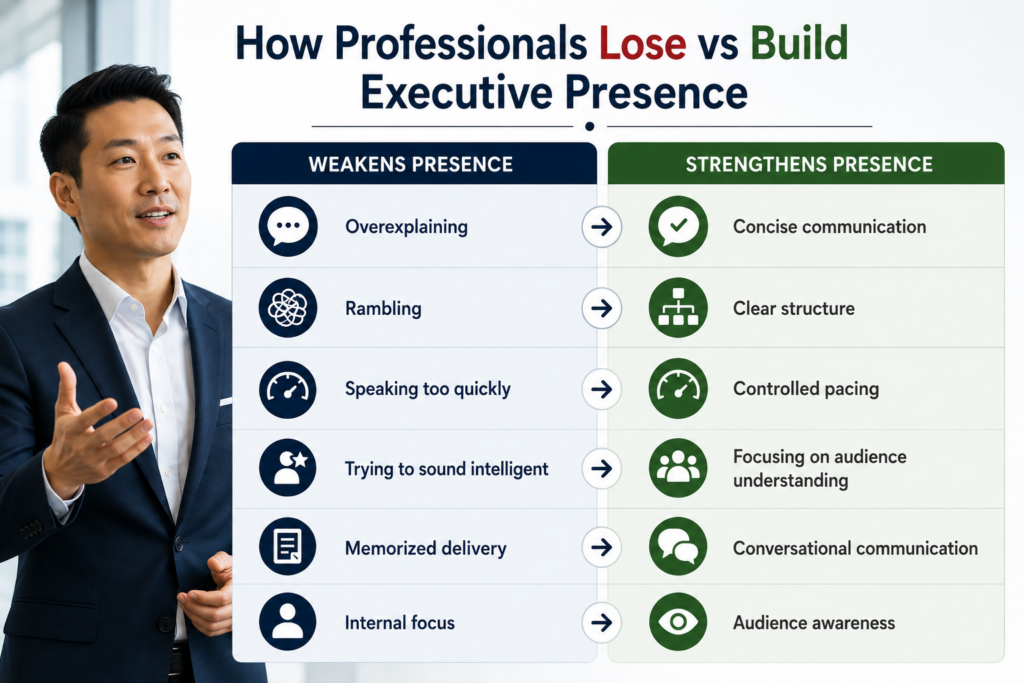
How professionals structure ideas, manage pauses, simplify information, engage audiences, and respond under pressure all influence leadership perception. In our workshops, we frequently see highly capable professionals weaken their presence by overexplaining, losing structure, or focusing too heavily on saying everything perfectly.
After more than 25 years delivering presentation and communication skills training, we have consistently seen that commanding presence develops through clarity, audience awareness, communication control, and composure under pressure. When professionals communicate with greater structure and intention, they often appear more confident, credible, and leadership-ready.
Key Takeaways
- Executive presence is heavily influenced by communication clarity and composure
- Rambling and overexplaining often weaken leadership perception
- Structured communication reduces pressure and improves message clarity
- Concise speaking helps audiences absorb and retain information more effectively
- Calm, organized communication creates stronger authority during high-stakes situations
- Professionals improve presence significantly when they simplify communication and focus on audience understanding
Why Professionals Lose Presence Under Pressure
Many professionals communicate very differently under pressure than they do in normal conversation. In everyday discussions, they may come across as clear, articulate, and confident. However, when the stakes feel higher, communication often becomes more difficult. Whether presenting to senior leadership, defending a recommendation, answering challenging questions, or participating in an important meeting, professionals are frequently trying to manage multiple concerns at the same time. They may be focused on sounding intelligent, remembering key information, avoiding mistakes, maintaining credibility, responding quickly, and organizing their thoughts in real time.
As this cognitive pressure increases, communication quality often decreases. One of the most common patterns we observe in workshops is that professionals begin overloading their communication with too much information because they are worried about leaving something important out. Instead of helping the audience understand the message more clearly, this often creates the opposite effect. Explanations become longer, key points become harder to identify, conclusions become less clear, and audience engagement begins to decline as listeners struggle to determine what matters most.
The result is often rambling, disorganized explanations, weak openings, excessive detail, and messages that lack a clear takeaway. Ironically, the professionals who are working hardest to protect their credibility are often the ones making it more difficult for audiences to recognize the value of their expertise. In many cases, communication becomes focused on demonstrating knowledge rather than helping the audience understand and act on that knowledge.
This pattern is particularly common among subject matter experts, senior managers, technical leaders, and professionals communicating in executive environments where visibility is high and the consequences of getting it wrong feel significant. One of the most important lessons professionals learn is that executive presence is rarely strengthened by communicating more information. More often, it is strengthened by communicating the right information with clarity, structure, and confidence. Audiences are typically not evaluating how much someone knows. They are evaluating how effectively that knowledge is communicated and whether it helps them make better decisions.
For additional insights into cognitive overload and communication under stress, see this research on decision-making under pressure from Harvard Business Review
Many professionals also become internally focused during presentations and discussions. Instead of paying attention to the audience, they focus on their own wording, nervousness, sequencing, or performance. This often weakens communication effectiveness because audiences begin experiencing the speaker as mentally disconnected from the room itself.
One challenge we frequently observe is that professionals who appear the calmest externally are often the individuals with the clearest communication structure internally. That structure reduces uncertainty, and reduced uncertainty significantly reduces communication pressure.
Professionals who communicate effectively tend to focus less on communicating everything they know and more on what the audience actually needs, how information is being received, whether key points are understood, and how to simplify complex ideas without oversimplifying them. This research on active listening and communication effectiveness from Ivey Business School further explores the relationship between audience awareness, listening, and communication effectiveness in professional environments.
This is one reason why executive presence is so closely connected to communication control. Professionals who communicate calmly and clearly under pressure are often perceived as more credible, more organized, more leadership-ready, more authoritative, and more capable in high-stakes situations. In many cases, the difference is not intelligence or expertise. The difference is communication structure and the ability to organize and deliver ideas clearly under pressure.
How Structure Creates a More Commanding Presence
One of the biggest shifts we see during workshops happens when professionals realize they do not need to communicate everything they know in order to communicate effectively. In fact, the opposite is often true. Strong executive communication usually involves simplifying information rather than expanding it.
This is where communication structure becomes extremely important. One challenge we frequently see is that professionals try to organize thoughts while speaking instead of organizing thoughts before speaking. As pressure increases, communication often becomes increasingly disorganized because the speaker is attempting to think, structure, edit, and deliver simultaneously.
Simple communication frameworks dramatically reduce this mental overload. One of the most effective concepts we teach is the Rule of Threes, which helps professionals structure communication in a way that is easier to deliver, easier for audiences to follow, and easier to remember. Professionals know how they will begin, what core ideas matter most, and how they will conclude. That clarity creates composure.
Instead of mentally managing large amounts of information, professionals begin focusing on communicating key ideas clearly and strategically. This often produces immediate improvements in communication confidence, concise speaking, audience engagement, executive presence, message retention, and conversational delivery.
For additional insights into communication clarity and information retention, see this research on learning, memory, and information retention from the American Psychological Association.
One pattern we frequently observe is that professionals become significantly calmer once they realize they no longer need to memorize everything perfectly. Instead of relying heavily on scripted wording, they begin communicating from structure and understanding. This allows them to adapt naturally, remain audience-focused, speak more conversationally, and maintain stronger composure under pressure.
Messages are also received and processed more effectively because audiences are no longer trying to sort through unnecessary complexity. The goal is not to sound more impressive. The goal is to become easier to understand.
Why Executive Presence Is Really About Communication Control
Many professionals assume executive presence is primarily about confidence, body language, or authority. While those factors matter, communication control is often the deeper issue. Professionals with strong executive presence typically communicate with clarity, pacing, structure, calmness, intentionality, and strong audience awareness. They rarely appear rushed or mentally overloaded.

This becomes especially important during executive presentations, leadership meetings, stakeholder discussions, difficult conversations, impromptu speaking situations, and question-and-answer sessions. One challenge we frequently see is that professionals lose presence the moment they become reactive. They begin speaking too quickly, expanding explanations unnecessarily, abandoning structure, or trying too hard to prove competence.
In contrast, professionals with a commanding presence tend to simplify under pressure rather than complicate. That shift dramatically changes how audiences experience them.
Another important misconception involves accents and communication credibility. Many professionals who speak English as a second language worry their accent weakens executive presence or leadership perception. In practice, this concern is often significantly greater in the speaker’s mind than in the audience’s. In diverse professional environments, accents are common and widely accepted. What matters far more is:
• clarity
• pacing
• structure
• confidence
• audience understanding
Professionals who communicate clearly and strategically are usually perceived positively regardless of accent.
One of the biggest transformations we see during workshops happens through video review and structured coaching. Professionals are often surprised to discover that they appear more credible than they assumed, audiences understand more than they realized, concise communication strengthens authority, slowing down improves leadership presence, and simplified messaging improves audience engagement.
That awareness creates rapid improvement. By the second day of workshops, professionals often become calmer under pressure, more concise, more structured, more audience-aware, stronger during impromptu speaking situations, and more effective during executive discussions.
For professionals looking to improve executive presence, communication clarity, audience engagement, and leadership communication effectiveness, our Presentation Skills Training focuses heavily on structured communication, executive-level speaking situations, concise messaging, and coach-led practical application within real-world professional environments.
Frequently Asked Questions
What creates a commanding presence during presentations?
A commanding presence is often created through communication clarity, composure, structure, audience awareness, and calm delivery under pressure rather than personality alone.
Why do professionals ramble during presentations?
Professionals often ramble because they are trying to manage large amounts of information mentally while speaking. Pressure and lack of communication structure frequently increase overexplaining and disorganized delivery.
How does concise communication improve executive presence?
Concise communication helps audiences understand and retain information more easily. Professionals who communicate clearly and efficiently are often perceived as more confident, organized, and authoritative.
Why does structure reduce speaking anxiety?
Structure reduces mental overload by helping professionals organize ideas before speaking. This allows them to focus more on communication and audience engagement instead of trying to manage information reactively.
Does accent affect executive presence?
In most professional environments, clarity and communication effectiveness matter significantly more than accent. Structured, confident communication usually has a much larger impact on audience perception.
Conclusion
A commanding presence is rarely about trying to appear powerful, charismatic, or authoritative. In our experience, it is more often the result of calm, clear, and structured communication, particularly during situations where pressure, uncertainty, or visibility are high. Professionals who are perceived as having strong executive presence are not necessarily the most outgoing people in the room. More often, they are the individuals who communicate with clarity, remain composed when challenged, and help others understand complex information without creating unnecessary confusion.
Professionals strengthen executive presence when they simplify ideas, communicate more intentionally, reduce unnecessary complexity, and focus on audience understanding rather than personal performance. Instead of trying to impress others with everything they know, they concentrate on helping people quickly understand what matters, why it matters, and what action or decision should follow. This audience-focused approach often creates greater credibility, confidence, and influence than attempting to appear polished or impressive.
Over time, these communication habits affect far more than presentations alone. They influence leadership perception, stakeholder confidence, meeting effectiveness, audience engagement, and overall workplace influence. Whether communicating during executive briefings, leadership discussions, client meetings, or difficult stakeholder conversations, professionals with strong communication habits are often perceived as more capable, more trustworthy, and more leadership-ready because they consistently help others move from information to understanding and from understanding to action.
For professionals looking to elevate their Executive Presence, among other skills, we offer a range of specialized communication and leadership development programs. These include Presentation Skills Training, Public Speaking Workshops for Individuals, and Corporate Team & Group Training programs across Canada and the United States.