
Hybrid and remote work environments have fundamentally changed how conflict develops, how quickly misunderstandings escalate, and how communication challenges affect team performance. In traditional offices, many issues could be resolved through quick conversations, immediate clarification, or reading tone and body language in person. In hybrid environments, those opportunities are less common.
As communication increasingly happens through email, chat platforms, and video calls, messages become easier to misinterpret and harder to clarify quickly. Small misunderstandings can persist, assumptions can build, and unresolved tension can affect collaboration, trust, and productivity.
After more than 25 years delivering presentation and communication skills training, Commanding Presence has helped professionals, managers, and leaders navigate difficult conversations and workplace conflict across corporate, government, academic, and professional environments. Our practical training focuses on helping teams communicate clearly, address issues early, and maintain professionalism under pressure.
Key Takeaways
- Effective conflict management improves collaboration, trust, accountability, and team performance across hybrid workplaces
- Hybrid and remote work environments increase the likelihood of communication misunderstandings and unresolved tension
- Conflict in distributed teams often starts with small communication gaps rather than major disagreements
- Strong communication skills help teams resolve issues earlier and prevent unnecessary escalation
- L&D and HR teams play a critical role in helping organizations build healthier conflict management practices
Where Conflict Typically Starts in Hybrid Teams
In hybrid and remote environments, conflict rarely begins with a major disagreement. More often, it starts with small communication gaps that gradually build over time. A message may be interpreted differently than intended. Someone responds more slowly than expected. A meeting may feel unbalanced, with some voices receiving more attention than others. Responsibilities may not feel fully clear, leading to frustration around ownership and accountability.
While these situations may seem minor individually, they often compound without quick clarification. Common sources of conflict in hybrid teams include:
- misinterpreted written communication
- unequal participation during meetings
- delayed responses that create assumptions
- unclear responsibilities or decision ownership
In fully in-person environments, many of these issues would likely be resolved quickly through informal interaction. In hybrid environments, they tend to linger longer and create additional tension.
Why Small Issues Escalate More Quickly
One of the biggest differences in hybrid work is the lack of immediate feedback. When people are physically together, they can often recognize when something is not landing well and clarify it immediately. In digital environments, those signals become harder to interpret.
A short message may feel abrupt. A delayed reply may be interpreted as disengagement. A missed comment during a meeting may feel intentional instead of accidental. Without real-time clarification, people often fill in communication gaps themselves, and those assumptions are not always accurate.
Over time, this can cause employees to feel excluded, overlooked, or unfairly treated, even when that was never the intention. These challenges become even more complex across time zones, cultures, and functions where communication styles and expectations may differ significantly.
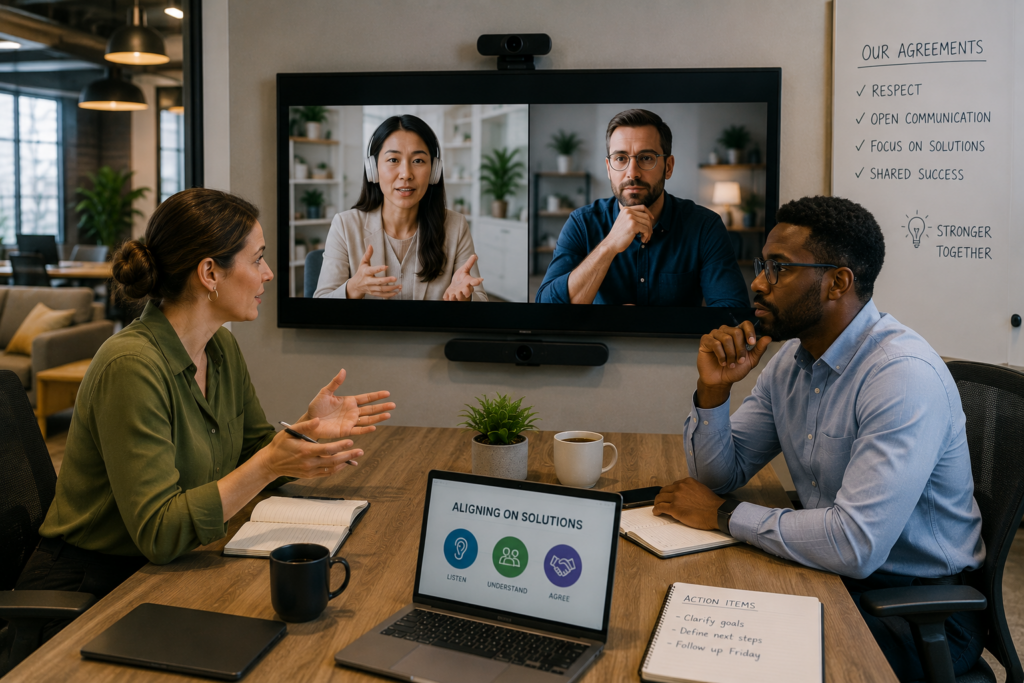
Why Hybrid Conflict Is Harder to Detect
Another major challenge in hybrid environments is visibility. Conflict is often less obvious to leaders because tension tends to appear in more subtle ways. Instead of direct disagreement, leaders may notice reduced participation, shorter responses, missed deadlines, or lower engagement levels.
These signals are easy to overlook when teams are not physically together. Without strong communication awareness, leaders may not recognize an issue until it has already escalated and begun affecting trust or performance. That is what makes early intervention so important in hybrid teams.
The Role of Communication in Resolving Conflict
At the center of all of this is communication. Conflict in hybrid environments is often less about disagreement itself and more about how differences are communicated, interpreted, and addressed.
When communication is unclear or avoided, issues tend to grow. When communication is direct, structured, and respectful, issues are far more likely to be resolved quickly and constructively. Strong communicators address concerns early, clarify expectations clearly, and navigate difficult conversations without unnecessarily escalating tension.
This is not about being overly formal or scripted. It is about being intentional in how conversations are handled.
What Effective Conflict Management Looks Like
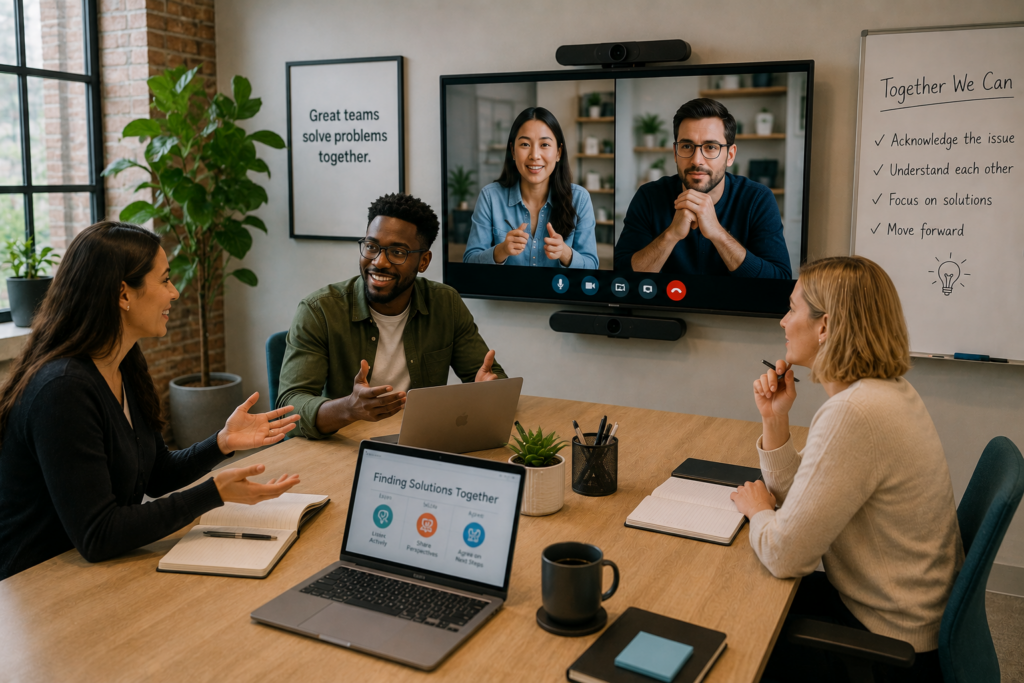
Teams that manage conflict effectively tend to approach these situations differently. They address issues earlier rather than waiting for them to become larger problems. They communicate directly while still maintaining professionalism and respect. They also create space for dialogue rather than making assumptions about intent.
In practice, effective conflict management often includes:
- addressing misunderstandings directly
- clarifying expectations and responsibilities early
- asking questions before making assumptions
- focusing conversations on resolution instead of blame
These behaviors help prevent small issues from becoming larger organizational problems.
Why These Skills Matter More Now
In hybrid work environments, conflict management is no longer only a leadership skill. It has become a broader team capability. Everyone on the team contributes to how communication flows and how issues are addressed.
Strong conflict management skills help maintain trust across distributed teams, reduce unnecessary friction, improve accountability, and support healthier collaboration. Without these capabilities, even relatively small issues can create ongoing tension that affects engagement and team performance over time.
The Role of L&D and HR
Learning and Development and HR teams play a major role in supporting this shift. In hybrid environments, organizations can no longer assume employees will naturally navigate conflict effectively. The communication environment has changed, and the required skills have evolved with it.
Providing conflict management training creates greater consistency across teams. It gives leaders and employees a shared communication framework and common language for handling difficult conversations constructively. This reduces inconsistency and makes it easier for teams to resolve challenges before they escalate unnecessarily.
What Makes Conflict Management Training Effective
Like other communication skills, conflict management improves through practice. Understanding principles conceptually is not enough. People need opportunities to apply those skills in realistic workplace situations.
That may include practicing:
- addressing misunderstandings in written communication
- managing tension during virtual meetings
- clarifying expectations when roles overlap
- navigating emotionally charged conversations
When training reflects the real communication challenges employees experience every day, it becomes far easier to transfer those skills into actual workplace situations.
A More Proactive Approach to Conflict
One of the most important shifts organizations can make is moving from reactive to proactive conflict management. Instead of waiting for issues to escalate, teams can address concerns earlier while they are still manageable.
This requires awareness to recognize issues early, communication skills to address them clearly, and confidence to engage in conversations without avoiding them. When these elements are present, conflict becomes something teams can navigate constructively rather than something they fear or avoid entirely.
The Impact on Team Performance
When teams improve how they manage conflict, the difference becomes highly noticeable. Conversations become more direct and productive. Misunderstandings are resolved faster. Trust remains stronger even during disagreement. Collaboration improves because issues are addressed instead of ignored.
Over time, this creates healthier team dynamics, stronger working relationships, and more consistent organizational performance. The work itself may not have changed, but the way teams communicate through challenges has. And in hybrid environments, that shift has a major impact on how effectively organizations operate.
Frequently Asked Questions
Why is conflict management more difficult in hybrid workplaces?
Hybrid workplaces reduce informal communication and make it harder to read tone, intent, and body language. This increases the likelihood of misunderstandings and makes conflict harder to detect early.
What are the most common causes of conflict in remote teams?
Common causes include unclear expectations, misinterpreted written communication, delayed responses, unequal participation in meetings, and lack of clarity around responsibilities or decision-making.
Why is communication so important in conflict resolution?
Strong communication helps clarify misunderstandings early, reduce assumptions, maintain trust, and keep conversations focused on resolution instead of escalation or blame.
How can organizations improve conflict management skills across teams?
Organizations often see the best results when employees practice real-world scenarios, receive communication feedback, and develop shared frameworks for handling difficult conversations consistently across hybrid and remote environments.
For professionals looking to elevate their conflict resolution and conflict management skills Communication Skills Training, Negotiation Skills Training and Conflict Management Training programs across Canada and the United States.