

Many professionals struggle under pressure not because they lack expertise, but because they are organizing complex thoughts while speaking. Unexpected questions, shifting conversations, and stakeholder challenges can quickly lead to rambling, overexplaining, and unclear messages.
In our workshops, we frequently find that what appears to be a confidence problem is often a structure problem. Subject matter experts usually know their material. What they need is a repeatable way to organize and communicate it clearly in real time.
After more than 25 years delivering presentation and communication skills training, we have consistently seen professionals improve when they stop trying to share everything they know and focus on saying less and saying it better. The FOCUS!™ Method helps professionals structure ideas, communicate concisely, and remain clearer under pressure during meetings, presentations, executive briefings, and impromptu speaking situations.
Key Takeaways
- Many communication problems are actually structure problems rather than confidence problems
- Structured communication reduces anxiety and improves message retention
- Concise communication strengthens executive presence and audience understanding
Why Professionals Struggle to Organize Ideas Under Pressure
In many professional environments, communication happens in real time.
Unlike writing, there is no opportunity to revise wording repeatedly, reorganize paragraphs, or carefully edit responses before delivering them. Professionals are expected to think clearly, communicate concisely, and respond quickly while simultaneously managing pressure, audience reactions, and organizational dynamics.

One challenge we frequently see is that professionals attempt to process too much information mentally while speaking. They may be trying to remember every important detail, avoid sounding unprepared, maintain credibility, organize thoughts while speaking, and respond strategically all at the same time.
As cognitive pressure increases, communication often becomes less clear. Professionals begin overexplaining, losing track of their message, speaking too broadly, or struggling to get to the point quickly.
For additional insights into cognitive overload and communication under pressure, see this research on communication under pressure from Harvard Business Review, which explores how pressure affects decision-making, clarity, and communication performance.
Many professionals assume they need more confidence when what they actually need is a better communication structure.
This distinction is extremely important.
One pattern we frequently observe is that professionals become significantly calmer once they know how they are going to begin, what key points matter most, and how they are going to conclude. That predictability reduces uncertainty, and reduced uncertainty reduces anxiety.
This is one reason why professionals often improve very quickly once they begin using structured communication methods consistently.
Instead of trying to mentally manage large amounts of information, they begin relying on a simple framework that guides the conversation more naturally. As a result, communication becomes more concise, easier to follow, more audience-focused, and significantly easier to deliver under pressure.
This also strengthens executive presence because audiences experience the speaker as calmer, clearer, and more organized.
Why the FOCUS!™ Method Improves Communication Clarity
The FOCUS!™ Method is designed to simplify communication by helping professionals organize information into a clear, repeatable structure.
At its core, the method helps professionals say less and say it better.
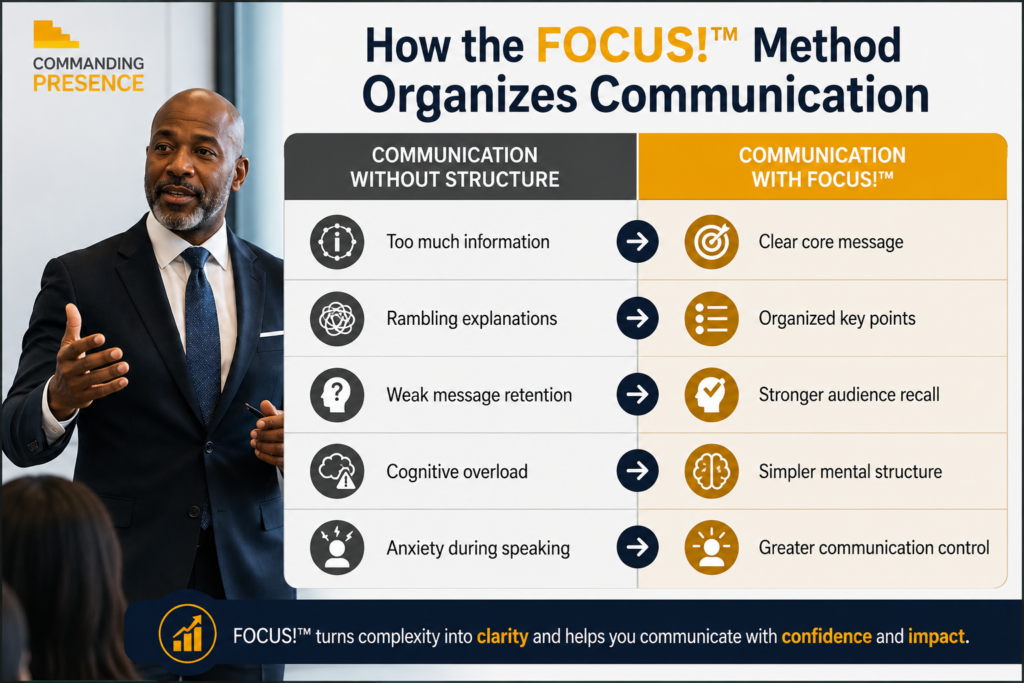
One challenge we frequently see is that professionals often communicate too much information because they are worried about leaving something important out. Ironically, this usually reduces audience understanding rather than improving it.
The FOCUS!™ Method works because it aligns with how people naturally process and retain information.
Two core principles help make the method effective:
- the Rule of Threes
- hierarchical memory organization
The Rule of Threes reflects a simple but powerful communication reality. People tend to process and remember information more effectively when it is grouped into three key ideas. This pattern appears repeatedly across communication, education, leadership messaging, and storytelling because three creates a structure that is easier for audiences to recognize and retain.
For additional insights into memory, learning, and information retention, see this research on memory and information retention from the American Psychological Association, which explores how people process, retain, and recall information more effectively.
Hierarchical memory builds on this idea by organizing information into layers consisting of a central message, a small number of supporting ideas, and simple supporting details. The FOCUS!™ Method follows this natural structure by helping professionals identify the one core message that matters most, organize three key supporting points, and reinforce each point with supporting details that strengthen audience understanding and message retention.
This approach creates clarity for both the speaker and the audience. The speaker gains a clear roadmap for organizing and communicating ideas, while the audience benefits from a structure that is significantly easier to process, follow, and remember. Rather than trying to absorb large amounts of disconnected information, listeners can quickly understand the main message and how the supporting ideas connect to it.
One challenge we frequently observe is that professionals often assume audiences want more information when, in reality, audiences usually want clearer information. The goal is not to communicate everything. The goal is to communicate what matters most in a way that is easy to understand and retain. This becomes especially valuable during executive briefings, stakeholder discussions, difficult conversations, client meetings, interviews, presentations, and impromptu speaking situations where professionals are expected to think quickly while maintaining clarity, confidence, and composure.
For additional insights into leadership communication and audience understanding, see this research on active listening and communication effectiveness from Ivey Business School, which explores the importance of listening, audience awareness, and communication effectiveness in leadership and professional environments.
How Professionals Apply the FOCUS!™ Method in Real Situations
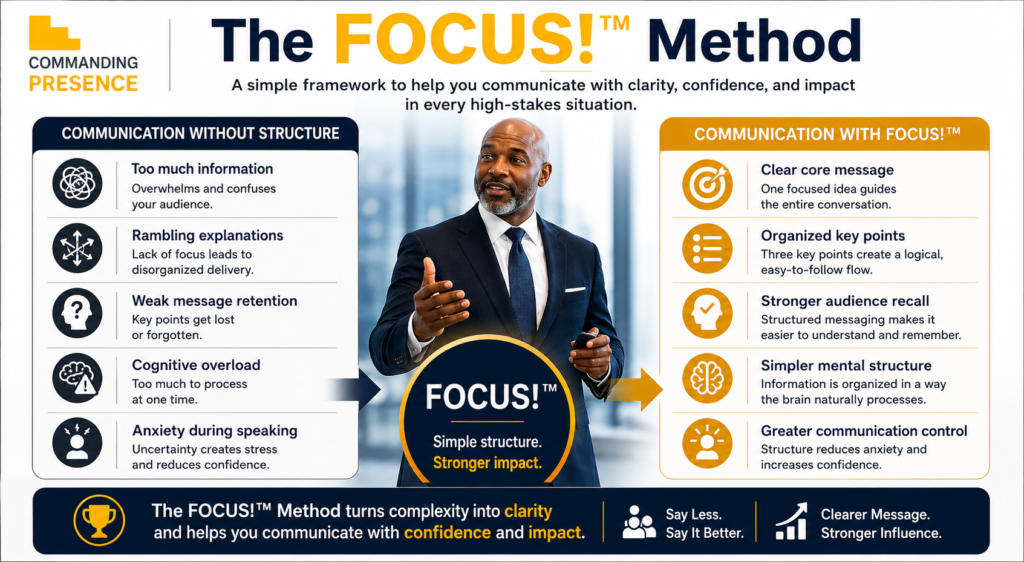
One reason the FOCUS!™ Method is so effective is because it is highly practical. Unlike communication techniques that only apply to formal presentations, the framework can be used across a wide range of professional situations, including meetings, executive briefings, stakeholder discussions, difficult conversations, client interactions, and impromptu speaking. This versatility makes it particularly valuable because most workplace communication happens in everyday interactions rather than formal presentations.
In meetings, the framework helps professionals contribute ideas more strategically instead of speaking reactively or overexplaining unnecessarily. During executive briefings, it helps leaders communicate recommendations more clearly while improving message retention among decision-makers. In stakeholder discussions, it provides structure that helps professionals stay organized and focused, even when conversations become challenging, complex, or unpredictable.
The framework becomes especially valuable during impromptu speaking situations where professionals are expected to think on their feet. One challenge we frequently observe is that people become overwhelmed when asked unexpected questions because they begin mentally searching through large amounts of information at once. As pressure increases, communication often becomes less structured and more difficult to follow.
The FOCUS!™ Method simplifies this process by providing an immediate framework for organizing thoughts. Instead of trying to recall everything they know about a topic, professionals identify the central response, organize three supporting points, communicate conversationally, and reinforce the key takeaway before concluding. This approach keeps communication focused and significantly reduces the tendency to ramble, lose structure, or become overwhelmed by information.
Another major benefit is that the framework reduces dependence on memorization. Many professionals mistakenly believe strong communication requires remembering exact wording. In practice, memorization often increases pressure because speakers become focused on recall rather than audience understanding. When communication is built around a clear structure instead of a script, professionals gain much more flexibility and confidence.
Structured communication allows people to adapt naturally, remain audience-aware, communicate more conversationally, and maintain composure even when discussions change direction unexpectedly. This is one reason we often see rapid improvement during workshops. By the second day, many participants become noticeably more concise, calmer while speaking, more organized verbally, stronger during impromptu speaking situations, and more effective in executive communication environments.
Long-term improvement comes through repetition and continued application. As professionals consistently use the structure in meetings, presentations, and everyday conversations, communication begins to feel more natural and far less mentally overwhelming. Over time, the framework becomes a repeatable communication process that supports greater clarity, confidence, executive presence, and communication effectiveness across virtually every professional situation.
For professionals looking to strengthen communication clarity, executive presence, concise speaking, and structured communication under pressure, our Presentation Skills Training programs focus heavily on practical application, structured speaking methods, executive-level communication scenarios, and coach-led feedback in real-world business environments.
Frequently Asked Questions
Why do professionals struggle to organize thoughts while speaking?
Many professionals try to organize information while simultaneously speaking under pressure. Without structure, this can create cognitive overload and reduce communication clarity.
How does the FOCUS!™ Method improve communication?
The FOCUS!™ Method helps professionals organize information into a clear structure that improves clarity, message retention, concise communication, and audience understanding.
Why does structured communication reduce anxiety?
Structured communication reduces uncertainty. When professionals know how they will begin, what key points they will communicate, and how they will conclude, speaking situations become significantly easier to manage.
Why is concise communication important in leadership situations?
Concise communication improves audience understanding, retention, and trust. Leaders who communicate clearly and efficiently are often perceived as more confident, organized, and effective under pressure.
Can the FOCUS!™ Method help with impromptu speaking?
Yes. The framework is especially effective for impromptu speaking because it provides a simple structure professionals can quickly apply during meetings, questions, discussions, and high-pressure communication situations.
Conclusion
Many professionals already possess the expertise, knowledge, and analytical ability required to communicate effectively. The challenge is often not a lack of information, but the ability to organize that information clearly when the pressure is high. Whether responding to questions, presenting recommendations, leading meetings, or participating in executive discussions, professionals are frequently expected to think quickly while communicating with clarity and confidence. The FOCUS!™ Method helps simplify this process by providing a practical structure that reduces cognitive overload, improves message retention, and makes communication easier for both the speaker and the audience.
By focusing on structure rather than memorization, professionals are able to communicate more clearly without feeling responsible for remembering exact wording or managing large amounts of information mentally. This allows them to say less and say it better while remaining flexible and audience-focused during meetings, presentations, executive briefings, stakeholder discussions, and impromptu speaking situations. Over time, this creates calmer communication, stronger executive presence, clearer thinking under pressure, and messages that audiences are significantly more likely to understand, retain, and act upon.
For professionals, managers, and leaders looking to elevate their speaking and presentation skills to match the level of their expertise, we incorporate the FOCUS!™ Method into all of our communication and leadership development programs. These include Presentation Skills Training, Executive Communication Coaching, Public Speaking Workshops for Individuals, and Corporate Team & Group Training programs across Canada and the United States.