

Modern organizations rely heavily on collaboration, cross-functional decision-making, and shared accountability. As a result, many professionals are now expected to influence outcomes without having direct authority over the people involved. This shift has fundamentally changed how leadership operates inside organizations.
At Commanding Presence, we frequently observe that professionals who struggle with influence are often highly capable technically. The challenge is rarely a lack of expertise. More often, it is how ideas are communicated, structured, and delivered during high-stakes conversations where alignment and buy-in are required.
Key Takeaways
- Influence without authority has become a core leadership capability in modern organizations.
- Overexplaining and lack of confidence are two of the most common communication barriers to influence.
- Technical subject matter experts often struggle because they communicate too much detail instead of prioritizing clarity.
- Strong influence depends heavily on audience awareness and communication structure.
- Executive presence often improves when professionals simplify communication and lead with clearer recommendations.
Managers, technical subject matter experts, project leads, and emerging leaders are increasingly responsible for gaining buy-in, aligning stakeholders, guiding conversations, and moving initiatives forward across teams with competing priorities and different perspectives. In many cases, their success no longer depends solely on the quality of their work. It depends on how effectively they communicate that work.
Many professionals rely too heavily on detail, overexplain recommendations, or hesitate to communicate with sufficient clarity and confidence when discussions become complex or politically sensitive. Over time, these communication habits can slow decision-making, weaken stakeholder alignment, and reduce leadership visibility, even when the underlying thinking and recommendations are strong.
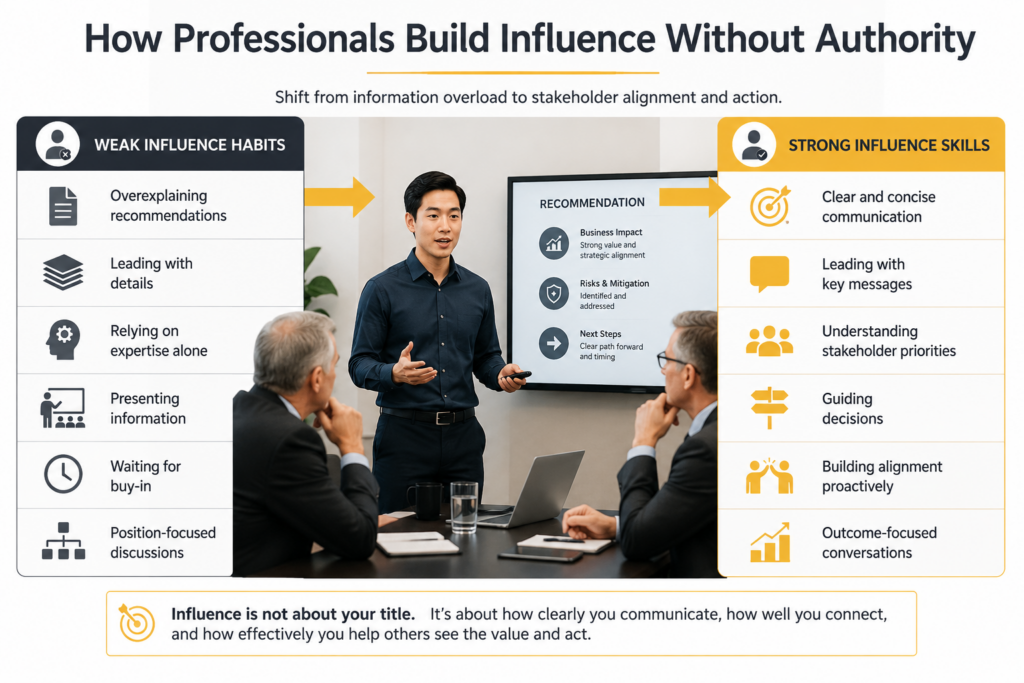
Why Influence Without Authority Matters More Today
Many workplace decisions no longer happen through direct top-down management alone.
Projects often involve multiple departments, cross-functional teams, external stakeholders, and collaborative decision-making processes that require alignment rather than command-and-control leadership.
Research from the McKinsey & Company on collaborative organizations and decision-making highlights how flatter organizational structures increasingly depend on influence, collaboration, and communication effectiveness to drive execution.
For many professionals, this creates a major adjustment. Technical expertise and analytical capability may establish credibility initially, but influence often depends on something different: the ability to communicate recommendations clearly, build trust quickly, and help stakeholders align around decisions. This becomes especially important during client presentations, internal recommendations, project approvals, executive updates, and cross-functional stakeholder discussions.
In these situations, professionals often need to gain support from people they do not directly manage. That requires communication capability, not positional authority.
Why Technical Professionals Often Struggle With Influence
One of the most common communication patterns we observe during workshops is overexplaining. Technical subject matter experts, emerging leaders, and highly analytical professionals often feel compelled to communicate every detail behind their thinking. Their goal is usually to demonstrate credibility, reduce risk, or ensure that nothing important is overlooked.
While the intention is understandable, the result is often the opposite of what they intended. The message becomes harder to follow, discussions become longer than necessary, and stakeholders can struggle to identify the core recommendation quickly. As more information is added, the most important message often becomes less visible.
Many professionals mistakenly believe stronger influence comes from providing more information. In practice, stronger influence often comes from making communication easier for audiences to process. Decision-makers rarely need every detail immediately. They typically need to understand the recommendation, the business impact, and the reasoning that supports it.
In our workshops, we frequently observe that professionals become more influential when they stop trying to communicate everything they know and start focusing on what their audience needs to understand. The strongest recommendations are rarely the longest. They are usually the clearest.
This is one reason executive communication often appears more concise than technical communication. Strong leaders typically focus first on the most important decision, the key business impact, and the next action required before moving into supporting details. By making the message easier to understand, they make it easier for others to align, decide, and take action.
Why Confidence and Structure Are Closely Connected

Another major observation we frequently see is that professionals often assume influence problems are confidence problems alone.
In reality, confidence and structure are heavily connected.
When professionals are unclear about how to organize information, they often become more internally focused while speaking. They begin monitoring themselves excessively, searching for wording in real time, and overexplaining to compensate for uncertainty.
This usually reduces executive presence significantly.
At Commanding Presence, much of our work centers around helping professionals simplify communication through the FOCUS!™ Method.
The FOCUS!™ Method helps participants organize recommendations, updates, and stakeholder conversations more clearly so they can communicate naturally without becoming overwhelmed by excessive detail.
One of the biggest “ah-ha” moments participants often experience during workshops is realizing that influence improves when communication becomes simpler rather than more complex.
When professionals stop trying to communicate everything they know and begin focusing on what their audience needs most, conversations often become clearer, shorter, more confident, and easier to follow.
This shift also tends to improve executive presence quickly because professionals appear calmer, more decisive, and more audience-focused.
Influence Happens in Conversations, Not Slides
One of the biggest misconceptions many professionals hold is believing influence happens primarily through presentation materials.
In reality, influence usually happens through interaction.
Slides may support communication, but they rarely create alignment by themselves.
Influence develops through how recommendations are introduced, how questions are handled, how objections are addressed, and how clearly professionals guide discussions toward decisions and next steps.
In workshops, we frequently observe professionals becoming overly dependent on slides because they provide a sense of security.
However, when professionals rely too heavily on slides, audience connection often weakens. Communication becomes less conversational, less adaptable, and less responsive to stakeholder concerns in real time.
Research from the National Library of Medicine on active listening explains that active listening requires feedback and confirmation of understanding between speaker and listener. In leadership communication, this reinforces that influence depends on audience understanding, engagement, and responsiveness, not simply one-way information delivery.
This is especially important during client-facing conversations and leadership recommendations where trust and responsiveness influence outcomes significantly.
How Video Coaching Accelerates Influence Development
One of the most transformational aspects of communication coaching is video recording and review. Many professionals have never actually seen how they communicate during realistic stakeholder discussions, leadership conversations, or presentation situations. As a result, they are often unaware of communication habits that may be affecting their influence and credibility.
When participants review workshop recordings, they frequently notice patterns they had never recognized before. Some discover they overexplain recommendations, weaken confidence with unnecessary qualifiers, rush through important points, avoid making direct recommendations, or lose audience connection by focusing too heavily on slides rather than the people in the room.
These observations often create rapid improvement because professionals can immediately see how specific communication behaviors affect stakeholder perception. Video coaching also helps participants recognize strengths they may have been overlooking. Many discover they appear far more credible, knowledgeable, and confident than they initially believed, which often strengthens communication confidence very quickly.
Why Influence Skills Matter for Leadership Development
For organizations, influence without authority has become one of the most important leadership development capabilities. Professionals who communicate clearly, guide discussions effectively, build stakeholder alignment, and influence decisions collaboratively are often viewed as more leadership-ready regardless of their title or position within the organization.
Organizations frequently report improvements in stakeholder alignment, project execution, client communication, leadership visibility, and cross-functional collaboration when professionals strengthen their influence skills. One particularly important outcome is reduced organizational friction.
When professionals communicate recommendations more clearly and confidently, teams spend less time revisiting conversations, clarifying expectations, and reworking decisions. Instead, they are able to align more quickly, make decisions with greater confidence, and focus more of their energy on execution. Over time, this improves both individual leadership effectiveness and overall organizational performance.
FAQs
What does influencing without authority mean?
Influencing without authority refers to the ability to guide decisions, build alignment, and move work forward without relying on formal managerial power or positional authority.
Why do technical professionals often struggle with influence?
Technical professionals often rely too heavily on detail and logic when communicating recommendations. Strong influence typically requires concise communication, audience awareness, and clear prioritization.
How does communication structure improve influence?
Strong communication structure helps professionals organize ideas clearly, reduce unnecessary detail, and communicate recommendations more confidently and effectively.
Why is executive presence important for influence?
Executive presence helps professionals appear calm, credible, and confident during stakeholder discussions, leadership meetings, and high-pressure conversations.
How does video coaching improve influence skills?
Video review increases self-awareness by allowing professionals to observe delivery habits, audience engagement, pacing, and communication patterns directly.
Conclusion
Influencing without authority is no longer simply a leadership advantage. In today’s workplace, it has become a core communication capability. As organizations become increasingly collaborative, cross-functional, and matrixed, professionals must rely more heavily on communication, stakeholder alignment, and audience-focused influence rather than positional authority alone. The ability to gain buy-in, guide discussions, and move initiatives forward often depends less on job title and more on how effectively ideas are communicated.
For technical subject matter experts and emerging leaders, this often requires a significant communication shift. Many professionals are accustomed to relying on expertise, detail, and analysis to build credibility. While expertise remains important, influence is often strengthened when professionals communicate recommendations more clearly, focus on what matters most to the audience, and make it easier for stakeholders to understand key decisions and priorities.
When professionals learn how to simplify recommendations, communicate with greater confidence, and guide conversations more intentionally, influence often improves quickly. Discussions become more productive, stakeholder alignment becomes easier to achieve, and recommendations are more likely to gain traction. Over time, these communication skills contribute to stronger executive presence, better cross-functional collaboration, improved leadership visibility, and more effective leadership communication throughout the organization.
For professionals looking to elevate their ability to influence others, we offer Communication Skills Training, Negotiation Skills Training and Conflict Management Training programs across Canada and the United States.