

Every company has a story that appears in sales conversations, leadership presentations, recruiting messages, customer interactions, and everyday communication. The question is whether that story is clear and consistent or interpreted differently across the organization.
After more than 25 years delivering communication and presentation training to executives, leaders, sales teams, and subject matter experts, we have found that organizations rarely lack information. More often, important ideas are not communicated clearly enough to create consistent understanding and alignment. When messaging becomes complex or fragmented, teams interpret strategy differently, priorities drift, and customers struggle to understand the value being communicated. When organizations communicate a clear and consistent story, alignment improves, decisions happen faster, and teams operate with greater confidence.
Key Takeaways
- Strong company storytelling improves organizational alignment and communication consistency
- Clear business narratives help employees understand priorities, strategy, and decision-making direction
- Storytelling helps audiences process, remember, and apply information more effectively than disconnected data alone
- Leadership communication becomes more effective when complex ideas are communicated with structure and clarity
- Strong storytellers are just as important as the company story itself
Why Information Alone Is Not Enough

Most organizations communicate heavily through information. They present metrics, build detailed slide decks, review dashboards, share updates, and provide extensive data. All of that is important.
But information by itself does not always create clarity.
Information may explain what is happening, but it does not always explain why it matters, what implications exist, or what people should do next. Without that context, employees, customers, and stakeholders are often left interpreting meaning on their own.
This is where communication gaps begin to form.
Teams may understand the numbers but not the direction behind them. Employees may hear updates without fully understanding organizational priorities. Stakeholders may receive information without understanding how it connects to larger business objectives.
Another major challenge involves memory retention. Research in organizational communication and cognitive psychology consistently shows that people retain structured narratives more effectively than disconnected facts because stories help create meaning, context, and relational understanding between ideas.
For leaders, this matters because strategy is not simply something employees need to understand intellectually. It is something they need to repeat, apply, and act on consistently across different situations.
What Makes a Company Story Effective?
When people hear the word “storytelling,” they often assume it means being theatrical, overly creative, or motivational. In a business context, storytelling is much more practical.
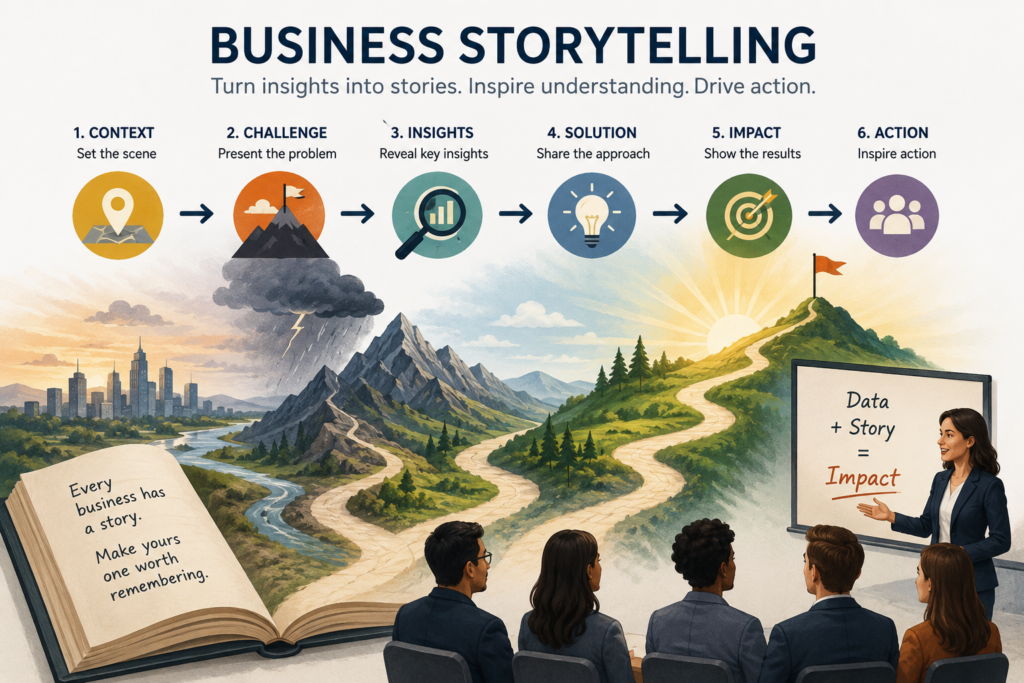
Effective company storytelling is really about organizing complex information in a way that is structured, clear, and easy to follow. It provides audiences with a framework that explains what is happening, why it matters, and what should happen next.
Strong company stories often include:
- a clear challenge, opportunity, or market shift
- a defined point of view that explains strategic direction
- a simple explanation of how the organization creates value
- proof points that build confidence and credibility
- clear communication around priorities and next steps
When these elements are communicated consistently, they create a shared frame of reference across the organization. People spend less time interpreting strategy independently and more time aligning around the same direction.
How Storytelling Improves Decision-Making
One of the biggest advantages of strong company storytelling is its effect on decision-making. In most organizations, decisions are made constantly and at multiple levels. Leaders cannot personally guide every decision being made across teams.
When the organizational story is clear, employees gain a stronger framework for making decisions independently. They can evaluate whether a decision supports the company’s direction, reinforces organizational priorities, and aligns with how the company creates value.
This reduces hesitation and improves execution speed.
Without that clarity, employees often require more approvals, more meetings, and more alignment conversations before moving forward.
Stories Help People Act, Not Just Understand
In business communication, the goal is rarely understanding alone. The goal is action. Organizations want employees, customers, stakeholders, or leadership teams to move decisions forward, prioritize effectively, support change, or take meaningful next steps.
Storytelling helps bridge the gap between information and action.
It organizes information in ways that feel meaningful and relevant, which makes audiences more likely to remember it and apply it. Story also creates context, reducing ambiguity around why decisions matter.
Where Company Storytelling Often Breaks Down
Even organizations with strong messaging frameworks often struggle with consistency. One common issue is that the story exists clearly at the executive level but becomes diluted as it moves across departments and teams.
Different groups may emphasize different priorities. Leaders may communicate the same initiative differently. Teams may add excessive detail that makes the core message harder to follow.
Another common problem is overcomplication.
Organizations often try to communicate everything at once. In an effort to be thorough, they overload presentations, updates, and messaging with excessive information. Instead of improving clarity, this often makes communication more difficult to process and repeat consistently.
There is also the issue of delivery.
A strong narrative on paper is not enough if leaders and teams cannot communicate it effectively during presentations, meetings, customer conversations, or executive briefings.
Why Strong Storytellers Matter as Much as the Story Itself
One pattern we repeatedly observe in Commanding Presence workshops is that organizations often focus heavily on developing messaging while underestimating the importance of how that messaging is delivered.
A company may have an excellent story, but if leaders communicate it inconsistently, overcomplicate it, or struggle to present it clearly under pressure, the impact is significantly reduced.
Strong communicators typically:
- lead with the point clearly and concisely
- simplify complexity without oversimplifying meaning
- adapt communication based on the audience
- communicate with stronger executive presence and confidence
- reinforce key ideas consistently across conversations
These are not natural talents reserved for a small group of people. They are communication skills that can be developed intentionally through practice, coaching, and feedback.
The Role of Communication in Reinforcing the Company Story
Consistency is what transforms messaging into a story that people actually believe and apply consistently. When leaders reinforce the same narrative across meetings, presentations, conversations, and strategic discussions, the story becomes embedded into how employees think and operate.
When communication lacks consistency, priorities become less clear. Teams rely more heavily on individual interpretation, which often creates operational friction and misalignment.
Improving communication, therefore, is not simply about helping individuals become better presenters. It is about strengthening organizational alignment through more consistent communication practices.
What Changes When Storytelling Improves
When organizations improve storytelling and communication clarity, the difference becomes noticeable quickly. Conversations become more focused. Presentations become easier to follow. Strategic priorities feel clearer. Decisions move faster because there is less ambiguity surrounding direction and expectations.
Customers also tend to understand value propositions more quickly because messaging feels clearer and more relevant. Employees gain a stronger understanding of priorities and how their work connects to larger organizational goals.
The organization begins operating with greater consistency, not because complexity disappeared, but because communication became more effective.
A More Practical Way to Think About Storytelling
At its core, business storytelling is not about performance or creativity for its own sake.
It is about clarity.
It is about organizing ideas, priorities, data, and strategy into communication that people can understand, remember, and apply consistently.
That requires structure, discipline, communication awareness, and the ability to communicate effectively in real-world business situations.
When those elements come together, the company story stops being something that exists only inside presentations or messaging documents.
It becomes something reinforced consistently through how leaders, managers, sales teams, and employees communicate every day.
And that is where storytelling starts creating measurable impact across alignment, communication effectiveness, decision-making, and organizational performance.
Frequently Asked Questions
Why is company storytelling important for business performance?
Strong company storytelling helps employees, customers, and stakeholders understand organizational priorities, strategic direction, and value more clearly. This improves alignment, decision-making, communication consistency, and organizational execution.
How does storytelling improve leadership communication?
Storytelling helps leaders organize complex ideas into communication that is easier to follow, remember, and apply. It creates stronger clarity, engagement, and audience understanding during presentations, meetings, and strategic discussions.
What makes a business story effective?
Effective business stories are structured, concise, audience-focused, and connected to organizational priorities. They clearly explain what matters, why it matters, and what actions should happen next.
Why do organizations struggle with communication consistency?
Communication inconsistency often happens when messaging becomes overly complex, leaders communicate priorities differently, or employees interpret strategy independently without a shared communication framework.
For professionals looking to elevate their business storytelling skills, among other skills, we offer a range of specialized communication and leadership development programs. These include Presentation Skills Training, Public Speaking Workshops for Individuals, and Corporate Team & Group Training programs across Canada and the United States.