

Conflict is a natural part of workplace collaboration, especially when people with different priorities, perspectives, and communication styles work under pressure. Strong teams do not avoid disagreement; they manage it in ways that create clarity, accountability, and better decisions.
Many capable professionals have never been taught how to handle conflict constructively. As a result, they may rely on avoidance, instinct, or emotional reactions that increase tension. Effective conflict management means addressing issues early, clearly, and professionally. It requires listening, emotional regulation, accountability, and the ability to guide difficult conversations toward productive outcomes.
After more than 25 years of coaching, we have seen these skills strengthen trust, collaboration, and organizational resilience. Conflict management is not a soft skill, it is a core workplace capability.
Key Takeaways
- Conflict is a normal and unavoidable part of organizational collaboration and communication
- Strong conflict management skills improve communication clarity, accountability, trust, and team performance
- Effective conflict management focuses on resolution, emotional regulation, and productive communication rather than confrontation
Why Conflict Is Increasing in Modern Workplaces
The nature of work has changed significantly over the past decade.
Organizations are more collaborative, cross-functional, and interconnected than ever before. Teams frequently work across departments, reporting structures, time zones, communication styles, and competing priorities. Projects often involve multiple stakeholders with different objectives, responsibilities, and pressures.
At the same time, organizations still expect speed, efficiency, adaptability, and strong execution. That combination naturally increases tension.
One challenge we frequently see is that workplace conflict is often treated as an abnormal disruption rather than as a predictable outcome of modern organizational complexity. In reality, conflict becomes more likely any time organizations increase collaboration while operating under pressure.
For additional insights into psychological safety and workplace communication, see this research on psychological safety and workplace communication from Harvard Business Review, which explores how trust, communication openness, and interpersonal safety influence collaboration, learning, feedback, and team effectiveness in workplace environments.
Hybrid and remote work environments have added additional communication complexity. Without regular in-person interaction, professionals lose many of the informal conversations and clarification opportunities that naturally help resolve misunderstandings earlier. Communication becomes more dependent on email, virtual meetings, and shorter interactions where tone and intent are often interpreted differently.
This increases the likelihood of communication breakdowns, unresolved tension, unclear expectations, passive-aggressive communication, and frustration building quietly over time.
Another important factor involves communication speed. In many organizations, professionals are expected to respond quickly while balancing large workloads and competing demands. Under pressure, communication often becomes shorter, more reactive, and less intentional. Listening quality decreases, patience decreases, and small misunderstandings can escalate more quickly than they otherwise would.
For additional insights into communication under stress and emotional regulation, see this research on stress and emotional regulation from the American Psychological Association, which explores how stress affects cognitive processing, emotional regulation, communication clarity, and interpersonal interaction in high-pressure environments.
One pattern we frequently observe in workshops is that professionals often underestimate how much unresolved tension affects team performance over time. Even relatively small conflicts can begin influencing collaboration, communication openness, trust, accountability, and meeting dynamics if they are not addressed constructively.
This is one reason conflict management skills have become increasingly important for both leaders and teams. Strong conflict management reduces organizational friction before it spreads.
Why Professionals Often Avoid Difficult Conversations
Most professionals do not avoid conflict because they do not care. They avoid it because they want to preserve relationships, avoid discomfort, reduce tension, or prevent conversations from escalating emotionally. In the moment, avoidance often feels easier and safer than addressing an issue directly.
Unfortunately, avoidance rarely resolves the underlying problem. One challenge we frequently see in workshops is that professionals often delay difficult conversations for too long. They hope situations will improve naturally, or they attempt to minimize issues rather than address them clearly. Over time, unresolved tension frequently becomes more emotionally charged and more difficult to resolve.
For additional insights into conflict avoidance and workplace defensiveness, see this research on conflict avoidance behavior from Mind Tools, which explores how defensiveness, avoidance behaviors, and poor listening habits can negatively affect workplace communication, conflict resolution, and professional relationships.
Communication patterns also begin changing when conflict remains unresolved. Instead of direct and open communication, interactions become more guarded, indirect, or emotionally reactive. Teams may experience passive resistance, reduced collaboration, unclear accountability, defensive reactions, and lower trust across departments.
Another major challenge involves emotional escalation. When professionals feel criticized, misunderstood, or pressured, conversations can quickly shift from problem-solving into emotional self-protection. Listening decreases, defensiveness increases, and communication becomes more focused on protecting positions rather than resolving issues productively.
For additional insights into defensiveness, emotional regulation, and communication psychology, see this research on emotional regulation and interpersonal communication from Psychology Today, which explores how emotional regulation affects communication behavior, defensiveness, interpersonal interaction, and responses during stressful or emotionally charged conversations.
One challenge we frequently observe in workplace communication is that defensiveness often increases when professionals feel emotionally overloaded, misunderstood, or pressured during difficult conversations. Stronger emotional regulation typically improves communication clarity, listening behavior, conflict resolution, and overall interpersonal effectiveness under pressure.
Strong conflict management training changes this significantly. Professionals begin separating the issue itself from personal judgment. This immediately improves communication quality because discussions become more objective, more structured, and less emotionally reactive.
Another important shift involves listening. Many professionals believe they are listening during conflict when they are actually preparing rebuttals internally or waiting for opportunities to defend their position. Strong conflict management improves listening dramatically because professionals learn how to stay focused on understanding rather than reacting.
One pattern we frequently observe after training is that professionals become significantly calmer during difficult conversations because they stop viewing conflict as something to avoid or “win.” Instead, they begin focusing more intentionally on clarity, understanding, accountability, and practical resolution.
This shift changes communication behavior quickly. Conversations become more direct without becoming more aggressive. Listening improves, defensiveness decreases, and tension becomes easier to manage productively.
How Strong Conflict Management Improves Team Performance
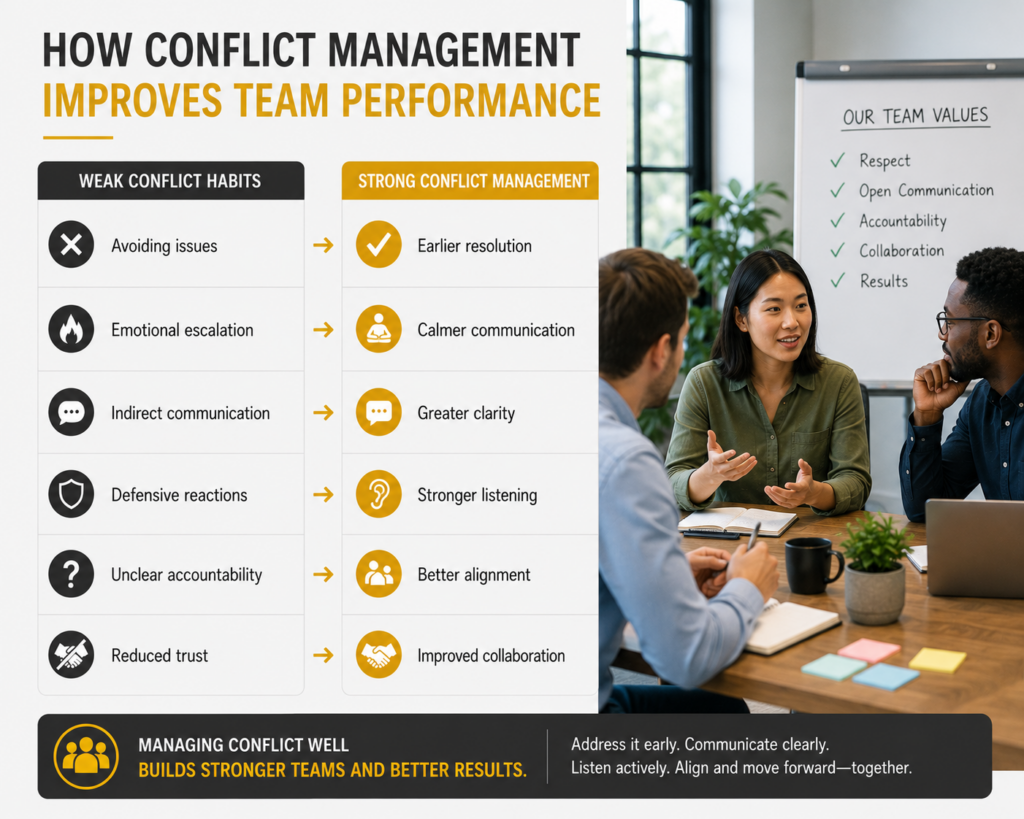
Conflict management directly affects how teams function day to day. When conflict is handled poorly, organizations often experience communication breakdowns, unresolved tension, collaboration challenges, lower trust, and slower decision-making. Conversations become more guarded, accountability weakens, and professionals begin avoiding issues rather than addressing them directly.
Strong conflict management creates the opposite effect. One of the biggest organizational shifts we frequently observe after conflict management training is that conversations become more open, more direct, and significantly more constructive. Professionals begin addressing issues earlier instead of allowing frustration to build quietly over time.
This creates stronger accountability, clearer expectations, improved collaboration, better cross-functional communication, and stronger trust across teams. Another major improvement often involves emotional regulation under pressure. Professionals frequently report feeling calmer and better prepared during difficult conversations because they have stronger communication frameworks for navigating tension.
Instead of reacting emotionally or defensively, they become more intentional about clarifying issues, listening actively, understanding different perspectives, and guiding conversations toward resolution. This often improves communication quality almost immediately.
Another important change involves leadership behavior. Managers and leaders who strengthen conflict management skills often become more effective at addressing issues early, clarifying expectations, and maintaining professionalism during difficult conversations. Teams begin feeling safer raising concerns because conversations become less emotionally unpredictable and more solution-focused.
One pattern we frequently observe during workshops is that teams become more direct while simultaneously becoming more collaborative. Professionals rely less on avoidance, passive frustration, or indirect communication and begin communicating concerns more clearly and constructively. This significantly reduces organizational friction.
Clients frequently report that difficult conversations happen earlier, accountability discussions become clearer, communication becomes calmer under pressure, collaboration improves, and unresolved tension decreases. These improvements often appear quickly because stronger communication structure changes how professionals approach conflict almost immediately.
Another major improvement involves trust. Trust does not improve because conflict disappears. Trust improves because professionals gain confidence that issues can be discussed openly, respectfully, and productively without damaging relationships unnecessarily.
That shift creates more resilient teams, stronger working relationships, and more effective organizational collaboration overall. For organizations looking to improve communication quality, collaboration, accountability, emotional regulation, and difficult conversation capability, our Conflict Management Training programs focus heavily on practical workplace situations, communication under pressure, emotional awareness, structured conflict resolution techniques, and real-world application.
Frequently Asked Questions
Why are conflict management skills important at work?
Conflict management skills help professionals address issues early, maintain productive communication, reduce tension, and improve collaboration across teams and departments.
Why do professionals avoid difficult conversations?
Many professionals avoid difficult conversations because they fear damaging relationships, escalating tension, or creating discomfort. Unfortunately, avoidance often increases organizational friction over time.
How does conflict management improve team performance?
Strong conflict management improves communication clarity, accountability, collaboration, trust, and problem-solving effectiveness within teams.
What causes conflict escalation at work?
Conflict often escalates because of emotional reactions, unclear expectations, indirect communication, poor listening, unresolved tension, and communication under stress.
Can conflict management skills be developed through training?
Yes. Conflict management skills improve significantly through structured frameworks, practice, coaching, emotional awareness development, and real-world communication exercises.
Conclusion
Conflict is a natural and unavoidable part of how modern organizations operate. Whenever people work together under pressure while balancing competing priorities, deadlines, and different perspectives, some level of tension will emerge. The goal is not to eliminate conflict entirely. The goal is to manage it in ways that improve communication, strengthen accountability, maintain trust, and support productive collaboration.
Strong conflict management skills help professionals address issues earlier, communicate more directly, regulate emotional reactions more effectively, and guide difficult conversations toward constructive outcomes. As organizations become increasingly collaborative and communication-driven, professionals who manage conflict well often become more effective leaders, stronger teammates, and more trusted communicators. In many cases, organizational performance improves not because conflict disappears, but because teams become significantly better at handling it.
For professionals looking to elevate their conflict management skills, we offer Communication Skills Training, Negotiation Skills Training and Conflict Management Training programs across Canada and the United States.