

Conflict is a normal part of leadership. Competing priorities, deadlines, accountability, and organizational change inevitably create disagreement. Avoiding difficult conversations rarely resolves problems. More often, it allows them to grow.
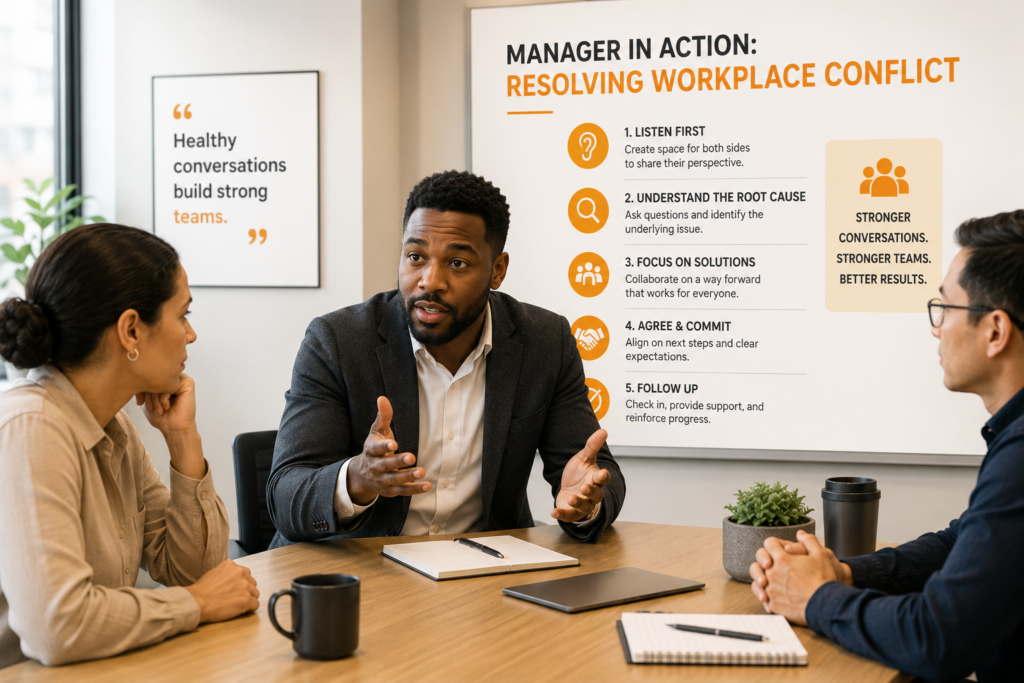
In our workshops, we frequently see capable leaders who are well prepared for operational challenges but less prepared for emotionally charged or uncomfortable conversations. These situations require clear communication, effective listening, emotional control, and the ability to keep discussions productive.
Effective conflict management is not about confrontation. It is about addressing issues early, maintaining professionalism, and guiding conversations toward practical outcomes.
After more than 25 years of delivering training to leaders, we have consistently seen unresolved conflict weaken trust, collaboration, accountability, and decision-making. High-performing teams still experience disagreement, but their leaders know how to address it constructively and move conversations toward solutions.
Key Takeaways
- Conflict management is a core leadership communication capability
- Avoiding difficult conversations often creates larger problems.
- Addressing issues early prevents unnecessary escalation
- Emotional control helps leaders remain productive under pressure
- Strong conflict management improves trust, accountability, and alignment.
Why Conflict Becomes More Difficult in Modern Organizations
Leadership communication has become significantly more complex over the past decade. Organizations now operate with faster timelines, greater cross-functional collaboration, hybrid work environments, distributed teams, and increasingly interconnected decision-making structures. As a result, leaders are navigating more competing priorities, more communication channels, and more interpersonal complexity than ever before. The ability to communicate clearly, align stakeholders, and address challenges quickly has become a critical leadership capability rather than simply a management skill.
One challenge we frequently observe in workshops is that conflict often develops not because of poor intentions, but because expectations, priorities, communication styles, or assumptions are not fully aligned. Team members may believe they are working toward the same goal while operating from very different understandings of responsibilities, timelines, or desired outcomes. When these gaps are not identified and addressed early, they often create misunderstandings that gradually become larger communication problems.
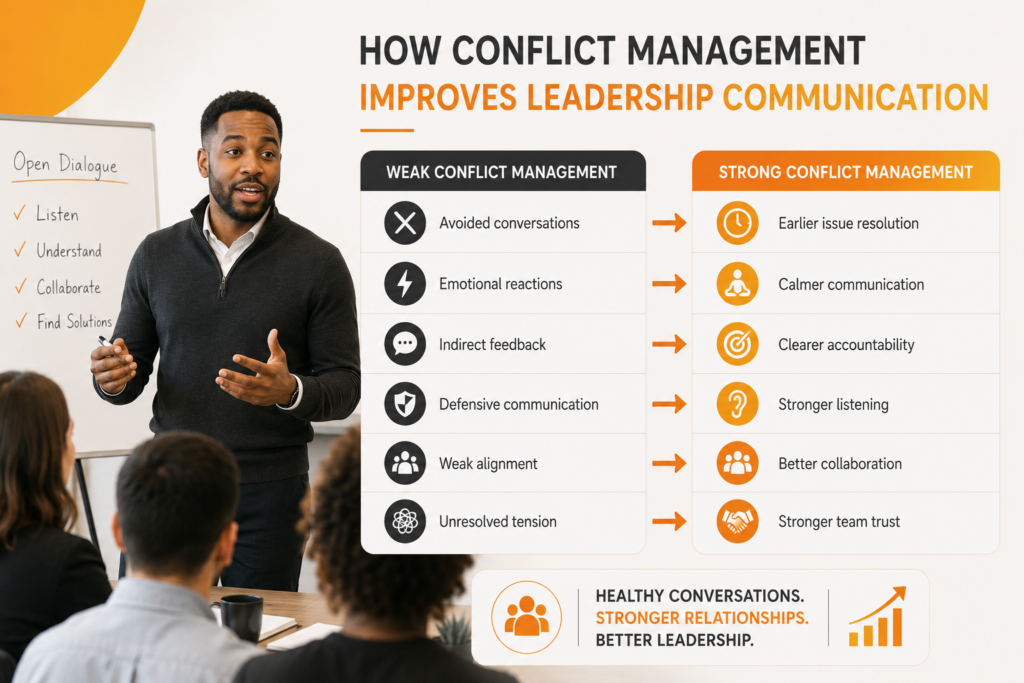
The result is frequently unclear accountability, indirect communication, unresolved tension, delayed conversations, and weaker alignment between teams. Over time, these issues can slow decision-making, reduce trust, and create unnecessary friction across the organization. Leaders who communicate proactively and address alignment issues early are often able to prevent many conflicts before they escalate, creating stronger collaboration, clearer expectations, and more productive working relationships throughout the organization.
For additional insights into psychological safety and organizational communication, see this research on psychological safety and workplace communication from Harvard Business Review, which explores how trust, communication openness, and team dynamics influence collaboration, learning, and organizational performance. One pattern we frequently observe is that leaders often wait too long before addressing issues directly.
Many leaders delay difficult conversations because they hope situations will resolve naturally, worry about damaging relationships, or simply want to avoid discussions that feel uncomfortable or emotionally charged. Unfortunately, delayed conversations often become significantly harder over time. Frustration builds, assumptions increase, communication becomes more reactive, and small issues that could have been addressed early frequently evolve into much larger organizational problems. This challenge becomes even more pronounced in hybrid and remote work environments where communication lacks many of the non-verbal cues and informal interactions that often help resolve tension before it escalates.
One challenge we frequently observe in virtual environments is that misunderstandings can develop and intensify more quickly because communication tends to become shorter, less contextual, and more transactional. Emails, chat messages, and virtual meetings can reduce clarity while increasing interpretation and assumption. Strong conflict management skills therefore become even more important because leaders must create alignment and clarity intentionally rather than relying on proximity or informal conversations to resolve issues naturally. At the same time, many leaders struggle with the emotional side of conflict. The issue is rarely a lack of professionalism. More often, conflict situations trigger defensiveness, frustration, stress, or emotional reactivity, which can weaken listening, reduce objectivity, and shift conversations away from productive resolution. Effective conflict management helps leaders remain composed under pressure, maintain perspective, and guide conversations toward solutions rather than allowing emotions to drive outcomes.
For additional insights into emotional regulation and leadership communication, see this research on emotional intelligence and leadership communication from the Center for Creative Leadership, which explores how emotional regulation, self-awareness, and emotional intelligence influence leadership effectiveness, communication composure, and decision-making under pressure.
Strong conflict management helps leaders remain calmer, more structured, and more intentional during difficult conversations.
This significantly improves communication outcomes.
Why Leaders Often Avoid Difficult Conversations
Most leaders do not struggle with conflict because they lack good intentions. More often, they struggle because they lack a clear structure for managing difficult conversations productively. One challenge we frequently observe is that leaders enter conflict situations without a framework for guiding the discussion. As a result, they may avoid conversations entirely, soften accountability too much, communicate indirectly, become overly emotional or reactive, or lose objectivity once the discussion becomes uncomfortable. In many cases, leaders are concerned about damaging relationships or escalating tension, so they postpone conversations until frustration has already built on both sides. Unfortunately, delaying difficult discussions rarely improves the situation and often weakens both communication and trust over time.

For additional insights into conflict resolution and workplace communication, see this research on workplace conflict and communication effectiveness from the Harvard Law School Program on Negotiation, which explores how communication, active listening, emotional awareness, and collaborative problem-solving contribute to more effective conflict resolution in professional environments.
One of the most common patterns we observe after conflict management training is that leaders become significantly more confident once they learn how to structure difficult conversations clearly and professionally. Rather than approaching conflict emotionally or reactively, they begin focusing on facts instead of assumptions, clarity instead of avoidance, outcomes instead of blame, and listening instead of reacting. This shift creates calmer and more productive conversations because the discussion becomes focused on solving problems rather than defending positions. As communication structure improves, difficult conversations often become clearer, less emotionally charged, easier to resolve, and more focused on practical outcomes. In many cases, these conversations strengthen trust because employees and stakeholders feel issues are being addressed directly and professionally.
Another major challenge involves listening. During conflict situations, leaders often listen primarily to defend their own position rather than fully understanding the other person’s perspective. When this happens, people stop feeling heard, communication quality declines, and productive dialogue becomes much more difficult. Strong conflict management improves listening because leaders become more intentional about separating emotional reactions from communication objectives. They learn how to stay curious, gather information, and understand concerns before moving toward solutions. This creates a more balanced discussion and often uncovers underlying issues that might otherwise remain hidden.
An equally important shift involves accountability communication. Many leaders struggle to balance directness with professionalism, often becoming either overly soft and indirect or overly aggressive and reactive. Effective conflict management helps leaders communicate expectations, accountability, and feedback clearly while maintaining professionalism and respect. This becomes particularly valuable during performance discussions, cross-functional disagreements, stakeholder alignment conversations, leadership conflicts, and difficult feedback situations where relationships and outcomes are both important. One of the biggest changes we frequently see during workshops is that leaders begin addressing issues earlier rather than allowing frustration to build over time. That shift alone often prevents larger organizational problems from developing and helps create a culture where communication remains open, direct, and productive.
For additional insights into conflict resolution and workplace communication, see this research on workplace conflict and communication effectiveness from the Harvard Law School Program on Negotiation, which explores how communication, active listening, emotional awareness, and collaborative problem-solving contribute to more effective conflict resolution in professional environments.
How Conflict Management Improves Organizational Performance
Conflict management directly affects organizational performance because communication quality directly influences collaboration, alignment, accountability, and trust. When leaders avoid conflict or handle difficult conversations inconsistently, organizations often experience slower decision-making, reduced accountability, communication breakdowns, weaker cross-functional alignment, and declining team trust. Over time, these patterns create organizational friction that affects both culture and execution.
One challenge we frequently observe is that organizations underestimate how much unresolved interpersonal tension affects day-to-day operations. Meetings become less productive, teams hesitate to raise concerns openly, communication becomes more cautious or indirect, and collaboration weakens because important issues remain unresolved beneath the surface. While these problems may not always be immediately visible, they often create significant barriers to organizational effectiveness.
Strong conflict management helps reduce that friction by creating an environment where difficult conversations can be handled respectfully, directly, and professionally. As employees gain confidence that issues will be addressed constructively, trust increases, communication becomes more open, accountability improves, and teams become more willing to collaborate through challenges rather than avoid them.
One of the biggest organizational shifts we frequently observe after training is that leaders begin handling conversations more consistently across teams and departments. This creates stronger alignment because communication expectations become clearer and more predictable. When leaders approach conflict with a common framework and a consistent communication style, employees are better able to understand expectations, address concerns, and work through disagreements productively.
Another major improvement often involves communication under pressure. Many leaders initially struggle during emotionally charged conversations because they become reactive or lose communication structure as tension increases. Strong conflict management helps leaders maintain composure, objectivity, and communication clarity even during difficult situations, allowing them to focus on solutions rather than emotional reactions.
Clients frequently report improvements in accountability conversations, leadership communication, cross-functional collaboration, and team trust following conflict management training. Leaders often become more direct, calmer under pressure, stronger listeners, and more confident addressing issues early before they become larger organizational problems.
For organizations looking to improve leadership communication, accountability, collaboration, and communication effectiveness during difficult conversations, our Conflict Management Training programs focus heavily on practical workplace application, real-world leadership situations, communication under pressure, and structured conversation frameworks designed to improve organizational communication outcomes.
Frequently Asked Questions
Why are conflict management skills important for leaders?
Conflict management skills help leaders address issues early, maintain accountability, strengthen communication, and prevent small problems from escalating into larger organizational issues.
Why do leaders avoid difficult conversations?
Many leaders avoid difficult conversations because they fear damaging relationships, escalating tension, or handling conversations poorly under pressure.
How does conflict management improve organizational performance?
Strong conflict management improves communication clarity, accountability, collaboration, decision-making, and team trust across organizations.
Why is conflict more difficult in hybrid and remote workplaces?
Hybrid and remote communication environments reduce informal communication and non-verbal context, which can increase misunderstanding and communication friction.
Can conflict management skills be learned?
Yes. Conflict management is a practical leadership skill that improves significantly through structured frameworks, practice, coaching, and communication feedback.
Conclusion
Conflict management is no longer simply an interpersonal skill. In today’s workplace, it has become a core leadership communication capability. Leaders are expected to navigate difficult conversations with clarity, professionalism, emotional control, and organizational awareness while maintaining relationships and keeping teams aligned around shared goals.
Strong conflict management helps leaders address issues early, communicate expectations more clearly, and guide conversations toward productive outcomes rather than allowing tension to build over time. As organizations become more collaborative, cross-functional, and communication-driven, the ability to manage conflict effectively plays a direct role in accountability, trust, alignment, and overall team performance.
Leaders who handle conflict well often create stronger communication cultures because employees gain confidence that concerns can be discussed openly, respectfully, and constructively. This encourages greater collaboration, clearer accountability, and more productive problem-solving across teams and departments.
In many organizations, the difference between organizational friction and organizational momentum comes down to how leaders handle difficult conversations. When conflict is managed effectively, communication improves, trust grows, and teams are better able to move forward together even when challenges, disagreements, or competing priorities arise.
For professionals looking to elevate their conflict management skills Communication Skills Training, Negotiation Skills Training and Conflict Management Training programs across Canada and the United States.