
Managers negotiate daily through conversations about priorities, workloads, timelines, resources, accountability, and stakeholder expectations. These discussions directly affect how efficiently work moves across teams.
Many managers receive little formal negotiation training, despite being expected to balance competing priorities, influence outcomes, and manage difficult conversations. Technical expertise may earn a promotion, but leadership requires different communication skills. Effective workplace negotiation is not about winning. It is about creating alignment, communicating constraints, balancing priorities, and maintaining trust.
After more than 25 years of coaching, we have seen strong negotiation skills improve clarity, collaboration, execution, and confidence under pressure. Negotiation is now a core management capability, not a specialized executive skill.
Key Takeaways
- Managers negotiate constantly through conversations involving priorities, workload, accountability, timelines, and stakeholder alignment
- Strong negotiation skills improve communication clarity, operational flow, and cross-functional collaboration
- Effective workplace negotiation is primarily about alignment, structure, and communication clarity rather than “winning” discussions
Why Negotiation Has Become a Core Management Skill
Modern organizations are increasingly collaborative, interconnected, and communication-driven. Managers rarely operate in environments where they have complete authority over decisions, timelines, staffing, budgets, or organizational priorities. Instead, they work within systems that require constant coordination across departments, leadership groups, stakeholders, and project teams. As a result, managers must influence outcomes through conversation rather than authority alone.

One challenge we frequently see is that many managers still think of negotiation as something reserved for procurement teams, legal departments, or high-level business deals. In reality, negotiation is embedded into the daily communication patterns of management. Managers negotiate timelines, project scope, staffing priorities, accountability expectations, workloads, and resource allocation constantly throughout the workday.
For additional insights into negotiation psychology and influence, see this research on emotional intelligence in negotiation from the Program on Negotiation at Harvard Law School, which explores how emotional awareness, emotion recognition, and interpersonal understanding influence negotiation outcomes, trust, collaboration, and professional influence.
This becomes especially important in organizations where work moves quickly and collaboration spans multiple teams or functions. In these environments, managers constantly face situations where competing demands must be balanced without damaging relationships or slowing execution. The ability to negotiate calmly and clearly often determines whether projects move efficiently or become stalled by confusion, frustration, or unresolved priorities.
One of the biggest challenges managers face is balancing outcomes with relationships. Managers must advocate for priorities and protect team capacity while still maintaining collaboration, trust, and professionalism across departments. Without a structured negotiation approach, many managers default toward one of two extremes. Some become overly accommodating because they want to avoid tension or preserve harmony. Others rely too heavily on authority, positional pressure, or emotional escalation to move conversations forward. Neither approach consistently creates strong long-term outcomes.
For additional insights into decision-making and communication framing, see this research on framing in negotiation from the Program on Negotiation at Harvard Law School, which explores how the way information is presented can influence perception, decision-making, negotiation outcomes, and professional communication.
Strong workplace negotiation creates a much more balanced communication approach. Managers become more intentional about clarifying expectations, understanding competing priorities, communicating constraints, and aligning around practical outcomes that support both execution and relationships. One pattern we frequently observe after training is that managers often become significantly more aware of how frequently they negotiate during the workday once they begin recognizing negotiation as a communication process rather than a formal event.
That awareness alone changes how conversations are approached. Instead of reacting emotionally or improvising under pressure, managers begin entering conversations with greater structure, preparation, and clarity. This improves communication effectiveness almost immediately because conversations become less reactive and more outcome-focused.
Another major shift involves preparation. Many managers enter difficult conversations focused almost entirely on their own immediate objective rather than evaluating broader organizational priorities, stakeholder concerns, relationship dynamics, or potential pushback. Strong negotiation preparation changes this significantly because managers begin evaluating not only what outcomes are required, but also what constraints exist, where flexibility is possible, and how competing stakeholders may interpret the discussion.
This dramatically improves communication clarity and negotiation confidence because managers no longer feel forced to improvise emotionally during difficult conversations.
Why Managers Often Struggle With Workplace Negotiation
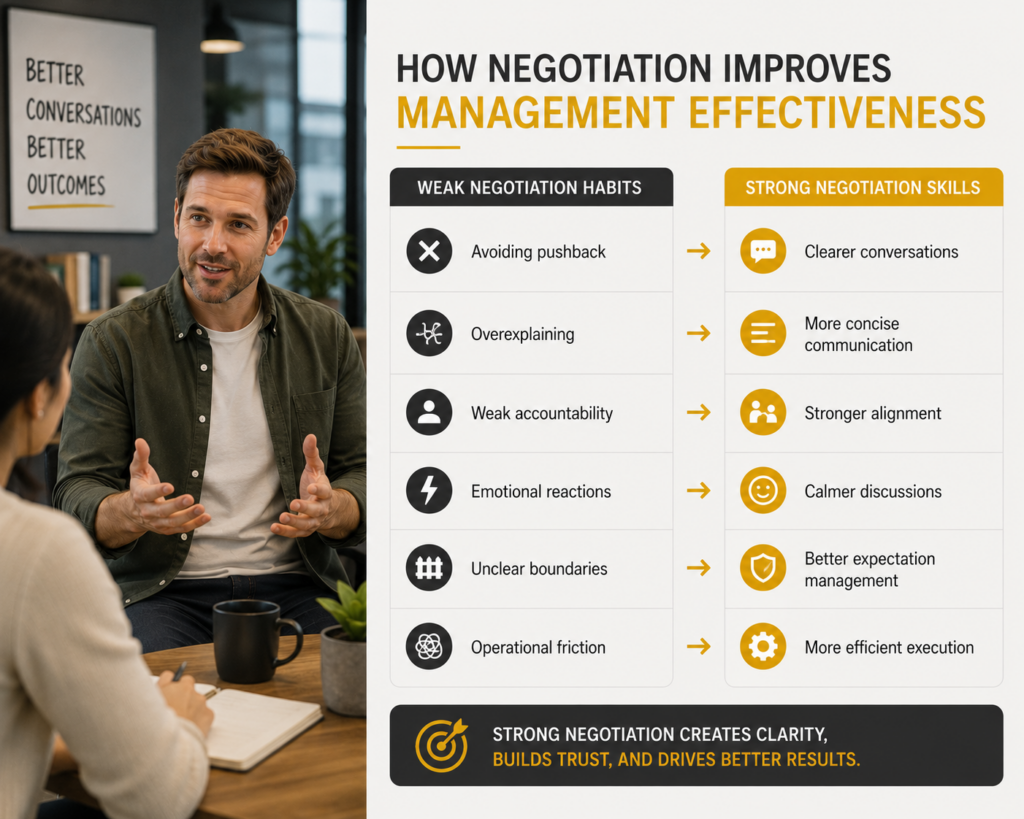
Most workplace negotiation problems are not caused by lack of intelligence or professionalism. They are caused by pressure, ambiguity, and lack of communication structure. One challenge we frequently see in workshops is that many managers avoid pushback because they worry about appearing difficult, damaging relationships, escalating tension, or creating unnecessary conflict. As a result, conversations often become overly accommodating, indirect, or unclear.
Unfortunately, avoiding negotiation rarely eliminates tension. It usually delays it. Unclear expectations create confusion, weak accountability conversations create inconsistency, and unresolved tension frequently becomes larger and more emotionally charged over time.
For additional insights into conflict avoidance and workplace communication behavior, see this research on preventing and managing team conflict from Harvard Division of Continuing Education, which explains how open communication, active listening, and addressing conflict directly can help reduce workplace tension and improve team effectiveness.
Another major challenge involves overexplaining positions. Many managers feel pressure to justify every decision extensively because they want to maintain consensus or reduce resistance. While the intention is usually positive, excessive explanation often weakens communication rather than strengthening it. One challenge we frequently observe is that managers sometimes communicate too defensively under pressure. Instead of clearly stating priorities, expectations, or boundaries, conversations become overloaded with background information, qualification, or unnecessary detail.
Strong negotiation helps managers communicate more directly and more strategically. Instead of overexplaining, managers begin focusing more intentionally on priorities, outcomes, constraints, accountability, and next steps. This creates clearer and more productive discussions because conversations become easier for stakeholders to process and respond to.
Another major issue involves emotional reactions under pressure. Negotiation conversations frequently involve competing demands, organizational tension, conflicting priorities, or resource limitations. In these situations, managers may become reactive because conversations feel politically sensitive or personally challenging.
For additional insights into stress, emotional regulation, and decision-making, see this research on stress and decision-making from the American Psychological Association, which explores how stress affects cognitive performance, emotional regulation, judgment, and interpersonal interactions. These factors often play a significant role in negotiation, influence, and high-stakes professional conversations.
One challenge we frequently see is that managers sometimes interpret pushback as resistance or personal disagreement rather than as part of the negotiation process itself. Strong negotiation training changes this perspective significantly. Managers begin seeing pushback as information rather than confrontation. This shift improves listening dramatically because managers stop reacting emotionally and start focusing more intentionally on understanding priorities, operational constraints, and stakeholder concerns.
Another important shift involves accountability communication. Many managers struggle to balance professionalism with directness during difficult conversations. They may soften expectations too much, avoid difficult feedback, or delay accountability discussions because they fear tension or discomfort. Strong negotiation structure improves this considerably because managers become more comfortable clarifying expectations, defining boundaries, communicating priorities, and addressing resistance professionally without sounding aggressive or confrontational.
One pattern we frequently observe after training is that managers often become significantly calmer during difficult conversations because they no longer feel responsible for emotionally “winning” interactions. Instead, they focus more intentionally on guiding discussions toward realistic and productive outcomes. This improves both communication clarity and relationship management simultaneously.
Strong negotiation also improves listening quality significantly. Effective negotiators are not simply better at advocating for their own position. They are significantly better at understanding motivations, concerns, and operational realities affecting other stakeholders. This creates more collaborative conversations and reduces unnecessary organizational friction across teams.
How Strong Negotiation Skills Improve Organizational Performance
Negotiation directly affects how efficiently work moves through organizations. When managers negotiate effectively, communication becomes clearer, expectations become more aligned, and collaboration becomes significantly more efficient. One challenge we frequently see is that organizations often underestimate how much operational friction is caused by weak negotiation habits.
Projects slow down because expectations are unclear. Teams duplicate work because priorities are not aligned. Meetings become repetitive because discussions lack structure and resolution. Cross-functional relationships weaken because unresolved issues continue resurfacing without clear ownership or alignment.
Strong negotiation skills reduce this friction significantly.
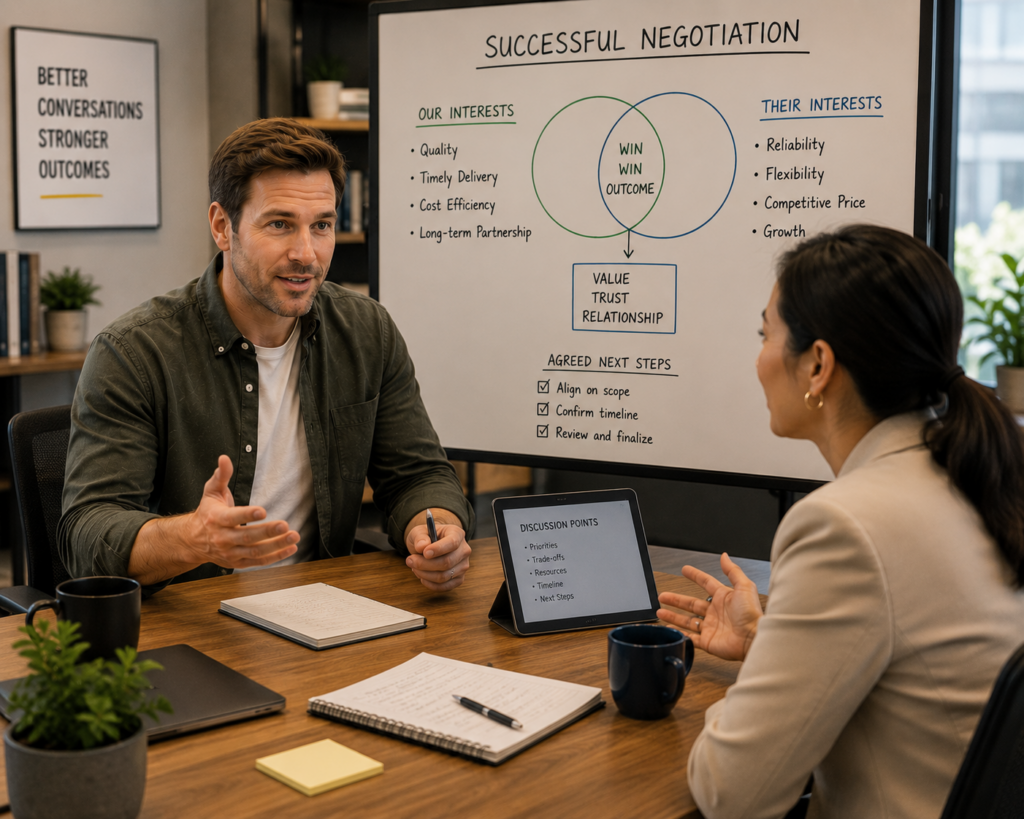
One of the biggest organizational shifts we frequently observe after negotiation training is that conversations become more direct, more outcome-focused, and less emotionally reactive. Managers begin addressing issues earlier instead of allowing confusion or frustration to build over time. This creates faster alignment, clearer accountability, stronger collaboration, and reduced escalation across teams.
Another major improvement often involves cross-functional communication. Managers who negotiate effectively become better at balancing competing priorities while still maintaining strong relationships with peers and stakeholders. This improves stakeholder alignment, communication consistency, project coordination, and operational execution throughout the organization.
Another important change involves confidence under pressure. Many managers initially struggle during difficult conversations because they feel uncertain about how to push back professionally or maintain composure while navigating competing demands. After structured negotiation training, managers frequently report feeling calmer, more prepared, and more confident during high-pressure conversations. They stop improvising emotionally and begin communicating more intentionally.
One pattern we frequently observe during workshops is that managers become significantly more effective once they learn how to frame conversations around shared outcomes instead of competing positions. This changes communication dynamics dramatically because conversations become less defensive, listening improves, alignment happens earlier, and discussions become more productive overall.
Clients frequently report that after negotiation training, meetings become shorter and more focused, accountability discussions become clearer, managers handle pushback more professionally, and stakeholder alignment improves significantly. These improvements often appear quickly because stronger negotiation structure improves communication quality almost immediately.
For organizations looking to improve communication clarity, stakeholder alignment, accountability discussions, and operational collaboration, our Negotiation Skills Training programs focus heavily on practical workplace negotiation, real-world management conversations, communication under pressure, and structured negotiation techniques designed to improve organizational effectiveness across teams and departments.
Frequently Asked Questions
Why do managers need negotiation skills?
Managers negotiate priorities, timelines, resources, expectations, and stakeholder alignment constantly throughout the workday. Strong negotiation skills help managers navigate these conversations more effectively while maintaining collaboration and accountability.
Is workplace negotiation different from sales negotiation?
Yes. Workplace negotiation is usually focused on alignment, communication clarity, collaboration, and balancing competing organizational priorities rather than transactional outcomes.
Why do managers struggle with negotiation?
Many managers lack formal negotiation training and often rely on instinct during difficult conversations, pushback, or high-pressure situations. This can create reactive communication, unclear expectations, or overly accommodating behavior.
How do negotiation skills improve organizational performance?
Strong negotiation improves communication clarity, accountability, collaboration, decision-making efficiency, and stakeholder alignment across organizations.
Can negotiation skills be developed through training?
Yes. Negotiation skills improve significantly through structured frameworks, practice, coaching, preparation techniques, and real-world application.
Conclusion
Negotiation is no longer a specialized skill reserved for sales or procurement teams. It has become a core management capability that directly affects communication quality, stakeholder alignment, operational flow, and organizational execution. Managers negotiate constantly through conversations involving timelines, accountability, workload, priorities, collaboration, and competing demands.
Strong negotiation skills help managers navigate these conversations with greater structure, clarity, calmness, and professionalism while maintaining productive working relationships. As organizations become increasingly cross-functional and communication-driven, managers who negotiate effectively often become stronger leaders because they reduce friction, improve accountability, create better alignment, and help work move forward more efficiently. In many cases, organizational performance improves simply because workplace conversations become clearer, more intentional, and more productive.
For professionals looking to elevate their negotiation skills, we offer Communication Skills Training, Negotiation Skills Training and Conflict Management Training programs across Canada and the United States.