

Presentation skills influence everyday workplace communication, including meetings, executive briefings, project updates, client conversations, and stakeholder discussions. In our workshops, we frequently see knowledgeable professionals weaken strong ideas through excessive detail, unclear structure, or limited audience awareness. Expertise has less impact when people cannot quickly understand the message or determine what action should follow.
After more than 25 years delivering presentation and communication skills training, we have consistently seen that effective presentation skills are less about performance or charisma and more about clarity, structure, conciseness, and audience connection. When professionals strengthen these capabilities, meetings become more productive, leadership communication improves, and ideas become easier to understand and act upon.
For additional insights into leadership communication and professional perception, see this research on leadership communication and credibility from Forbes, which explores how communication clarity and leadership communication influence professional credibility and organizational influence.
Key Takeaways
- Presentation skills affect everyday workplace communication, not just formal presentations
- Weak structure and excessive detail often reduce message clarity and audience engagement
- Strong presentation skills improve leadership communication, meeting effectiveness, and organizational alignment
Why Presentation Skills Affect Everyday Workplace Communication

In modern workplace environments, professionals are expected to communicate constantly. They are expected to explain recommendations clearly, contribute strategically during meetings, summarize information concisely, lead conversations effectively, and communicate under pressure in ways that help move discussions forward productively.
These expectations apply across organizations, particularly for managers, directors, executives, subject matter experts, project leaders, and client-facing professionals.
One challenge we frequently see is that professionals often approach communication reactively instead of strategically. They may know their material extremely well but struggle to organize information clearly, simplify complexity, communicate concisely, maintain audience attention, or manage discussion flow effectively.
As a result, presentations and meetings often become longer, less focused, and more mentally exhausting for audiences.
For additional insights into leadership communication and audience engagement, see this research on active listening and leadership effectiveness from the Center for Creative Leadership, which explores how listening, audience awareness, and communication responsiveness influence leadership effectiveness, trust, and organizational communication.
One pattern we frequently observe is that professionals often communicate too much information because they assume more detail automatically creates more credibility. While the intention is usually positive, excessive detail often has the opposite effect. Audiences begin working harder to determine what matters most, what action is required, and what the actual recommendation is. This becomes especially problematic during executive briefings, stakeholder discussions, leadership meetings, project updates, and decision-making conversations where communication clarity directly affects organizational momentum.
Strong presentation skills help professionals organize information more effectively so communication becomes easier for audiences to process, follow, and remember. This is one reason presentation skills increasingly influence leadership perception inside organizations. Professionals who communicate clearly are often viewed as more organized, more strategic, more credible, and more capable under pressure. In many cases, the difference is not expertise. The difference is communication clarity and the ability to communicate ideas in a way that helps others quickly understand and act on them.
Another challenge involves audience awareness. We frequently see professionals communicate from their own perspective rather than the audience’s perspective. They focus heavily on everything they know about a topic instead of focusing on what the audience actually needs to understand. As a result, presentations can feel overly technical, too detailed, difficult to follow, and disconnected from audience priorities.
Strong presentation skills help professionals simplify information while maintaining accuracy and credibility. That balance is critical in workplace communication because audiences need enough information to make decisions and take action, but not so much information that the key message becomes lost. The most effective communicators understand how to provide the right level of detail for the audience and situation, making their communication more engaging, influential, and effective.
Why Weak Presentation Habits Reduce Communication Effectiveness
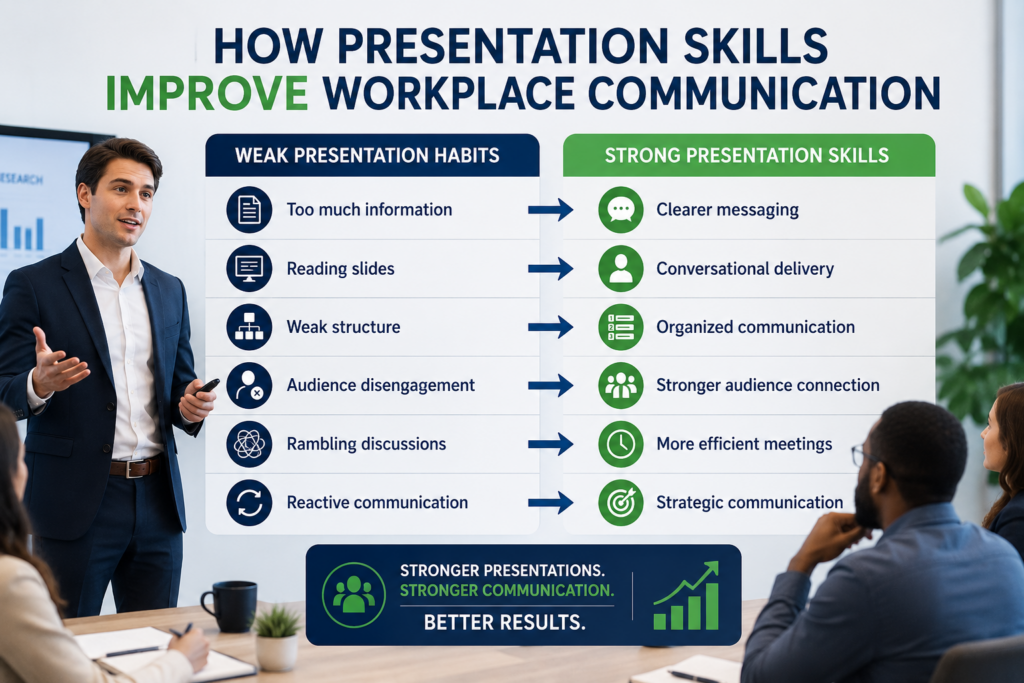
Many presentation problems are actually rooted in communication structure issues. One challenge we frequently see is that professionals attempt to convey their ideas in the exact manner they exist in their own minds. Subject matter experts, due to their deep and contextual understanding of the information, can inadvertently communicate too broadly or include an overload of data that audiences cannot realistically process in real time. This disconnect often leads to weak structural coherence, resulting in overloaded slides, unclear messaging, rambling explanations, poor audience retention, diminished engagement, and lower executive presence.
Another prevalent issue is the tendency to read slides verbatim. In many workplace environments, professionals lean heavily on slides because they feel a sense of security having all the information visible in front of them. Unfortunately, this reliance can create presentations that feel scripted, overly detailed, and disengaged from the audience. When visuals dominate the speaker’s attention, it can lead to a lack of genuine interaction, which is crucial for effective communication.
Moreover, professionals often concentrate excessively on the accuracy of content at the expense of audience understanding. This shift in focus can significantly weaken overall communication effectiveness. In many cases, the depth of knowledge can be a double-edged sword, as it may lead experts to undervalue the simplicity needed for audience comprehension.
For additional insights into communication under pressure and decision-making, consider exploring this research on communication under pressure and decision-making from Harvard Business Review. It delves into the ways pressure and cognitive overload can impact clarity and communication effectiveness, as well as professional decision-making processes. When under pressure, the complexities of communication become even more pronounced, impairing the ability to relay essential information succinctly.
Strong presentations go beyond the mere act of delivering information; they aim to facilitate audience understanding swiftly, enable retention of key ideas, maintain engagement, and promote efficient decision-making. Effective presentation skills are therefore intrinsically linked to organizational performance. Well-structured presentations lead to shorter meetings, clearer discussions, improved stakeholder alignment, and enhanced efficiency in decision-making.
For further insights into workplace communication and organizational effectiveness, see this research on workplace communication and collaboration from Deloitte. It explores how communication, collaboration, and leadership alignment significantly affect organizational performance and workplace effectiveness.
After attending workshops focused on enhancing presentation skills, we frequently observe that professionals start to simplify their information much more effectively. This improvement often occurs after they grasp how audiences naturally process communication. Instead of overwhelming audiences with everything they know, these professionals begin to concentrate on what truly matters—the essential information that audiences need, the required actions or decisions, and ways to communicate ideas more simply and conversationally. This refined approach can lead to immediate improvements in communication effectiveness and a notable enhancement of executive presence.
An additional common issue facing many professionals is the nervousness experienced under pressure. It’s not uncommon for individuals to undergo observable changes in their communication style when stakes are high. They may find themselves speaking too quickly, losing their structural coherence, over-explaining details, becoming excessively formal, or mentally overloading themselves with the effort to recall excessive amounts of information simultaneously.
An important insight is that many professionals often presume that nervousness is the primary barrier to effective communication, while the more profound issue is often related to how well their communication is organized. As such, when professionals cultivate a stronger communication structure, they frequently experience a decrease in anxiety because they no longer bear the burden of managing vast amounts of information in their minds while trying to communicate effectively.
The relationship between structure and communication is vital; when a clear structure is established, it fosters clarity. Clarity, in turn, cultivates a sense of control in the communication process. Gaining this control can significantly enhance executive presence, allowing professionals to convey their messages with confidence and ease.
How Presentation Skills Improve Leadership Communication
As careers progress, communication expectations change significantly. Professionals are increasingly expected not only to possess expertise but also to communicate that expertise clearly in situations involving visibility, pressure, and organizational complexity. This is where presentation skills become especially important.
One challenge we frequently see is that many professionals assume presentation skills only matter during formal presentations. In reality, the same communication habits appear across meetings, executive discussions, difficult conversations, stakeholder interactions, project leadership, team communication, and client communication. The ability to effectively communicate in these various contexts can be a defining factor in a professional’s success and career advancement.
One of the biggest shifts we frequently observe during workshops is that professionals stop viewing presentations as performances and begin viewing them as leadership communication situations. This shift changes behavior dramatically. Instead of focusing heavily on memorization or perfection, professionals begin focusing on audience understanding, communication clarity, structure, message retention, and strategic discussion management. They learn to tell stories that resonate, adjust their tone to fit the audience, and utilize visual aids to enhance comprehension.
This shift towards effective communication produces stronger executive presence because communication becomes calmer, more intentional, and more audience-focused. A professional who can engage their audience not only elevates their own status but also fosters a space for open dialogue and shared ideas among team members.
Another important change involves conversational delivery. Many professionals initially communicate in ways that feel overly formal or overly scripted. As communication structure improves, delivery often becomes significantly more natural and engaging, because professionals no longer feel the need to mentally manage excessive amounts of information while speaking. They become adept at reading the room, adapting their message in real-time, and creating an interactive experience that draws in their listeners.
By the second day of workshops, professionals often become noticeably more concise, more confident leading discussions, stronger during meetings, better at handling questions, more engaging communicators, and more effective in executive communication situations. Participants frequently report a newfound ease in their communication style and an enhanced ability to connect with their audience.
Long-term improvement occurs when professionals continue applying these skills consistently in real workplace situations. Over time, communication habits become more intentional, more structured, and more effective across the organization. This ongoing development not only benefits the individual but also positively influences team dynamics and overall organizational culture.
For professionals and organizations looking to improve workplace communication, executive presence, audience engagement, and communication effectiveness in real business situations, our Presentation Skills Training programs focus heavily on practical application, structured communication, executive-level workplace scenarios, and coach-led feedback designed to create measurable communication improvement. This comprehensive approach ensures that participants are not only informed but also transformed into confident communicators ready to tackle the challenges of their professional landscape.
Frequently Asked Questions
Why do presentation skills matter in the workplace?
Presentation skills affect meetings, leadership discussions, stakeholder communication, project updates, and decision-making conversations. Strong communication helps professionals explain ideas more clearly and contribute more effectively.
Why do professionals struggle with presentation skills?
Many professionals are highly knowledgeable but have never received structured communication training. This often leads to weak organization, excessive detail, nervousness under pressure, and reduced audience engagement.
How do presentation skills improve executive presence?
Strong presentation skills improve clarity, composure, audience awareness, and communication structure. Professionals who communicate clearly and calmly are often perceived as more credible and leadership-ready.
Why is audience awareness important during presentations?
Audience awareness helps professionals focus on what listeners actually need to understand rather than trying to communicate excessive amounts of information.
Can presentation skills improve meeting effectiveness?
Yes. Clearer communication helps meetings become more focused, efficient, and productive by improving understanding, alignment, and decision-making.
Conclusion
Presentation skills are no longer limited to formal speaking environments; they extend far beyond the traditional podium or conference room. In today’s diverse workplace, the ability to present ideas effectively influences how professionals contribute, communicate, lead discussions, explain complex concepts, and ultimately build their credibility in everyday interactions. This shift underscores the importance of developing and honing these skills in all facets of professional life.
Strong presentation skills are essential not just for delivering speeches but also for enhancing communication clarity throughout an organization. When professionals can convey information clearly and concisely, it fosters better understanding among colleagues and stakeholders. This clarity leads to greater audience engagement, making it easier for others to connect with the presented material emotionally and intellectually. When an audience feels engaged, they are more likely to retain the information shared and act upon it, further reinforcing the value of effective presentation skills.
Moreover, possessing strong presentation skills cultivates what is known as executive presence. This term refers to the ability to project confidence, credibility, and authority, even in informal settings. Professionals with executive presence can inspire trust and motivate their teams and peers, leading to improved organizational effectiveness. By communicating ideas persuasively and authoritatively, these individuals can steer discussions in the right direction, influence decision-making processes, and rally support for their initiatives.
In our modern business environments, the importance of effective communication cannot be overstated; it increasingly shapes both professional influence and organizational performance. As competition grows and workplaces become more dynamic, the ability to express ideas persuasively becomes a critical asset. Whether in meetings, collaborative projects, or casual interactions, how one presents their thoughts can significantly affect their influence and the overall success of their organization.
Presentation skills often serve as the primary mechanism through which professional influence is communicated. They act as a bridge that connects ideas to action, ensuring that messages resonate with audiences and lead to tangible outcomes. Therefore, investing in developing these skills must be a priority for anyone looking to enhance their career trajectory and contribute positively to their workplace. By embracing and refining presentation abilities, professionals position themselves not only as effective communicators but also as influential leaders within their organizations.
For professionals, managers, and leaders looking to elevate their speaking and presentation skills to match the level of their expertise, we offer Presentation Skills Training, Public Speaking Workshops for Individuals, and Corporate Team & Group Training programs across Canada and the United States.