
Hybrid work, cross-functional collaboration, and faster decision-making have increased the pressure on professionals to communicate clearly in shorter, less structured situations.
After more than 25 years of delivering presentation and communication skills training to subject matter experts, managers, and leaders, we have seen presentation skills become essential far beyond formal presentations. They now shape project updates, meetings, leadership discussions, client conversations, recommendations, and stakeholder decisions.
The professionals who stand out are not always the most knowledgeable. They are often the ones who can structure complex ideas, communicate them confidently, and make their expertise easy to understand and act upon. In increasingly complex organizations, that ability has become a significant professional and leadership advantage.
Key Takeaways
- Presentation skills now matter in meetings, briefings, updates, and stakeholder conversations.
- Hybrid and cross-functional work demand clearer, more audience-focused communication.
- Clear communicators are often seen as more credible, confident, and leadership-ready.
- Communication gaps can slow alignment, decisions, and execution.
- Strong presentation skills help professionals influence outcomes and move conversations forward.
Presentation Skills Are No Longer About Sharing Information
There was a time when presenting was largely about sharing information. Professionals were expected to provide updates, explain completed work, review data, and communicate project status. In many environments, that was enough. If the information was accurate and complete, the communication was considered successful.
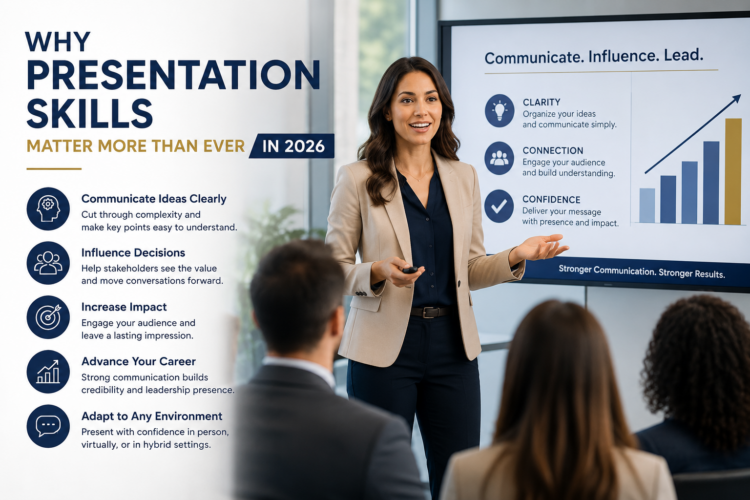
Today, organizations expect much more. Professionals are no longer evaluated solely on their ability to communicate information. They are increasingly expected to influence decisions, create alignment, communicate recommendations clearly, and help move conversations toward meaningful action. As a result, communication effectiveness has become closely tied to professional credibility, leadership potential, and organizational impact.
Strong communicators understand that effective presentations are not simply about delivering information. They are about helping audiences understand what matters, why it matters, and what should happen next. They know how to organize ideas so that key messages are clear, recommendations are easy to evaluate, and discussions remain focused on outcomes rather than details alone.
One communication pattern we frequently observe in workshops is that many professionals continue to approach presentations as information-sharing exercises. They provide extensive background information, walk audiences through every step of their thinking, and gradually build toward their recommendation. While this often feels logical to the speaker, it places unnecessary work on the audience. Senior leaders, stakeholders, and decision-makers rarely want to spend several minutes trying to determine the main point. They want to understand the recommendation early so they can evaluate the supporting information within the appropriate context.
This shift from reporting information to influencing outcomes is one of the most important communication changes professionals must make in today’s workplace. The ability to communicate recommendations clearly, simplify complexity, and create alignment has become just as important as the expertise behind the recommendation itself.
Why Hybrid Work Has Raised the Communication Standard
Hybrid work has changed communication in ways that many organizations continue to underestimate. In traditional office environments, communication benefited from countless subtle signals. Eye contact, body language, facial expressions, side conversations, and informal interactions provided immediate feedback about how a message was being received. Presenters could quickly determine whether audiences were engaged, confused, aligned, or ready to move forward.
Hybrid environments remove many of those advantages. Today, professionals often communicate with audiences that are split between meeting rooms and video screens. Some participants may be fully engaged while others are balancing multiple priorities simultaneously. Attention is more fragmented, feedback is less visible, and maintaining engagement requires significantly more effort than it once did.
This means communication must become far more intentional. Professionals need to establish clarity earlier, communicate more concisely, and create stronger audience engagement throughout conversations. They also need to project confidence and executive presence in environments where traditional communication cues are reduced or missing altogether.
One reality of hybrid work is that audiences have become less patient with communication that lacks focus. When professionals spend too much time on background information, delay their recommendations, or communicate without structure, attention drops quickly. Important messages become diluted, decisions take longer, and meetings often fail to produce clear outcomes.
The professionals who thrive in hybrid environments are typically those who can simplify complexity, maintain audience engagement, and communicate with confidence regardless of whether their audience is sitting across the table or joining remotely.
The Compounding Effect of Unclear Communication
One of the most overlooked realities of workplace communication is that small communication problems rarely stay small. When a message is slightly unclear during a meeting, people often assume the misunderstanding will sort itself out later. In practice, the opposite usually happens. The lack of clarity carries forward into follow-up conversations, emails, project plans, stakeholder discussions, and ultimately decision-making.
People begin interpreting information differently. Assumptions are made. Expectations become less aligned. Teams leave the same conversation with different understandings of priorities and next steps.
Over time, these seemingly minor communication gaps create significant organizational friction. Meetings become longer because the same topics need to be revisited. Decisions take longer because stakeholders require additional clarification. Projects slow down because teams are working from slightly different interpretations of the same information.
None of this is usually intentional. It is simply the result of communication that lacks sufficient structure and clarity. When these issues are multiplied across multiple teams, departments, and projects, the organizational impact becomes substantial.
The Visibility Factor Most Professionals Underestimate
Communication also plays a major role in how professionals are perceived inside organizations. Many people assume visibility comes primarily from doing great work. While performance remains essential, communication increasingly determines whether that work is understood, recognized, and valued by others.
Professionals who communicate clearly are often viewed as more capable, more prepared, more strategic, and more leadership-ready. Their recommendations are easier to understand. Their updates are easier to follow. Their contributions tend to carry more influence because audiences can quickly understand both the message and its relevance.
At the same time, we frequently work with highly capable professionals whose expertise is not fully recognized because their communication does not reflect the quality of their thinking. They may take too long to get to the point, overexplain details that are not immediately relevant, hesitate when asked for a recommendation, or rely too heavily on slides rather than communicating directly.
In most cases, the issue is not a lack of capability or expertise. The underlying work is often excellent. The challenge is that the quality of the thinking is not always reflected in the communication. When recommendations are buried beneath excessive detail or key messages lack structure, audiences can miss the value of the expertise entirely.
Over time, these communication habits can influence leadership opportunities, visibility, stakeholder confidence, and career progression. In many organizations, the ability to communicate clearly becomes increasingly important as professionals move into more senior roles.
What Strong Communicators Do Differently
When you observe professionals who consistently communicate effectively, several patterns emerge. They are intentional about how they structure information. Rather than building up to the point, they lead with it. This helps audiences quickly understand the purpose of the conversation and makes the supporting information easier to process.
Strong communicators also focus on relevance rather than completeness. Instead of sharing everything they know, they focus on what their audience needs to know. They simplify complex ideas without losing meaning and organize information in a way that supports understanding and decision-making.
Another important difference is audience awareness. Effective communicators recognize that different audiences require different levels of detail. A senior executive, a client, a technical team, and a cross-functional stakeholder group may all need the same information presented in different ways.
The expertise itself remains the same, but the way it is communicated changes dramatically. Strong communicators understand how to adapt their message without compromising accuracy, and that ability often determines whether ideas gain traction or get lost in the conversation.
The Role of Delivery and Executive Presence
While communication structure plays a critical role, delivery has an equally important impact on how messages are received. In today’s workplace, professionals are often evaluated not only on what they say, but on how confidently, clearly, and effectively they communicate it. Tone, pacing, executive presence, and audience engagement all influence how recommendations and ideas are perceived.
Executive presence is often misunderstood. Many people associate it with charisma, seniority, or personality. In our experience, executive presence is far more closely tied to communication. Professionals who communicate with clarity, composure, and confidence are often perceived as having stronger executive presence regardless of their title or level within the organization.
When professionals have a clear structure for their message, they tend to appear more confident. They hesitate less, overexplain less, and navigate questions more effectively. As a result, audiences are more likely to trust both the message and the person delivering it.
This is one reason presentation skills training frequently improves executive presence. The improvement often begins with communication structure and then expands into greater confidence, influence, and audience engagement.
What This Means for Organizations
At an organizational level, communication capability has a direct impact on performance. When communication is strong, meetings become more productive because people get to the point faster. Leaders receive clearer recommendations. Teams remain more aligned. Decisions happen more quickly because stakeholders have the information they need in a format they can easily understand.
When communication is weak, the opposite tends to occur. Meetings become longer. Discussions become repetitive. Teams leave conversations with different interpretations of the same information. Decisions get delayed because clarity is missing.
Over time, this creates drag throughout the organization. Many organizations initially view these challenges as process issues, resource issues, or alignment issues. Often, however, communication is at the center of the problem.
Organizations that invest in communication skills development frequently see benefits that extend well beyond individual performance. They create stronger alignment, faster decision-making, improved collaboration, and more effective leadership communication across the business.
Why Improvement Needs to Be Practical
One reason communication gaps persist is that they are rarely solved through awareness alone. Most professionals already understand the importance of being clear, concise, and audience-focused. The challenge is applying those principles consistently during real conversations where there are competing priorities, time pressures, and high expectations.
Improvement happens when people have the opportunity to practice communication in realistic situations. They need to structure recommendations, deliver updates, answer difficult questions, and adapt their message based on how audiences are responding.
Equally important is feedback. Professionals often have limited awareness of how their communication is actually being received. Coaching, structured practice, and video review help close that gap by providing immediate insight into what is working and what needs adjustment.
Without application, improvement tends to be temporary. With practice, coaching, and repetition, improvement becomes sustainable.
How Commanding Presence Helps
At Commanding Presence, our workshops focus on helping professionals improve presentation skills, communication skills, executive presence, and speaking confidence through highly interactive, workplace-focused learning experiences. Rather than concentrating on theoretical presentation techniques, participants work through the same communication situations they encounter every day, including meetings, executive briefings, stakeholder discussions, project updates, and client conversations.
Participants learn how to structure information more clearly, communicate with greater confidence, strengthen executive presence, and adapt their message to different audiences. Most importantly, they practice these skills in realistic situations, receive direct coaching and feedback, and immediately apply what they learn.
That combination of structure, application, and coaching is what creates lasting change.
The Result in Everyday Work
When communication improves, the impact becomes noticeable quickly. Conversations become more focused, ideas become easier to understand, meetings become more productive, and decisions happen with greater clarity. Teams stay aligned with less effort because expectations are communicated more effectively.
From an individual’s perspective, there is greater confidence in how ideas are communicated and received. From an organizational perspective, work moves forward more efficiently because communication supports execution rather than slowing it down.
In many cases, the work itself has not changed at all. What has changed is how effectively that work is communicated. Organizations that invest in stronger communication capabilities often discover that meetings become more productive, decisions happen faster, and teams stay better aligned because information is easier to understand, evaluate, and act upon.
In today’s workplace, that difference often separates organizations that move quickly from those that struggle to keep pace.
Frequently Asked Questions
Why are presentation skills more important today than they were in the past?
Presentation skills now influence meetings, leadership communication, stakeholder discussions, project updates, executive briefings, and hybrid workplace interactions. Professionals are expected to influence outcomes, not simply share information.
How has hybrid work changed communication expectations?
Hybrid work requires professionals to communicate more clearly, engage audiences more intentionally, and project executive presence across both in-person and virtual environments.
What is the connection between presentation skills and executive presence?
Executive presence is largely influenced by communication. Clear structure, confidence, audience awareness, and concise messaging all contribute to how professionals are perceived.
Why do organizations invest in presentation skills training?
Organizations invest in presentation skills training because stronger communication improves decision-making, stakeholder alignment, leadership communication, team effectiveness, and overall organizational performance.
For professionals looking to elevate their presentation skills, among other skills, we offer Presentation Skills Training, Public Speaking Workshops for Individuals, and Corporate Team & Group Training programs across Canada and the United States.