

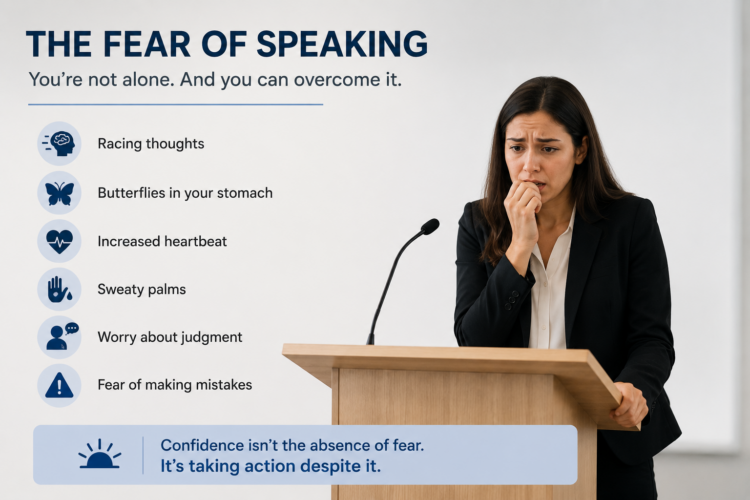
Public speaking anxiety is often less about speaking and more about fear of forgetting information, freezing under pressure, losing credibility, or being judged.
In our workshops, we frequently see professionals assume effective speakers are naturally confident. In reality, most have developed practical structures and habits that help them manage pressure.
After more than 25 years delivering presentation and communication skills training, we have consistently seen confidence grow through preparation, structured practice, feedback, and real-world application. Professionals improve when they stop trying to perform perfectly and focus instead on organizing ideas clearly, connecting with audiences, and communicating naturally under pressure.
Key Takeaways
- Long-term confidence develops through repetition, practice, and continued speaking opportunities
- Public speaking anxiety is often driven by uncertainty, not lack of intelligence or capability
- Many professionals fear forgetting information, freezing, or losing credibility during presentations
- Structure helps reduce anxiety by simplifying how professionals organize and deliver ideas
- Audience awareness often improves communication more than memorization or performance techniques
- Video review and coaching dramatically increase self-awareness and accelerate improvement
Why Public Speaking Anxiety Feels So Intense for Professionals
Public speaking anxiety affects professionals across nearly every industry and level of leadership. Even highly experienced managers, technical experts, executives, and client-facing professionals often experience significant stress before presentations, meetings, or high-stakes speaking situations.
One reason presentation anxiety often feels so intense is that professionals are frequently being evaluated while they speak. Unlike many other workplace tasks, communication happens in real time and in front of an audience, which can create a heightened sense of pressure. Professionals may worry about sounding unprepared, forgetting important points, losing credibility, appearing less knowledgeable than they actually are, struggling to answer questions effectively, or being judged by senior leaders, colleagues, or stakeholders. Even highly capable and experienced professionals can experience these concerns because the stakes often feel personal. In many cases, the anxiety is not about the presentation itself, but about how they will be perceived while delivering it.
In many professional environments, communication performance directly affects leadership perception, visibility, and influence. As a result, speaking situations can feel high stakes, even when the presentation itself is relatively short.
One challenge we frequently see is that professionals become overly focused on themselves during presentations instead of focusing on the audience and the message itself. They begin monitoring their wording, delivery, pacing, and performance simultaneously, which creates cognitive overload.
For additional insights into communication and decision-making under stress, see this research on effective communication under pressure from Harvard Business Review.
When too many variables are being managed mentally, anxiety tends to increase rapidly.
This is especially common during impromptu speaking situations such as answering unexpected questions, providing updates during meetings, presenting to senior leadership, defending recommendations, or handling difficult stakeholder conversations. Many professionals describe these moments as mentally “blanking,” even when they know the material extremely well.
In reality, the issue is rarely a lack of knowledge. More often, it is the combination of pressure and a lack of communication structure. Without a clear framework for organizing their thoughts, professionals often struggle to communicate their message with clarity and confidence.
One pattern we frequently observe is that professionals who overexplain are often trying to avoid being misunderstood or appearing less knowledgeable. Ironically, providing too much information usually creates more confusion rather than less. Strong communicators focus less on including every detail and more on helping the audience quickly understand what matters most. That shift in focus often leads to clearer communication, greater confidence, and stronger audience engagement.
For additional perspective on self-doubt and communication confidence, see this research on imposter syndrome in high achievers from Psychology Today, which explores how many high-performing professionals experience self-doubt despite strong expertise, leadership capability, and professional success.
For many professionals, simply understanding that these fears are common can already reduce a significant amount of pressure.
How Structure and Audience Awareness Reduce Speaking Anxiety
One of the biggest transformations we see during workshops happens when professionals realize they do not need to memorize everything perfectly in order to communicate effectively. Many professionals enter workshops believing strong speaking requires flawless recall and perfectly scripted delivery. In reality, that approach often increases pressure because the speaker becomes mentally focused on remembering wording rather than communicating naturally with the audience.
Instead of trying to manage large amounts of information mentally, professionals begin working from a simple communication structure that helps them organize thoughts more clearly and communicate more conversationally under pressure. At Commanding Presence, a major part of this process involves the FOCUS! Method and audience connection techniques that help professionals simplify thinking, structure ideas more effectively, and communicate with greater clarity in high-pressure situations.
One of the most effective structural concepts we teach is the Rule of Threes. This framework significantly reduces speaking anxiety because professionals know how they are going to begin, what core ideas they want to communicate, and how they are going to conclude. That clarity reduces mental overload dramatically. Instead of trying to remember everything they know about a topic, professionals focus on the most important ideas and whether the audience is understanding the message clearly.
This shift is extremely important because many professionals mistakenly believe strong public speaking comes from memorization. In practice, memorization often increases nervousness because speakers become internally focused on recalling exact wording rather than externally focused on audience engagement and communication effectiveness. When professionals move away from memorized delivery and toward structured conversational communication, presentations often become more natural, more concise, more engaging, easier to follow, and significantly easier to deliver under pressure.
For additional insights into audience engagement and communication effectiveness, see this research on active listening and communication effectiveness from Ivey Business School, which explores how active listening, audience awareness, observation of verbal and non-verbal cues, and thoughtful responsiveness contribute to more effective professional communication
One challenge we frequently observe is that professionals initially focus almost entirely on themselves during presentations. They monitor their wording, delivery, nervousness, and performance constantly. However, once professionals begin focusing more fully on the audience instead of themselves, delivery often improves very quickly because communication becomes more interactive and less performative.
This is also where video review becomes extremely powerful. During workshops, participants are recorded multiple times and receive structured feedback and coaching. Many professionals are surprised to discover that they appear significantly more credible and composed than they originally believed. Others become aware of habits they had never previously noticed, including overexplaining, rushing, avoiding pauses, disconnecting visually from the audience, or sounding overly rehearsed. That awareness often creates rapid improvement because professionals finally see how their communication is being experienced externally.
By the second day of workshops, participants often become noticeably more concise, more conversational, calmer under pressure, more audience-focused, more comfortable speaking spontaneously, and significantly stronger in executive presence. However, long-term confidence develops through continued application after the workshop itself.
Professionals improve most when they continue finding opportunities to contribute during meetings, speak in front of groups, present ideas, lead discussions, and consistently practice structured communication techniques in real workplace situations. Confidence grows through repetition, experience, and successful communication outcomes over time.
The Difference Between Avoiding Speaking and Developing the Skill
When speaking situations feel uncomfortable, many professionals naturally begin avoiding them. They may speak less during meetings, avoid presentations whenever possible, pass on opportunities that increase their visibility with leadership, or defer to others during discussions even when they have valuable insights to contribute. While these behaviors may provide short-term relief from anxiety or discomfort, they often come at a professional cost over time.
Communication is one of the primary ways professionals demonstrate expertise, influence decisions, build credibility, strengthen executive presence, and establish themselves as leaders within an organization. Many career opportunities emerge not simply because someone has strong technical skills, but because they can communicate those skills effectively to colleagues, stakeholders, and senior leaders. When professionals consistently avoid speaking opportunities, they may unintentionally limit their visibility, influence, and long-term growth.
The solution is not forcing yourself to “be confident” or trying to eliminate nervousness entirely. In our experience, confidence is often the result of having a reliable communication process rather than the starting point. When professionals learn how to structure their thoughts, organize key messages, and communicate with greater clarity under pressure, uncertainty begins to decrease and confidence naturally grows.
For professionals looking to improve public speaking confidence, audience engagement, executive presence, and workplace communication effectiveness, our Public Speaking Training for Individuals focuses heavily on practical application rather than theory alone. Participants learn structured communication methods, audience awareness techniques, impromptu speaking strategies, and ways to communicate more effectively during presentations, meetings, and everyday workplace conversations. Through personalized coaching, video feedback, and guided practice, participants gain practical skills that help them communicate with greater clarity, confidence, and impact in real-world situations.
Frequently Asked Questions
Why do professionals fear public speaking so much?
Many professionals fear public speaking because they worry about forgetting information, sounding unintelligent, freezing under pressure, or losing credibility in front of others. In workplace environments, speaking situations often feel tied to professional perception and career visibility.
Does public speaking anxiety affect experienced professionals too?
Yes. Public speaking anxiety affects professionals at every stage of their career, including managers, executives, technical experts, and senior leaders. Experience alone does not automatically eliminate communication pressure.
How does structure reduce public speaking anxiety?
Structure reduces anxiety by simplifying how professionals organize and deliver information. When speakers know how they will begin, what they will say, and how they will conclude, mental overload decreases significantly.
Why is audience awareness important during presentations?
Audience awareness helps professionals adjust pacing, clarity, and delivery based on audience reactions. Strong communicators focus more on whether the audience understands the message than on performing perfectly.
Why is video feedback effective in public speaking training?
Video feedback increases self-awareness. Professionals often discover communication habits, delivery patterns, or audience disconnects they were previously unaware of, which helps accelerate improvement.
Conclusion
Public speaking confidence is rarely something professionals either naturally have or do not have.
More often, confidence develops when professionals gain structure, practical communication tools, audience awareness, and opportunities to practice in supportive environments.
The professionals who improve most are usually not the ones trying to become perfect performers. They are the ones who learn how to communicate more clearly, simplify their thinking, focus on the audience, and manage pressure more effectively.
Over time, those skills begin affecting far more than presentations alone.
They improve meetings, leadership communication, impromptu speaking, executive presence, stakeholder discussions, and overall professional confidence in high-stakes workplace situations.
For professionals looking to elevate their speaking and presentation skills to match the level of their expertise, we offer a range of specialized communication and leadership development programs. These include Presentation Skills Training, Public Speaking Workshops for Individuals, and Corporate Team & Group Training programs across Canada and the United States.