

Many professionals build successful careers through technical expertise, analytical thinking, and industry knowledge, yet struggle to communicate that expertise clearly in real time.
In our workshops, we frequently see capable subject matter experts overexplain or lose structure during fast-moving meetings, presentations, and high-pressure conversations. Unlike writing, spoken communication offers little time to revise or reorganize ideas.
After more than 25 years delivering presentation and communication skills training, we have consistently seen confidence improve when professionals learn to simplify their thinking, organize ideas quickly, and communicate with greater clarity under pressure. Strong expertise becomes more credible and influential when audiences can easily understand it.
Key Takeaways
- Many subject matter experts communicate more effectively in writing than verbally
- High-stakes speaking situations often create pressure that reduces clarity and conciseness
- Overexplaining is one of the most common communication challenges professionals face
- Communication confidence usually improves through structure, audience awareness, and practice
- Strong verbal communication increasingly affects leadership perception and career progression
- Professionals improve significantly when they simplify information and focus more on audience understanding
Why Communication Confidence Is So Difficult for Many Professionals
Many professionals experience a noticeable gap between how clearly they write and how clearly they speak. This is especially common among subject matter experts who spend much of their careers writing reports, analyzing information, solving technical problems, communicating through documents and email, and working independently for extended periods of time. Over the years, written communication often becomes highly developed because it is used constantly, while verbal communication receives far less structured practice and feedback.
One challenge we frequently observe in workshops is that professionals are often exceptionally precise in writing because writing allows time to think, revise, reorganize, and refine information before it is shared. Spoken communication operates very differently. During meetings, presentations, executive briefings, and high-pressure workplace conversations, professionals are expected to organize ideas instantly, communicate concisely, respond in real time, adapt to audience reactions, and simplify complex information on the spot. Even highly intelligent and knowledgeable professionals can find this transition uncomfortable because the communication process happens in front of an audience and leaves little opportunity to pause and revise.

In many workplace environments, communication is also closely connected to leadership perception. Professionals are often evaluated not only on what they know, but on how clearly and confidently they communicate that knowledge to others. Whether presenting recommendations, participating in meetings, answering questions from senior leaders, or explaining complex issues to stakeholders, communication becomes one of the primary ways expertise is assessed. This is one reason communication confidence plays such an important role in professional growth and leadership development.
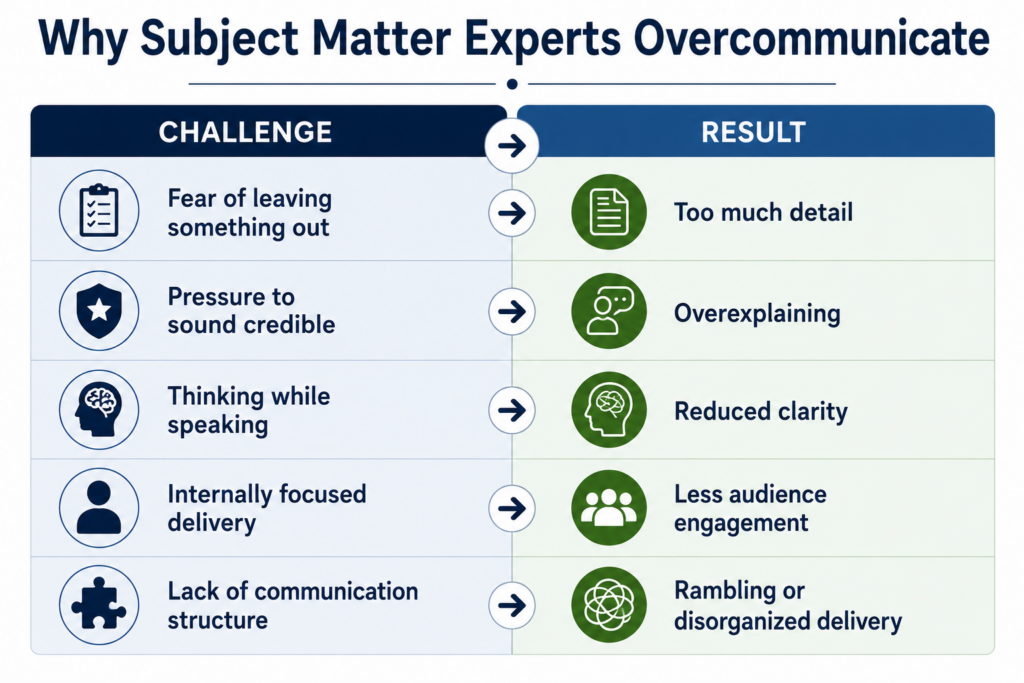
Many professionals also experience significant internal pressure during speaking situations. They may worry about sounding unintelligent, leaving out important information, losing credibility, failing to explain an idea thoroughly enough, being challenged publicly, or blanking during questions and discussions. These concerns are extremely common, particularly among high-performing professionals who care deeply about accuracy and expertise.
Ironically, this pressure often causes professionals to communicate less effectively. One pattern we frequently observe is that the people who are most concerned about protecting their credibility often overcommunicate. They provide excessive detail, overcomplicate explanations, and attempt to cover every possible angle rather than focusing on what matters most to the audience. While their intention is usually to demonstrate expertise, the result is often reduced clarity, lower audience engagement, and messages that are more difficult to understand. The most effective communicators recognize that credibility comes less from demonstrating everything they know and more from helping others quickly understand what matters, why it matters, and what action or decision should follow.
See this communication under pressure research from Harvard Business Review for additional insights on decision-making and communication under stress.
This is particularly common during leadership presentations, executive briefings, client-facing communication, stakeholder discussions, technical presentations, and impromptu speaking situations where professionals feel pressure to perform at a consistently high level. In many cases, highly capable professionals privately experience self-doubt despite strong expertise and career success. This research on imposter syndrome in high achievers from Psychology Today explores how these feelings commonly affect high-performing professionals in workplace and leadership environments.
For many professionals, communication confidence begins improving once they realize that audiences are rarely evaluating perfection. More often, audiences are responding to clarity, structure, confidence, relevance, audience awareness, and conversational delivery. In professional environments, people typically remember how clearly ideas were communicated and how effectively the speaker connected with the audience far more than minor mistakes or nervousness. That realization alone can significantly reduce communication pressure and help professionals communicate more naturally and confidently.
Why Concise Communication Becomes a Leadership Skill
As professionals advance in their careers, communication expectations often change dramatically. Early in a career, technical expertise and strong individual performance are usually enough to demonstrate value. Over time, however, professionals are increasingly expected to lead discussions, present recommendations, influence decisions, explain complex information clearly, communicate across departments, engage clients and stakeholders, and contribute confidently during meetings.
In these situations, concise communication becomes incredibly important. One challenge we frequently see in workshops is that many subject matter experts mistakenly believe that providing more information automatically creates more credibility. In reality, excessive detail often reduces audience engagement and weakens message clarity.
Strong communicators are usually not the people who say the most. More often, they are the people who communicate the clearest ideas in the shortest amount of time. This is one reason why audience awareness becomes such an important communication skill in leadership and professional environments.

Professionals who communicate effectively tend to focus less on communicating everything they know and more on what the audience actually needs, how information is being received, whether key points are understood, and how to simplify complex ideas without oversimplifying them. This research on active listening and communication effectiveness from Ivey Business School further explores the relationship between audience awareness, listening, and communication effectiveness in professional environments.
In our workshops, one of the biggest transformations often occurs when professionals stop trying to sound overly polished or overly technical and begin communicating more conversationally and directly. Video review plays a major role in this process. Many participants are surprised to discover that they appear more credible than they thought, overexplain more than they realized, speak too quickly under pressure, lose audience connection while mentally organizing information, and often communicate their expertise more effectively when they simplify their delivery.
That awareness creates rapid improvement. By the second day of workshops, participants often become more concise, more audience-focused, more conversational, more confident during discussions, more effective in impromptu speaking situations, and noticeably stronger in executive presence.
Long-term improvement, however, comes through continued application after training. Professionals who continue finding opportunities to contribute in meetings, lead discussions, present information, communicate ideas publicly, and practice concise communication typically continue improving rapidly over time.
For professionals looking to strengthen communication confidence, executive presence, concise speaking, and audience engagement in workplace communication situations, our Communication Skills Training focuses heavily on practical application, structured communication, audience awareness, real-world speaking situations, and coach-led feedback. Our Presentation Skills Training programs also help professionals improve clarity, confidence, and communication effectiveness during presentations, meetings, and leadership discussions.
Why Communication Confidence Changes Career Trajectory
Communication confidence affects far more than presentations alone. Professionals who communicate clearly and confidently are often perceived as more leadership-ready, organized, credible, influential, and capable under pressure. As a result, communication quality increasingly impacts career progression, leadership visibility, stakeholder trust, client relationships, executive presence, meeting participation, and influence during decision-making within many organizations.
One challenge we frequently observe in our Presentation Skills Training and Communication Skills Training is that highly capable professionals sometimes remain less visible simply because they communicate less frequently, less confidently, or less concisely than others around them. Over time, this can create a significant gap between actual expertise and perceived leadership capability.
The good news is that communication confidence is not fixed. Professionals often improve substantially once they develop stronger communication habits and repeatable systems for organizing and delivering ideas. Key areas that typically drive improvement include:
• repeatable communication structure
• audience awareness
• concise communication habits
• confidence speaking under pressure
• stronger real-time communication capability
Like any professional skill, communication confidence improves through repetition, coaching, practice, and continued application in real-world workplace situations.
Frequently Asked Questions
Why do smart professionals struggle with communication confidence?
Many highly intelligent professionals are trained primarily in analytical and written communication rather than real-time verbal communication. High-pressure speaking situations often require concise thinking, audience awareness, and immediate responses that feel very different from written communication.
Why do subject matter experts tend to overexplain?
Subject matter experts often overexplain because they fear leaving out important information or being perceived as less knowledgeable. In many cases, this pressure reduces clarity instead of improving credibility.
How does concise communication improve executive presence?
Concise communication helps professionals appear more confident, organized, and audience-aware. Leaders who communicate clearly and efficiently are often perceived as more credible and more effective under pressure.
Why does communication confidence improve with structure?
Structure reduces mental overload during speaking situations. When professionals know how to organize ideas clearly, they can focus more on audience connection and less on trying to manage large amounts of information mentally.
Why is video feedback effective in communication training?
Video feedback increases self-awareness. Many professionals discover communication habits, audience disconnects, or delivery patterns they were previously unaware of, which helps accelerate improvement.
Conclusion
Many professionals already possess the intelligence, expertise, and analytical ability needed to communicate effectively. The challenge is often not a lack of knowledge, but the ability to translate that knowledge into clear, concise verbal communication when the pressure is high. Whether responding to questions, presenting recommendations, leading meetings, or communicating with senior stakeholders, professionals are often expected to organize their thoughts quickly and communicate with clarity in real time.
Communication confidence typically improves when professionals simplify their thinking, develop repeatable communication structures, focus more on audience understanding, and practice communicating in realistic workplace situations. Over time, these skills influence far more than presentations alone. They shape leadership perception, strengthen executive presence, improve meeting effectiveness, increase stakeholder confidence, and enhance overall professional impact. As careers progress, the ability to communicate expertise clearly and confidently often becomes just as important as the expertise itself.
For professionals looking to elevate their communication skills to match the level of their expertise, we offer a range of specialized communication and leadership development programs. These include Presentation Skills Training, Communication Skills Training, and Executive Communication Coaching, programs across Canada and the United States.