

One of the most common communication challenges we see with our clients is not a lack of expertise. It is a lack of conciseness. Many highly capable professionals know their material extremely well, but when they need to explain it in a meeting, present it to leadership, provide an executive update, or respond under pressure, the message often becomes longer and more detailed than necessary.
The result is communication that feels heavier and more difficult to follow, even when the underlying thinking is strong. Audiences are left sorting through information to determine what matters most rather than focusing on the key message itself.
Key Takeaways
- Conciseness is a communication structure skill, not simply a speaking habit
- Many professionals overexplain because they prioritize completeness over audience clarity
- Strong communication improves executive presence, audience engagement, and decision-making speed
- Concise communicators lead with the point and structure information intentionally
- Learning to “say less and say it better” improves workplace communication across meetings, presentations, and leadership discussions
After more than 25 years delivering presentation skills training, executive communication coaching, and workplace communication workshops, one pattern consistently stands out. Professionals rarely struggle because they lack intelligence, expertise, or knowledge. More often, they struggle because they have never been taught how to organize complex ideas clearly for other people.
This becomes especially important during high-stakes presentations, leadership communication, executive briefings, sales discussions, stakeholder meetings, and fast-moving workplace conversations where attention is limited and clarity matters quickly.

Why Being Concise Is More Difficult Than People Realize
Most professionals understand they should “get to the point.” The challenge is that in many technical, analytical, operational, and leadership environments, people are rewarded for depth, thoroughness, and completeness. Over time, that mindset naturally carries into workplace communication.
Professionals often feel pressure to explain all the background information, walk through every step of their thinking, demonstrate expertise through detail, and avoid leaving anything important out. All of this is well intentioned.
But without a clear communication structure, the message often becomes comprehensive instead of effective.
One of the most common patterns we observe in workshops is that professionals communicate information in the order they learned it rather than in the order the audience needs to understand it. That difference has a major impact on audience engagement, communication clarity, and decision-making speed.
Where the Problem Shows Up Most Often
Lack of conciseness affects almost every form of workplace communication. In meetings, professionals may spend several minutes providing context before clearly stating the recommendation or key point. In presentations, slides become overloaded with information, forcing audiences to work harder to interpret what matters most.
In executive updates, background information often consumes most of the available time, leaving limited space for strategic discussion or decision-making. In emails, key requests or actions become buried inside paragraphs of supporting detail.
Across all of these situations, the outcome is remarkably similar. Attention drops, communication becomes harder to process, and decisions slow down because audiences need additional clarification.
Research on cognitive load and information processing consistently shows that audiences absorb and retain information more effectively when communication is structured clearly and unnecessary complexity is reduced.
For additional insights into cognitive overload and communication clarity, see this research on cognitive load theory and information processing from Education Corner, which explains how excessive information increases cognitive overload and reduces comprehension, attention, and information retention during communication and presentations.
Why “Just Be More Concise” Is Not Useful Advice
One reason this issue persists is because most communication advice around conciseness is too vague. Telling someone to “be concise” does not actually help them structure their communication differently in real time.
During high-pressure conversations, professionals are often balancing multiple demands simultaneously. They are recalling information, responding to questions, organizing ideas quickly, managing stakeholder reactions, and trying to maintain executive presence under pressure.
Without a communication framework to rely on, most people default to what feels safest. And what feels safest is usually more detail.
That is why conciseness is not simply a mindset. It is a communication skill. And like most communication skills, it improves through structured practice, audience awareness, coaching, and repetition.
What Strong Communicators Do Differently
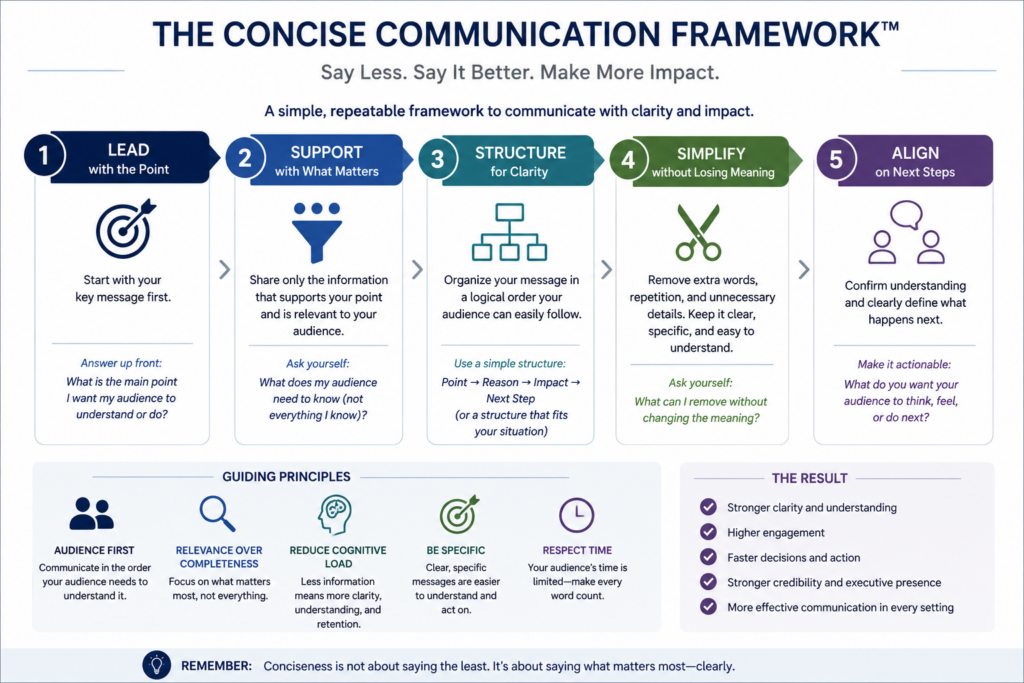
Professionals who communicate concisely are not less knowledgeable. In many cases, they are exceptionally knowledgeable. The difference is that they communicate with greater intentionality.
Strong communicators lead with the key point first, organize information into clearer structures, simplify complexity without oversimplifying meaning, and adjust detail levels based on the audience and situation.
This is one reason concise communication often strengthens executive presence almost immediately. When communication feels clear, focused, and structured, audiences naturally perceive the speaker as more confident, organized, and credible.
Research on leadership communication and audience engagement consistently reinforces that clarity improves audience understanding, trust, and communication effectiveness.
For additional insights into audience engagement and leadership communication, see this research on active listening and workplace communication from the Center for Creative Leadership, which explores how listening, audience awareness, and communication responsiveness strengthen leadership communication and engagement.
Why Structure Is the Real Solution
One of the biggest breakthroughs professionals experience during workshops is realizing that conciseness is primarily a structure problem. Without structure, people naturally communicate by walking audiences through their entire thought process. While that approach may make sense internally, it often requires audiences to work harder than necessary to identify the key message and understand what matters most.
Structure changes that dynamic. When professionals learn how to lead with the point, organize ideas clearly, separate key messages from supporting detail, and prioritize relevance over completeness, communication becomes significantly easier to follow. As clarity improves, audience engagement often improves naturally because people can focus on the message rather than trying to decipher it.
This becomes especially important in leadership communication environments where stakeholders are evaluating recommendations, risks, priorities, timelines, and strategic implications simultaneously. Clear structure helps leaders communicate complex information more efficiently and makes it easier for audiences to understand, retain, and act on important information.
The Relationship Between Conciseness and Executive Presence
Many professionals assume executive presence comes primarily from confidence, authority, or personality. In reality, communication clarity plays a much larger role than most people realize. One pattern we consistently observe during executive coaching and communication workshops is that professionals often appear more confident once their communication becomes clearer and more structured.
Clarity reduces hesitation. Structure reduces rambling. Audience understanding improves more quickly, and speakers feel more in control of the conversation itself. As a result, they often project greater confidence, credibility, and leadership presence without changing who they are.
One of the most effective communication shifts professionals can make is learning how to “say less and say it better.” That principle alone often improves speaking confidence, audience engagement, leadership communication, executive presence, meeting effectiveness, and presentation clarity because it helps audiences focus on what matters most.
Why Conciseness Has Such a Large Organizational Impact
Conciseness is one of the highest-leverage communication skills because it affects so many workplace situations simultaneously. Small improvements in communication clarity often create measurable improvements across meetings, presentations, executive briefings, stakeholder discussions, cross-functional collaboration, and decision-making speed.
When communication becomes easier to process, organizations spend less time clarifying, revisiting, and reinterpreting information. That creates operational efficiency alongside stronger workplace communication.
How Communication Improvement Actually Happens
One of the biggest misconceptions about communication skills training is that improvement happens primarily through theory. In reality, communication improves through application. While understanding communication concepts is important, meaningful improvement typically occurs when professionals have opportunities to practice, receive feedback, and apply new techniques in realistic workplace situations.
At Commanding Presence, we consistently see the fastest improvement when participants work through real communication challenges, receive coaching feedback in real time, improve audience awareness, review communication patterns through video feedback, and refine how they structure and deliver information under pressure. This approach helps participants move beyond understanding communication principles and begin applying them in meetings, presentations, stakeholder discussions, leadership conversations, and other high-stakes workplace situations.
This is especially valuable for managers, executives, sales professionals, technical subject matter experts, and leadership teams who regularly communicate complex information to diverse audiences. In our experience, communication challenges are rarely about intelligence or expertise. More often, they stem from issues related to structure, delivery, and audience awareness. When professionals strengthen these areas, they often become more concise, more confident, easier to follow, and significantly more effective communicators.
The Shift People Experience
When professionals improve their ability to communicate concisely, the results are often noticeable very quickly. Meetings become easier to follow, presentations become more engaging, and discussions become more productive because audiences can identify key messages and priorities more easily. Clearer communication also helps teams make decisions faster and move forward with greater alignment.
Perhaps most importantly, professionals often feel more confident because they can communicate their expertise more effectively. The knowledge was always there. The difference is that it is now being communicated in a way that allows audiences to understand it more quickly, trust it more readily, and act on it with greater confidence. Over time, this strengthens communication effectiveness, executive presence, and overall professional impact.
We offer a range of specialized communication and presentation training programs. These include Presentation Skills Training, Public Speaking Workshops for Individuals, and Corporate Team & Group Training programs across Canada and the United States.