

Technical expertise and industry knowledge help professionals establish credibility, but communication increasingly shapes career growth and leadership opportunity.
In our workshops, we frequently see highly capable professionals assume their work will speak for itself. In reality, advancement often depends on how clearly they contribute in meetings, present recommendations, influence stakeholders, and communicate under pressure.
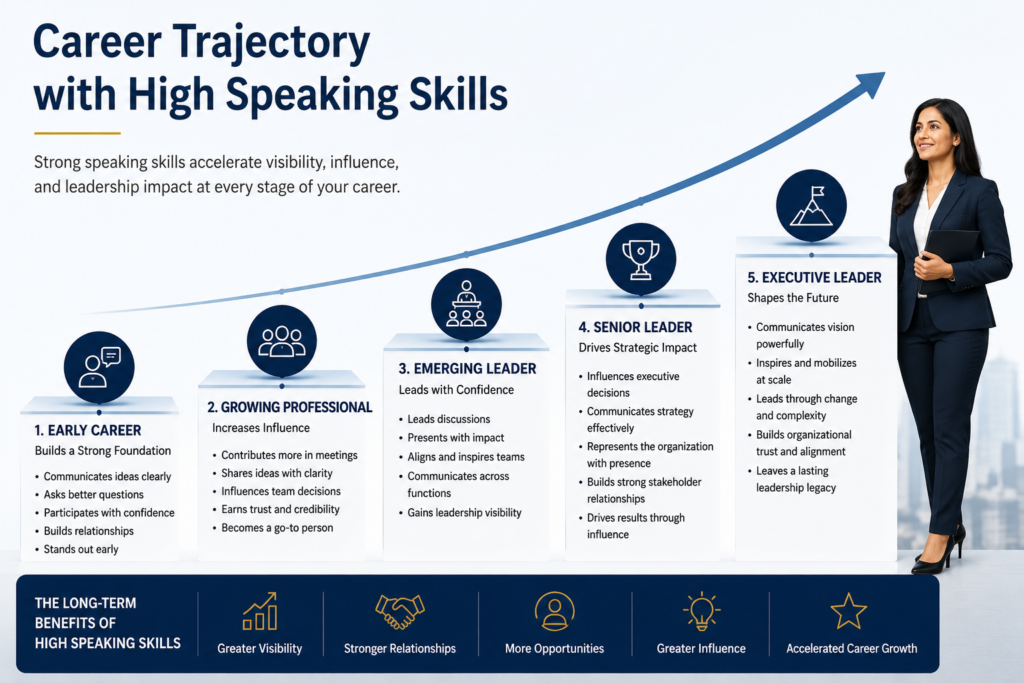
After more than 25 years delivering presentation and communication skills training, we have consistently seen stronger speaking skills increase confidence, visibility, influence, and leadership perception. As careers progress, communication becomes more than a supporting skill. It becomes a core leadership capability.
Key Takeaways
- Speaking skills increasingly affect leadership growth and professional visibility
- Subject matter experts often struggle to communicate expertise clearly under pressure
- Strong communication improves influence, contribution, and stakeholder confidence
- Professionals who communicate clearly are often perceived as more leadership-ready
- Improved speaking skills frequently lead to greater participation and career opportunity
- Communication confidence develops through structure, awareness, coaching, and repetition
Why Speaking Skills Become More Important as Careers Advance

Early in many careers, success is primarily tied to individual performance. Professionals are evaluated based on technical execution, analytical ability, productivity, and expertise within a specific function. Communication still matters, but it may not yet feel central to advancement.
Over time, however, professional expectations shift. As professionals move into leadership roles or positions with greater organizational visibility, communication becomes increasingly important because responsibilities become more collaborative and influence-based. Professionals are expected not only to perform work well, but also to guide discussions, influence decisions, explain complex ideas clearly, create alignment, build trust, communicate across teams, and support organizational priorities.
One challenge we frequently see is that many subject matter experts are exceptionally knowledgeable but have never received structured development around communication itself. They may understand highly complex material but struggle to simplify information, communicate concisely, organize ideas verbally, respond clearly in real time, and adjust communication to different audiences. This becomes especially noticeable during leadership meetings, executive presentations, cross-functional discussions, stakeholder conversations, difficult conversations, and impromptu speaking situations where communication must happen quickly and clearly under pressure.
Research on leadership communication and organizational influence consistently shows that effective leadership communication is heavily connected to listening, alignment, and audience understanding rather than simply delivering information. This research on active listening and leadership communication from Ivey Business School explores how listening, audience awareness, and communication responsiveness contribute to stronger leadership communication and organizational influence.
One pattern we frequently observe is that professionals often mistake communication for information transfer. In reality, leadership communication is usually about clarity, alignment, trust, and audience understanding. Professionals who communicate effectively are often perceived as more organized, more confident, more strategic, more leadership-ready, and more capable under pressure. In many organizations, communication becomes one of the primary ways leadership capability is evaluated.
Why Strong Speaking Skills Accelerate Career Growth
Communication affects career progression in both direct and indirect ways. Directly, professionals who communicate clearly are often more effective during presentations, meetings, interviews, leadership discussions, stakeholder conversations, and client-facing situations. Indirectly, strong communication changes how professionals are experienced by others inside the organization.
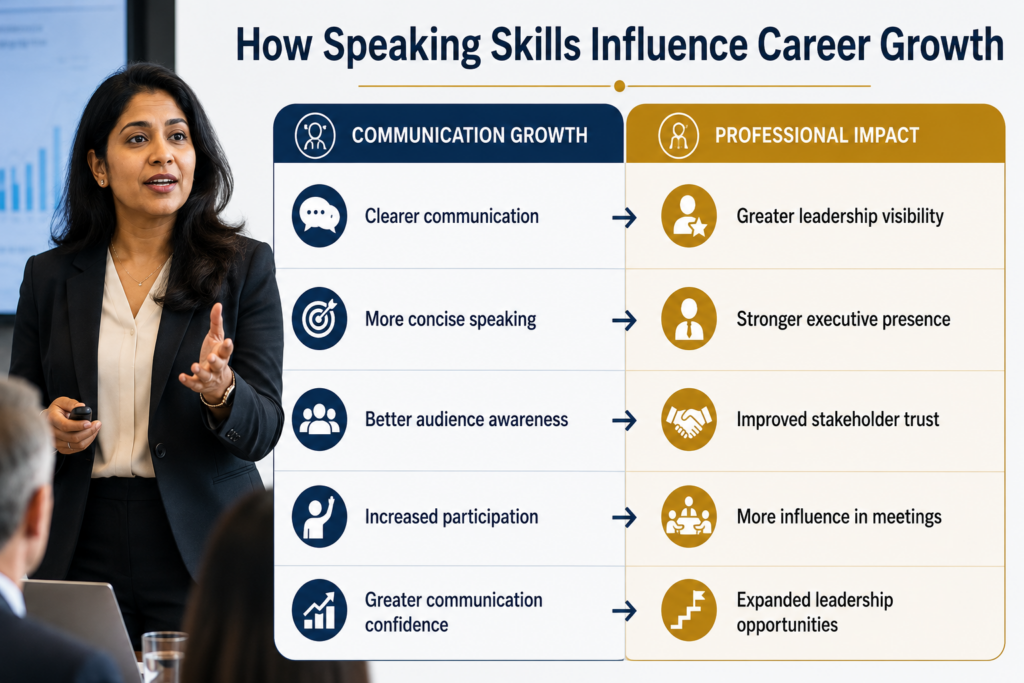
One challenge we frequently see is that highly capable professionals sometimes remain less visible because they contribute less frequently during meetings or avoid high-visibility communication situations altogether. Over time, this can create a disconnect between actual expertise and perceived influence. Professionals who improve speaking skills often begin participating more actively, communicating ideas earlier in discussions, contributing more strategically, influencing conversations instead of reacting to them, and becoming more comfortable speaking under pressure. That increased visibility frequently creates new leadership opportunities.
Research on communication confidence and leadership perception also shows that confidence and credibility are often strongly connected to how clearly and calmly professionals communicate during workplace interaction. This research on confidence and leadership perception from Harvard Business Review explores how communication style, composure, and executive presence influence leadership perception and professional credibility.
Many professionals experience a significant increase in confidence once they feel more in control of how they communicate. One challenge we frequently see is that professionals often avoid speaking situations because they fear sounding unintelligent, losing their train of thought, being challenged publicly, overexplaining, freezing during questions, or not communicating clearly enough. As communication structure and speaking confidence improve, those situations often become less stressful and more manageable.
This creates a compounding effect. Professionals begin speaking more frequently, which creates greater confidence, stronger communication habits, increased visibility, more influence, stronger relationships, and better leadership presence. Over time, this often changes professional trajectory significantly. One of the biggest long-term shifts we frequently observe is that professionals stop viewing communication as a stressful obligation and begin seeing it as a leadership tool. That mindset change is extremely important.
Why Speaking Skills Improve Leadership Effectiveness
Strong communication does more than improve presentations. It improves how professionals lead. Leaders spend a significant portion of their time communicating priorities, decisions, expectations, feedback, direction, strategy, and organizational change. The quality of those conversations often affects team alignment, engagement, trust, and execution.
One challenge we frequently see is that many professionals attempt to communicate leadership through authority or expertise alone. In practice, leadership communication is usually more effective when it is clear, concise, audience-aware, structured, and calm under pressure. Strong speaking skills help leaders simplify complexity, communicate direction more clearly, manage difficult conversations more effectively, build stronger stakeholder confidence, improve meeting effectiveness, and create greater organizational alignment.
Research on communication clarity and workplace effectiveness continues to show that audiences retain and process information more effectively when communication is structured clearly and delivered with reduced cognitive overload. American Psychological Association research on learning and memory
This is particularly important for people leaders and subject matter experts who operate in high-stakes environments where communication directly affects decision-making, collaboration, leadership perception, and organizational trust. One pattern we frequently observe in workshops is that professionals often become significantly more effective leaders once they improve concise communication and audience awareness. Instead of trying to communicate everything they know, they begin communicating what matters most. That shift changes how people experience them professionally.
By the second day of workshops and executive coaching sessions, professionals often become more concise, more composed, more strategic in conversations, more comfortable contributing during meetings, more effective in executive discussions, and more confident leading conversations. Long-term growth, however, happens through continued application. Professionals improve most when they continue finding opportunities to contribute during meetings, lead discussions, present ideas, communicate strategically, and practice concise communication regularly. Like leadership itself, communication is developed through repetition, feedback, and practical experience.
For professionals looking to strengthen leadership communication, executive presence, stakeholder communication, and speaking effectiveness in workplace situations, our Executive Coaching and Presentation Skills Training programs focus heavily on structured communication, leadership-level speaking situations, audience awareness, concise messaging, and practical real-world application.
Frequently Asked Questions
Why do speaking skills matter for career growth?
Speaking skills affect leadership visibility, communication effectiveness, stakeholder confidence, and organizational influence. As careers advance, professionals are increasingly evaluated on how effectively they communicate ideas and lead discussions.
Why do subject matter experts struggle with communication?
Many subject matter experts are trained heavily in technical expertise but receive little structured communication development. This can make it difficult to simplify information, communicate concisely, and respond clearly under pressure.
How do speaking skills improve leadership effectiveness?
Strong speaking skills help leaders communicate direction clearly, influence discussions, manage stakeholder relationships, and build trust more effectively across teams and organizations.
Can improving communication really accelerate career growth?
Yes. Professionals who communicate clearly and confidently are often perceived as more leadership-ready, more strategic, and more capable in high-visibility situations. We offer a range of specialized communication and presentation training programs, including Presentation Skills Training, Communication Skills Training, and Executive Communication Coaching programs across Canada and the United States.
Why does communication confidence improve with practice?
Communication confidence improves through repetition, structure, coaching, and real-world speaking experience. As professionals gain more control over how they communicate, pressure and uncertainty often decrease significantly.
Conclusion
Speaking skills affect far more than presentations alone. They influence leadership growth, organizational visibility, stakeholder confidence, relationship quality, and professional opportunities throughout a person’s career. As professionals advance into more senior roles, they are increasingly expected not only to possess expertise, but also to communicate that expertise clearly, strategically, and confidently in high-stakes situations. Whether leading meetings, presenting recommendations, influencing decisions, or navigating difficult conversations, communication becomes one of the primary ways leadership capability is demonstrated and evaluated.
Professionals who strengthen their speaking skills often become more influential, more visible, and more effective leaders because communication shapes how ideas are understood, trusted, and acted upon within organizations. Strong communication helps professionals build credibility, create alignment, and guide conversations toward productive outcomes. In today’s workplace, communication is no longer simply a supporting professional skill. It has become a core leadership capability that directly influences career growth, executive presence, and the ability to create meaningful impact across teams and organizations.