

Hybrid work has changed how leaders show up. Executives and senior managers must now lead people who are partly in the room and partly on screen, often at the same time.
This has made executive presence more visible and more dependent on communication. In the past, proximity, informal conversations, and reading the room helped leaders build credibility. In hybrid settings, influence relies more heavily on communicating clearly, confidently, and consistently across both environments.
After working with L&D and HR teams for the past 25 years, a common challenge we see is developing leaders who can maintain the same level of presence in person and virtually. Executive presence must translate across every format.
Key Takeaways
- Executive presence in hybrid leadership depends on clear, confident, and consistent communication.
- Leaders must engage remote and in-person participants equally.
- Strong presentation skills help leaders maintain attention, structure discussions, and respond effectively under pressure.
- Virtual training allows leaders to practise in the same environments where they communicate every day.
- Shared communication frameworks create greater consistency across leadership teams.
What Executive Presence Looks Like in a Hybrid Environment
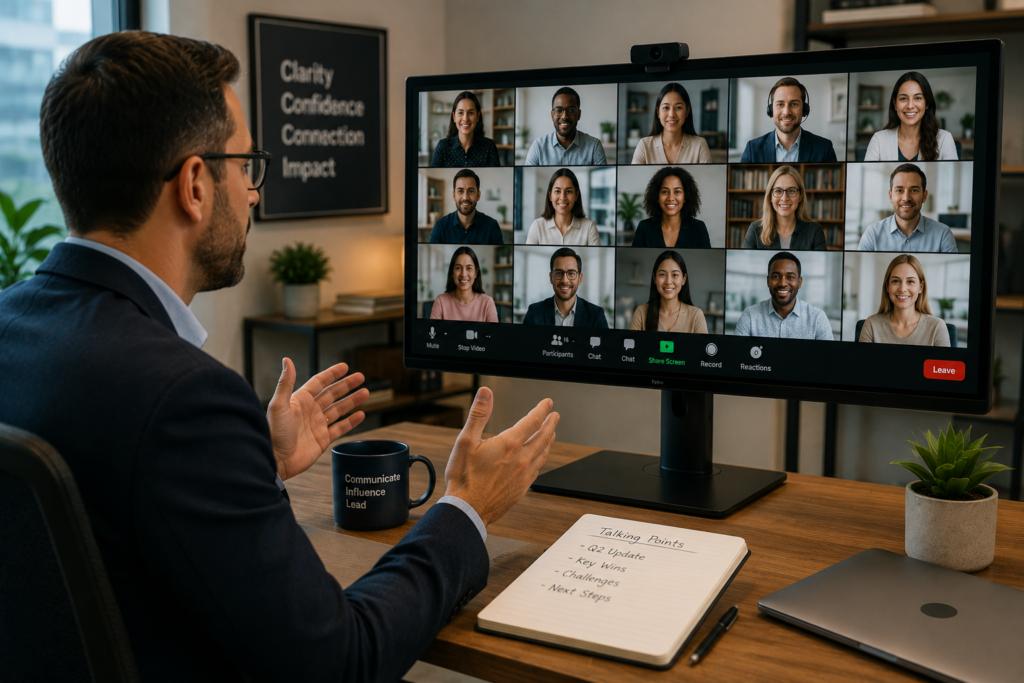
In a hybrid setting, executive presence is less about style and more about intentional communication. Leaders need to create clarity, maintain engagement, and guide conversations across different formats, sometimes within the same meeting. That requires a different level of awareness and control.
Effective hybrid leaders typically:
- communicate clearly in both live and virtual settings
- engage remote and in-person participants equally
- adjust messaging based on the audience and environment
- project confidence without overpowering the conversation
This becomes especially important in hybrid meetings, where leaders are effectively managing two audiences at once. Without a deliberate approach, one group often receives more attention than the other.
Where Things Start to Break Down
When executive presence doesn’t translate well across hybrid environments, the impact is noticeable. Remote participants may disengage because they feel less included in the conversation. Messages may become less clear if leaders are not structuring communication intentionally. Over time, confidence in leadership direction can begin to weaken.
There can also be inconsistency across leadership teams. Some leaders may be strong in person but less effective on video. Others may communicate well virtually but struggle to command attention in a physical room. For L&D and HR teams, these challenges often surface through leadership feedback, engagement surveys, and performance discussions. They are not always framed as communication issues, but communication is often the root cause.
Why Presentation Skills Matter More Than Ever
In a hybrid environment, presentation skills are no longer limited to formal presentations. Leaders are presenting constantly. They are presenting in team meetings, strategy updates, stakeholder discussions, and one-on-one conversations. Each of these moments requires clarity, structure, and the ability to engage the audience.
Strong presentation skills help leaders:
- organize their thinking clearly
- maintain audience attention without overrelying on slides
- read both in-room and remote audiences simultaneously
- respond to questions without losing structure
Without focused development, even experienced leaders can struggle to maintain that level of presence consistently across different formats.
Why Hybrid Environments Raise the Bar
Hybrid meetings introduce challenges that do not exist in fully in-person settings. Attention is split. Some participants are physically present, while others are joining remotely. Side conversations may happen in the room that remote participants cannot hear. Virtual attendees may hesitate to contribute, especially if the conversation lacks structure.
Leaders need to actively manage these dynamics. That includes being intentional about how they bring people into the conversation, how they pace discussions, and how they ensure key points are communicated clearly to everyone, not just those physically present. Without that level of control, engagement and clarity begin to decline.
The Role of Virtual Training in Building These Skills
One of the most effective ways to develop executive presence in a hybrid world is to train leaders in the same environment where they are expected to perform. Virtual training provides that opportunity.
It allows leaders to practice communicating through a screen, managing attention remotely, and adapting delivery in real time. It also creates a space where they can receive direct feedback on how they are coming across in a format that closely mirrors their day-to-day work. When done well, virtual training is not a compromise. It is a direct way to build the skills hybrid leadership requires.
Virtual training also provides practical advantages for L&D teams. It supports consistency across regions, easier scheduling for distributed teams, and the ability to scale development efforts without sacrificing quality.
Building Consistency Across Leadership Teams
One of the biggest challenges in hybrid organizations is inconsistency. Different leaders develop different communication styles based on their comfort level and experience. Over time, this can create uneven expectations and experiences across teams. Some meetings feel clear and well-led, while others feel unfocused or difficult to follow.
Establishing a consistent communication approach helps address this. When leaders share a common framework for how they structure messages, run meetings, and engage their audience, it becomes easier for teams to align and operate effectively. This consistency becomes even more important in hybrid environments, where clarity must come through regardless of format.
Why This Is Becoming a Strategic Priority
Executive presence in a hybrid world is no longer a “nice to have.” It directly impacts how leaders are perceived, how teams engage, and how effectively work gets done. When leaders communicate clearly and confidently, alignment improves and decisions move faster. When they do not, even strong strategies can lose momentum because they are not being communicated effectively.
For L&D and HR teams, this makes executive presence a strategic capability. Investing in it supports current leaders while also preparing the next generation to operate effectively in a hybrid environment.
A More Practical Way to Think About Executive Presence
At its core, executive presence in a hybrid setting comes down to clarity and control. Clarity in how messages are structured and delivered. Control in how conversations are guided and how different audiences are engaged.
When leaders develop these capabilities, they are able to show up consistently regardless of format. They do not rely on the room to carry their presence. They create it through how they communicate. And in a hybrid world, that is what makes the difference.
For organizations and professionals looking to strengthen communication, executive presence, and leadership effectiveness remotely, we offer live, coach-led virtual programs including Presentation Skills Training and Communication Skills Training through our Instructor-Led Virtual Workshops. These interactive virtual sessions are designed to help professionals communicate with greater clarity, confidence, structure, and audience awareness during meetings, presentations, leadership discussions, and high-pressure workplace communication situations.