

Virtual communication is now a permanent part of leadership, collaboration, meetings, and decision-making. This shift has changed how professionals establish credibility, influence, and executive presence.
In our workshops, we often see capable professionals struggle to project the same confidence and clarity online that they demonstrate in person. Virtual environments offer fewer physical cues, while distractions and multitasking make audience engagement harder.
After more than 25 years of coaching, we have found that professionals who communicate virtually with greater clarity, structure, and confidence are often perceived as more credible and leadership-ready. Their communication also improves meetings, collaboration, stakeholder alignment, and visibility across hybrid organizations.
Key Takeaways
- Virtual communication environments create different communication challenges than in-person interaction
- Strong virtual presentation skills improve leadership presence, audience engagement, communication clarity, and meeting effectiveness
- Professionals who communicate confidently and naturally virtually are often perceived as more credible, organized, and influential
Why Virtual Communication Raises the Bar
One of the biggest misconceptions about virtual communication is that it should feel easier because professionals are speaking from familiar environments.
In reality, virtual communication is often more demanding psychologically and cognitively than in-person interaction.
For additional insights into digital communication fatigue and attention processing, see this research on videoconference fatigue and communication overload from researchers published through the U.S. National Library of Medicine. The research explores how frequent videoconferencing can contribute to communication overload, information overload, reduced attention, and virtual meeting fatigue, all of which can affect communication effectiveness in digital workplace environments.
Virtual environments reduce many of the natural communication cues people rely on instinctively during in-person interaction. Eye contact feels less natural. Audience reactions are harder to interpret. Energy feedback is limited. Delays interrupt conversational rhythm. Participants may also be distracted by notifications, multitasking, or competing meetings happening simultaneously.
One challenge we frequently observe is that professionals often mistake virtual communication for simply “presenting online.” In reality, effective virtual communication requires a different communication approach altogether.
For example, many professionals unknowingly lower their energy level significantly on camera. Without a live audience physically in front of them, delivery often becomes flatter, slower, or more scripted. While this may feel normal to the speaker, audiences frequently perceive it as lower confidence or lower engagement.
Another common issue involves overreliance on slides.
One workshop observation we frequently see is that professionals often use slides to compensate for reduced confidence virtually. Instead of supporting communication, slides begin replacing communication structure entirely. Presenters may read directly from content or rely heavily on visual information because they feel less comfortable communicating conversationally through the camera itself.
This reduces audience engagement quickly.
For additional insights into cognitive overload and virtual information processing, see research on multitasking, attention, and cognitive performance from the American Psychological Association, which explores how multitasking affects attention, information processing, memory, and communication effectiveness. These challenges are particularly relevant in virtual environments where professionals are often required to process multiple streams of information simultaneously while participating in meetings and discussions.
Virtual audiences process information differently than in-person audiences. Because distractions are higher and attention is fragmented more easily, communication needs to become clearer, shorter, and more structured.
When virtual communication lacks structure, audiences disengage quickly.
This is one reason concise communication has become increasingly important in hybrid and remote work environments.
Another important shift involves communication pacing.
One challenge we frequently observe is that many professionals communicate too quickly virtually because silence feels uncomfortable online. As a result, presenters may unintentionally overwhelm audiences with information while reducing opportunities for processing and engagement.
Strong virtual communicators understand how to slow down strategically, pause intentionally, and create conversational rhythm even in digital environments.
This significantly improves audience retention and engagement.
The Communication Challenges Organizations Are Seeing
One pattern we frequently observe during instructor-led virtual workshops is that many professionals sound far less natural virtually than they do in person.
Communication often becomes overly formal, overly scripted, too detailed, low energy, less conversational, and less audience-focused.
This is particularly common among professionals who are highly knowledgeable but less experienced communicating through digital environments.
Another major challenge involves eye contact.
In virtual communication, eye contact works differently than in person. Many professionals focus on their own image, presentation slides, or participant windows rather than the camera itself. As a result, audiences often experience weaker connection and lower engagement even when the speaker is highly knowledgeable.
One challenge many organizations are noticing is that multitasking audiences create additional communication pressure. Virtual presenters are no longer competing only for attention within the meeting itself. They are competing against emails, messages, notifications, calendars, and other distractions simultaneously.
This raises the importance of communication delivery significantly.
One workshop observation we frequently see is that professionals often struggle to “read the room” virtually. In-person environments provide immediate feedback through posture, facial expression, attention, and group energy. Virtually, these signals are weaker or sometimes completely absent.
This uncertainty can increase nervousness and reduce communication confidence.
Another important issue involves structure.
Without strong communication structure, virtual updates and presentations often become longer and less focused. Professionals may ramble, overexplain, or lose clarity because they are attempting to compensate for limited audience feedback.
Over time, this affects meeting quality and engagement across organizations.
For additional insights into virtual meeting fatigue and attention management, see this research on videoconference fatigue and communication overload from the U.S. National Library of Medicine, which explores how prolonged videoconferencing can increase cognitive load, reduce attention, and contribute to communication fatigue in digital workplace environments.
One pattern we frequently observe is that professionals often underestimate how much delivery style affects virtual communication outcomes. In person, natural room energy can sometimes compensate for weaker delivery habits. Virtually, however, low vocal variation, weak pacing, poor camera engagement, and overly scripted communication become much more noticeable.
As a result, audiences disengage more quickly.
How Strong Virtual Presentation Skills Improve Leadership Presence
Virtual presentation skills are not only about presenting information clearly.
They directly affect leadership presence.
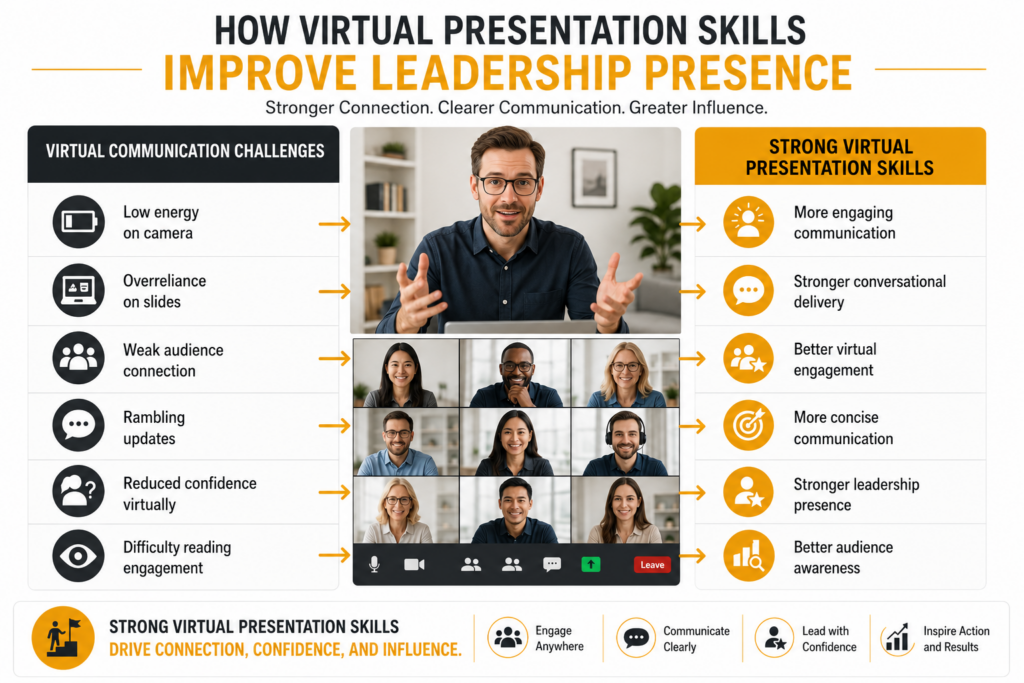
Professionals who communicate effectively virtually often appear calmer, more organized, more strategic, and more credible during meetings and discussions. Their communication tends to feel more intentional because they structure ideas clearly, engage audiences more naturally, and maintain stronger conversational energy.
One shift we frequently observe after training is that professionals begin communicating more conversationally rather than “performing” virtually. This immediately improves audience connection.
Another major improvement often involves confidence.
Many professionals initially believe they have a confidence problem when in reality they have a communication structure problem. Once individuals develop stronger structure, pacing, audience engagement, and delivery habits, confidence often improves naturally.
This becomes especially noticeable during leadership briefings, client presentations, executive discussions, virtual Q&A sessions, and high-stakes meetings.
Clients frequently report that after virtual presentation training:
- communication becomes clearer and more concise
- participation improves during meetings
- virtual engagement increases significantly
- leaders appear more confident on camera
- meetings become more productive
- teams communicate more consistently across regions
Another important shift involves visibility.
In hybrid organizations, communication quality increasingly affects who gets noticed organizationally. Professionals who communicate clearly and confidently virtually often become more visible because their ideas are easier to understand, follow, and remember.
Another major benefit involves stronger audience engagement.
When professionals communicate with greater structure, stronger delivery, and better pacing, audiences become significantly more attentive and responsive during virtual interaction. This improves collaboration, meeting quality, and overall communication effectiveness across teams.
For organizations looking to strengthen communication effectiveness across distributed teams, our Instructor-Led Virtual Workshops focus heavily on audience engagement, virtual executive presence, communication structure, concise delivery, camera confidence, and real-time interaction skills designed specifically for modern hybrid workplaces.
Frequently Asked Questions
Why are virtual presentation skills more important now?
Virtual and hybrid communication environments have become permanent parts of modern work, making clear and engaging communication increasingly important for leadership visibility and collaboration.
Why do professionals often struggle more virtually?
Virtual environments reduce natural communication cues and increase distractions, making audience engagement, confidence, and structure more difficult to maintain.
How do virtual presentation skills improve leadership presence?
Strong virtual communication improves clarity, audience engagement, confidence, credibility, and how professionals are perceived during meetings and presentations.
Why do virtual meetings often feel less engaging?
Many virtual presentations rely too heavily on slides, lack conversational delivery, and do not adapt effectively to shorter digital attention spans.
Conclusion
Virtual communication has fundamentally changed how professionals are seen, heard, and evaluated inside organizations.
Today, presentation skills extend far beyond formal presentations. They influence how professionals contribute during meetings, lead discussions, communicate ideas, engage stakeholders, and establish credibility through screens every day.
As hybrid and distributed work environments continue evolving, organizations are increasingly recognizing that virtual communication capability directly affects collaboration quality, leadership visibility, meeting effectiveness, and organizational performance.
Professionals who communicate effectively virtually often become more influential because they create stronger engagement, clearer alignment, and more confidence during interaction. Their communication feels more natural, more structured, and more audience-focused even in highly digital environments.
And in many workplaces, the professionals who communicate most effectively virtually are often the ones whose ideas gain the greatest traction.
For organizations and professionals looking to strengthen communication, executive presence, and leadership effectiveness remotely, we offer live, coach-led virtual programs including Presentation Skills Training and Communication Skills Training through our Instructor-Led Virtual Workshops. These interactive virtual sessions are designed to help professionals communicate with greater clarity, confidence, structure, and audience awareness during meetings, presentations, leadership discussions, and high-pressure workplace communication situations.